Key Takeaways
- Real-time simulation and hardware-in-the-loop (HIL) simulation shift high risk testing away from fragile hardware, so teams catch control and integration issues earlier and protect expensive prototypes.
- OEM prototyping costs fall when hardware iterations are fewer and more purposeful, with digital twins and scalable HIL benches taking on the bulk of design exploration, controller tuning, and fault studies.
- Embedded system testing becomes a continuous practice instead of a late milestone, as real-time feedback loops connect controllers to accurate plant models and support automated, repeatable scenario campaigns.
- Multi-disciplinary teams gain a shared simulation space for power electronics, controls, and grid engineers, which reduces misalignment, shortens design-to-validation timelines, and improves confidence in release decisions.
- Engineers who track metrics such as prototype build count, lab hours, issue discovery stage, and field failure cost can clearly quantify how real-time and HIL testing improve reliability and lower overall project spend.
You can spend less on hardware prototypes and still trust your design decisions when real-time simulation sits at the centre of your workflow. For many teams, the pain is simple and familiar: every new converter, inverter, or drive control platform comes with boards that burn out, test rigs that sit idle, and budgets that feel tighter than the specification allows. Engineers pour effort into beautiful prototypes, then watch them age on a lab shelf after one or two harsh test campaigns. Real-time simulation changes that pattern by shifting risk, learning, and iteration into a space where you control the pace and cost.
Teams working on OEM prototyping for drives, renewables, transport, or industrial systems feel intense pressure to deliver more validation on fewer hardware builds. Lab time is expensive, specialised components have long lead times, and every redesign pulls senior engineers away from innovation and teaching younger colleagues. Real-time simulation, combined with hardware-in-the-loop (HIL) simulation and high-fidelity digital twins, lets you explore high risk scenarios, validate controls, and refine system architecture long before the full prototype is ready. That shift is not just about comfort, because it feeds directly into shorter schedules, fewer surprises, and a clearer story when you need to justify investment in better tools.
Why reducing prototype costs is a critical challenge for OEM development
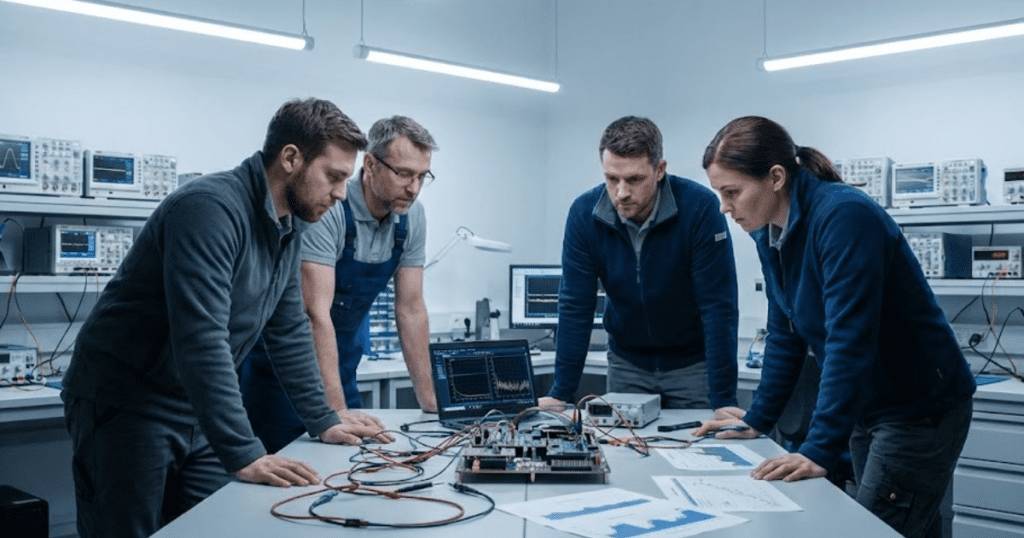
Original equipment manufacturers depend on physical prototypes to prove converter, inverter, and drive designs under electrical and mechanical stress. That dependence carries a direct price in materials, power stages, instrumentation, and safety infrastructure, plus an indirect price in schedule risk when parts arrive late or fail during testing. Once you factor in highly skilled engineering time, a single prototype iteration can represent weeks of effort and a sizeable portion of a yearly project budget. Many teams also need separate builds for hardware bring up, control tuning, compliance, and customer demonstrations, so costs multiply even before the first production unit ships.
Engineers responsible for OEM prototyping are often caught between ambitious performance targets and strict cost limits set by leadership and end clients. A control bug that slips into a hardware campaign can destroy silicon, damage test fixtures, or require a complete redesign of the control board or power stage. That kind of setback hits more than the project ledger, because it also erodes trust in new ideas and slows down collaboration across control, power electronics, and software teams. Real-time simulation gives those engineers a way to keep hardware iterations under control while still pushing for aggressive performance, reliability, and feature sets.
How HIL simulation improves early validation and system reliability
Hardware-in-the-loop (HIL) simulation connects actual control hardware to a real-time numerical model of the plant so you can test closed loop behaviour under thousands of conditions without waiting for the complete prototype. Engineers route the controller inputs and outputs through the simulator, which acts like a digital twin of the power stage, grid connection, motor, or other equipment under study. This setup lets you validate control algorithms, protection logic, and communications early in the project, when changes are cheaper and less disruptive. Many organisations use HIL simulation to validate embedded control units for vehicles, aircraft, industrial systems, and power electronics with high coverage and repeatability.
Early validation in a HIL setup improves system reliability because you can exercise fault cases, noisy sensors, and extreme operating conditions without putting hardware, people, or facilities at risk. Studies on HIL simulation point out that this approach reduces debugging effort, avoids damage to expensive prototypes, and lowers overall testing cost for complex industrial systems Continuous, automated test campaigns on a HIL bench also keep regression coverage high, which means each software update or control tweak arrives with stronger evidence behind it. As a result, physical prototypes shift from being the primary discovery tool to a final confirmation stage, where surprises are rare and safety margins are better understood.
7 ways real-time simulation reduces prototyping costs
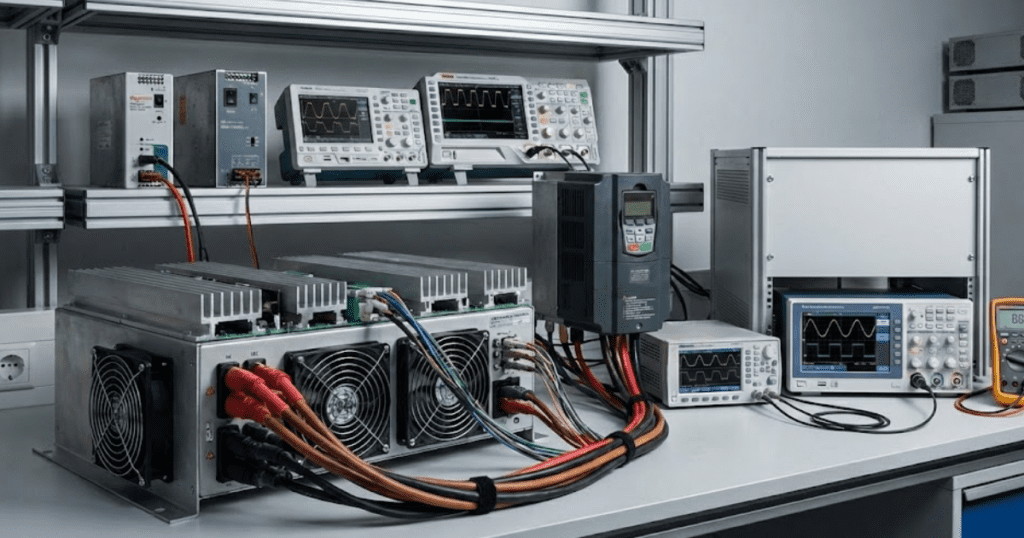
Real-time simulation reduces prototype spend by attacking the sources of waste that hide in complex development programmes. Rather than asking every question with copper, silicon, and steel, engineers can answer many of them with models that run fast enough to sit in the validation loop. That shift changes how teams think about risk, because issues that once showed up as burnt boards or failed acceptance tests now appear as waveforms and logs. Cost reduction follows naturally from that change, yet it also improves how engineers share insight across projects and generations of platforms.
“You can spend less on hardware prototypes and still trust your design decisions when real-time simulation sits at the centre of your workflow.”
1. Minimizing hardware rework through accurate model-based testing
Hardware rework often comes from surprises that appear only when a new control board meets a high energy power stage. Subtle timing errors, sensor conditioning issues, or underestimated margins can show up as overcurrent events, thermal stress, or oscillations that damage components and trigger redesigns. Real-time simulation changes the story by allowing you to connect digital control models to detailed power stage models and run them under realistic timing and switching conditions before you cut metal or order boards. Engineers can iterate on control gains, signal conditioning, and protection thresholds while watching every waveform, so they enter lab bring up with fewer unknowns and fewer hidden traps.
Accurate model-based testing also helps hardware teams lock down specifications earlier. When you know how the control logic behaves across voltage, current, and temperature ranges in the simulator, you can specify ratings for gate drivers, current sensors, and thermal interfaces with much greater confidence. That clarity reduces the need for conservative overdesign and cuts down on costly layout spins that exist only to recover safety margins. Over several projects, this discipline shows up as fewer urgent board revisions, more predictable schedules, and better use of specialist layout and test resources.
2. Detecting control issues earlier with real-time feedback loops
Control software sits at the centre of most modern power converters, drives, and protection schemes, yet many teams still wait until late in the project to run it against realistic conditions. Without real-time feedback, embedded control code may look fine in unit tests and basic simulations while hiding race conditions, misaligned filters, or numerical issues that only appear under rapid transients. A real-time simulator that exchanges inputs and outputs with the controller at target cycle times creates a closed loop that exposes those issues far earlier. That early view gives the software and control teams room to adjust architectures, state machines, and numerical methods before a single prototype is stressed on the bench.
This approach turns embedded system testing into an ongoing practice rather than a late milestone. Automated test suites can reuse the real-time setup to exercise corner cases such as grid faults, load surges, sensor dropouts, and communication delays through long campaigns, including overnight runs that would be impractical with physical hardware alone. Results feed straight into issue trackers and design reviews, which makes the impact of each software fix visible and quantifiable. Over time, teams see fewer control surprises during hardware bring up and a smoother path through compliance, customer validation, and field trials.
3. Shortening design-to-validation timelines for embedded systems
Real-time simulation shortens timelines because it connects modelling, embedded system testing, and HIL simulation into a continuous loop. Control engineers start with offline models to explore algorithms, then move those models into a real-time context where they interact with actual processors and I/O interfaces. That progression avoids the pause that often occurs while teams wait for full prototypes or lab slots, since meaningful validation can continue on the simulator. Schedule risk from part shortages or late mechanical assemblies shrinks, because control validation and system studies stay active even when hardware is not yet complete.
Validation teams also benefit from reusable test cases that span multiple development stages. A scenario that starts life as a model-in-the-loop simulation can be reused as software-in-the-loop and HIL test cases by pointing the same stimuli and expected results at different targets. That reuse keeps requirements, test descriptions, and acceptance criteria consistent while trimming the time spent re-writing test scripts for each phase. Shorter time from design to reliable validation means less money tied up in long programmes and more capacity for engineers to tackle ambitious control strategies or new product variants.
4. Reducing physical prototype iterations with digital twins and HIL
Every additional hardware build represents extra spend on materials, manufacturing, and lab time, so reducing the number of builds is one of the most direct ways to cut prototyping cost. High fidelity digital twins of the power stage, grid connection, or machine help engineers refine design choices before committing to the next revision. When those twins run in real time as part of a HIL simulation setup, the team can test entire control stacks, protection logic, and communication paths under realistic loading, fault, and interaction patterns. That depth of insight means the next hardware spin targets known gaps instead of acting as a broad experiment that tries to answer too many questions at once.
Many projects see a shift toward fewer, more purposeful prototypes when teams take this approach. Early builds focus on mechanical integration and basic power stage performance, while later builds focus on validating final firmware on hardware that has already been exercised extensively in the simulator. Sections of the HIL setup, such as fault injection logic or scenario libraries, can be reused across multiple product lines, which spreads their investment over time. As a result, each physical prototype delivers more learning per dollar, and the organisation can reserve hardware spend for the moments when it matters most.
5. Improving converter and drive testing through scalable simulation setups
Power converter and drive testing brings unique challenges, because high power levels, switching frequencies, and mechanical couplings make some scenarios hard or risky to reproduce with full hardware. Real-time simulation opens up a safer way to exercise these systems at scale, from single motor drives to multi-axis test benches for industrial automation or electric transport platforms. Engineers can construct simulation setups that mirror whole fleets of drives, complete with line disturbances, unbalanced loads, and faulted components, then connect one or more controllers to that virtual plant. That approach lets software teams and control specialists stress gating patterns, current regulators, and speed or torque loops under conditions that would be impractical or too destructive with hardware alone.
Scalable simulation also promotes reuse of test setups across projects. A drive HIL bench that starts life validating one motor control platform can often be reconfigured through software and interface panels to support later generations or variants, with only modest changes to the simulated plant model. Consistent stimuli, fault libraries, and data logging scripts help teams compare behaviour across platforms and supplier options without rebuilding every rig. Over time, that reuse trims bring up cost for new converters and drives, and gives technical leaders a clear audit trail of how each platform behaved during pre-production validation.
6. Supporting multi-disciplinary collaboration without full hardware builds
Modern power and industrial systems sit at the intersection of power electronics, control software, communication networks, and grid or plant engineering, so collaboration across those disciplines is essential. Full hardware builds are often too scarce and too expensive to serve every team that needs insight, which leads to long queues and fragmented understanding. Real-time simulation provides a shared reference point that different specialists can use at different stages, without needing exclusive access to a prototype. Protection engineers can study grid faults, control engineers can tune regulators, and system architects can explore operating strategies, all against the same set of models and scenarios.
This shared simulation space helps teams align assumptions before integration and reduces late stage disagreements about what the system should do under stress. Model repositories, HIL configurations, and test reports become artefacts that everyone can inspect, challenge, and refine in a controlled way. That clarity also helps new team members, graduate students, or external partners ramp up without waiting months for a slot on a physical test bench. Internal alignment of this kind reduces costly rework, supports smoother acceptance testing, and strengthens confidence when projects reach senior reviewers or external stakeholders.
7. Extending prototype lifespan through reusable simulation architectures
HIL benches and real-time models are not just tools for a single project, because they can form a simulation architecture that serves several generations of prototypes. Engineers can design interface panels, signal conditioning paths, and software configuration schemes that make it easy to swap controllers, update plant models, or change communications stacks. With that kind of modular structure in place, a prototype that once had a short, intense test campaign can support many rounds of controller updates, customer-specific configurations, and long term reliability studies. The physical hardware works as a flexible anchor for experiments instead of a one-off expense that loses relevance after the first design cycle.
This longer lifespan matters because it changes how teams plan investment in both prototypes and simulation infrastructure. Rather than funding each HIL bench as a bespoke project cost, some organisations start to treat these assets as shared capability that will support future platforms. That mindset makes it easier to justify higher fidelity models, richer fault injection tools, and better data pipelines, since the savings spread across many launches. As those practices mature, organisations see fewer duplicated test rigs, less scrap hardware, and a clearer link between early engineering effort and long term cost control.
Cost pressure on prototyping will only increase as electrification, software complexity, and regulatory expectations grow. Real-time simulation gives engineers a practical way to respond, because it shifts high risk exploration from fragile hardware into controllable, repeatable digital setups. Teams that commit to this approach invest more effort up front in models and test benches, yet they recover that time and budget through fewer failed tests, fewer emergency redesigns, and shorter lab campaigns. Over time, this discipline builds a durable technical advantage, with prototypes that last longer, go through fewer painful iterations, and reach the field with far fewer surprises.
How engineers quantify savings from real-time and HIL testing
Engineers who own budgets and schedules need more than anecdotes when they argue for real-time simulation or HIL benches. Clear, repeatable metrics show how prototype costs change as workflows improve, and they give technical teams a shared language with finance and leadership. Good metrics focus on money, time, and risk, not just on abstract notions of model quality. When these indicators are tracked across several projects, the savings from HIL simulation and real-time testing stop being a promise and start looking like measured performance.
- Prototype build count per project: Track how many distinct prototype builds you create for each product generation and separate them by purpose, such as bring up, design fix, or customer demo. A healthy trend after adopting real-time simulation is fewer builds overall, with a stronger share allocated to final confirmation and customer-facing work.
- Lab hours per prototype: Measure total engineering and technician hours spent on lab testing for each main prototype. Compare that number for projects before and after HIL adoption to show how much work shifts into automated or simulated runs.
- Issue discovery stage: Categorise significant defects by the stage where they were first detected, such as model-only studies, HIL, lab prototype, or field use. The goal is to see more high impact issues discovered during simulation or HIL testing, with fewer first appearing on costly prototypes.
- Test scenario coverage: Count how many distinct operating scenarios, fault cases, and endurance runs the team executes per project, including those carried out only on the simulator. Rising coverage paired with stable or lower prototype cost indicates that real-time simulation is doing its job without inflating the lab budget.
- Equipment damage and safety events: Log any damaged prototypes, failed test fixtures, or safety near misses associated with testing. A drop in these events once HIL benches are in place provides a strong story about both cost savings and risk reduction.
- Field issues and warranty costs: Track field failures and associated warranty or service costs for products validated with and without extensive HIL and real-time testing. Fewer failures after release add weight to any cost argument, because they connect better testing practice directly to customer outcomes and long term support savings.
| Metric | How to calculate it | Typical interpretation |
| Prototype builds per project | Count distinct hardware iterations for each product generation | Falling counts suggest better early validation and more learning per build |
| Lab hours per prototype | Sum of engineering and technician hours logged against each major prototype | Lower hours with stable or improved quality show that work has shifted into efficient simulation and automation |
| Issue discovery stage | Percentage of critical issues found at each stage of development | Higher share of issues found in simulation or HIL means fewer costly surprises on prototypes or in the field |
| Test scenario coverage | Number of unique operating points, faults, and endurance cases executed per project | Rising coverage with flat prototype cost indicates improved insight without extra hardware expense |
| Equipment damage and safety events | Count of damaged prototypes, failed fixtures, and near misses per project | Declining counts highlight safer testing practice and reduced risk to people, facilities, and budgets |
| Field issues and warranty costs | Total cost of post-release failures and warranty actions per product | Lower costs for projects using HIL and real-time testing support the case for investing in better simulation tools |
Quantifying savings from real-time and HIL testing takes some discipline, yet the mechanics are simple. Start with a handful of metrics that tie directly to money and time, then keep them consistent across projects so you can compare fairly. Over a few development cycles, patterns emerge that highlight which practices cut the most cost, and which need more attention. Those insights help you justify further investment in simulation tools and also guide how you structure teams, labs, and prototype budgets.
“Real-time simulation reduces prototype spend by attacking the sources of waste that hide in complex development programmes.”
How SPS Software supports cost-efficient prototype development and validation
SPS Software gives power system and power electronics teams a modelling companion that fits naturally into a real-time and HIL testing workflow. Engineers can build transparent, physics-based models of converters, drives, protection schemes, and grids, then reuse those same models when constructing HIL benches or real-time studies. That portability helps you keep one source of truth for plant behaviour from early feasibility studies through to prototype validation, which reduces model rebuilding effort and the risk of inconsistencies. Open, editable component models also make it easier for students, researchers, and senior engineers to share insight, teach methods, and adapt examples for new platforms.
SPS SOFTWARE also supports cost control by scaling from small teaching examples to large industrial models, so teams do not need separate tools as their projects grow in complexity. Academic labs can use the same libraries to train students on core concepts and to prepare controllers and scenarios that will later run on HIL platforms in partnership with OPAL-RT hardware. Industrial teams can connect their SPS Software models to embedded system testing workflows, which keeps controls and plant assumptions aligned as prototypes progress. This mix of technical depth, teaching readiness, and integration with real-time tools means SPS Software gives engineers a trustworthy foundation for lower risk, lower cost prototype development. That reliability builds confidence in both the models and the investment, positioning SPS SOFTWARE as a credible platform for long term engineering and education programmes.