

Key Takeaways
- Use EMT simulation when sub-cycle waveform detail sets equipment stress limits, and keep RMS studies for slower phasor questions.
- Trustworthy EMT results depend on consistent time step, network detail, and solver choices, backed by convergence and initial-condition checks.
- Run EMT studies against clear acceptance criteria, then keep the model as simple as possible while still answering that limit-focused question.
EMT simulation tells you what your system does between cycles.
A single cloud-to-ground lightning discharge can reach about 30,000 A, and that kind of impulse is measured in microseconds, not seconds. RMS studies can still be correct for many planning questions, but they will hide the stress that fast events place on insulation, breakers, converters, and protection logic. EMT gives you the instant-by-instant voltages and currents you need when “how high” and “how fast” matters.
The practical stance is simple: treat EMT as a precision instrument, not the default. You’ll get better outcomes when you pick EMT for questions that truly depend on waveform detail, and keep RMS modelling for questions that depend on slower phasor behaviour. That selection step is not academic, since model detail and simulation time rise quickly once you move into microsecond steps. Clear intent up front keeps EMT studies focused, credible, and easier to defend with technical leaders.
“Engineers reach for electromagnetic transient simulation when peaks, wave shape, and timing will set design limits.”
Define EMT simulation and the problems it is built for
EMT simulation is a time-domain method that solves instantaneous voltages and currents in an electrical network at small time steps. It keeps the full waveform instead of compressing it into a single RMS magnitude and phase. That lets you represent switching, saturation, arcing, and control actions as they occur. You use it when those details control equipment stress or system response.
Outputs typically look like sampled waveforms for each phase and conductor, so you can see steep dv/dt, high di/dt, and the exact moment a device changes state. Nonlinear elements such as transformers, surge arresters, and power electronic switches can be modelled with their physical equations instead of simplified steady-state equivalents. EMT also lets you capture unbalanced and zero-sequence effects without leaning on assumptions about sinusoidal behaviour. The trade is that you must manage many more state variables and much smaller numerical steps.
EMT problems are usually defined by “fast” physics. Travelling waves on lines, capacitor and reactor switching, converter gating, and fault inception angle all produce behaviour that does not average out cleanly over a cycle. That matters because protection and insulation coordination are often set by peaks, not averages. A good EMT study starts from an acceptance criterion, such as maximum overvoltage at a terminal or maximum current through a device. Once you name the limit you care about, the needed model detail becomes easier to justify.
Know when EMT is required and when RMS is enough
EMT is required when the decision you need to make depends on waveform shape, sub-cycle timing, or nonlinear switching behaviour. RMS modelling is enough when the question depends on slower electromechanical dynamics and balanced, near-sinusoidal assumptions hold. EMT also becomes the safer choice when protection logic depends on high-frequency content or DC offset. The goal is not to run EMT everywhere, but to use it where RMS will give you false confidence.
- You need peak voltage or current, not just RMS magnitude.
- You must represent converter switching, gating, or fast control loops.
- You are studying breaker operation, prestrike, restrike, or fault inception angle.
- You are assessing harmonics, subharmonics, or high-frequency resonance.
- You need accurate behaviour for saturation, arcing, or nonlinear surge devices.
Power systems now include many more inverter-connected devices at the distribution and transmission edge, and those devices bring fast controls and switching artefacts into system studies. Solar accounted for 53% of new U.S. utility-scale generating capacity added in 2023, and a large share of that capacity connects through inverters that behave very differently from synchronous machines during transients. A disciplined workflow uses RMS studies to screen cases and narrow the study set, then uses EMT to verify the short list where waveform detail will change the engineering call. That sequencing also keeps compute and model QA effort in check.
How EMT modelling differs from RMS phasor-based studies
The main difference between EMT and RMS modelling is what gets preserved from the waveform. RMS studies solve phasors that represent a sinusoid over a cycle, so fast changes are averaged out. EMT solves instantaneous values, so switching, harmonics, and nonlinearities appear directly in the results. That makes EMT better for transient stress questions, while RMS stays efficient for slower system-level dynamics.
| Study checkpoint | RMS phasor modelling | EMT time-domain modelling |
| What the state variables represent | Voltages and currents are represented as magnitudes and angles of sinusoids. | Voltages and currents are represented as instantaneous waveforms over time. |
| What time resolution means for results | Changes within a cycle are smoothed, so peaks and steep edges are lost. | Sub-cycle timing is explicit, so peaks and steep edges are visible. |
| How nonlinear device behaviour shows up | Nonlinearities are often linearized or represented with simplified equivalents. | Nonlinearities can be modelled directly, so saturation and clamping are captured. |
| How switching events are handled | Switching is often approximated as a change between steady states. | Switching is modelled at the instant it occurs, including transient ringing. |
| What questions the model answers best | Voltage stability, power flow sensitivity, and slower dynamics are answered efficiently. | Insulation stress, resonance risk, and protection response to fast events are answered directly. |
RMS modelling can still include fault currents, relay elements, and control blocks, but it will always assume a smooth sinusoidal backbone for the electrical quantities. EMT breaks that assumption and forces you to pay attention to stray RLC, line representation, and converter switching detail. That extra effort is justified only when the decision hinges on what happens within a few milliseconds or less. Teams get the best value when they treat RMS and EMT as complementary, not competing, study types. Matching the method to the question keeps your results defensible.
“Careful execution will always matter more than the most sophisticated network you can draw.”
Key electrical transients EMT captures that RMS studies can miss

EMT captures transients where the waveform is distorted, asymmetric, or rich in high-frequency content. That includes capacitor bank energization, transformer inrush, fault inception with DC offset, and resonance triggered by switching. It also covers the interaction between converter controls and network impedance at frequencies far above the fundamental. RMS studies will often show the right trend but miss the peak stress and timing that sets equipment limits.
Waveform detail matters because many limits are instantaneous. Surge arresters clamp based on voltage, not RMS, and insulation coordination is based on peak overvoltage and front time. Protection elements that depend on high-frequency components, such as travelling-wave concepts or fast directional logic, also depend on signals that RMS models do not preserve. Converter current limiters and phase-locked loops respond to sub-cycle distortion, which can shift the system response even when RMS voltage looks acceptable. EMT gives you those signals directly, which removes guesswork when you’re validating a protection or equipment limit.
Scope control is still important. Not every harmonic or oscillation matters, and not every part of the network must be modelled at full detail to answer a focused question. The practical approach is to tie each transient type to one measurable outcome, such as arrester energy, breaker TRV stress, or relay pickup time. That keeps interpretation anchored in engineering criteria, not pretty waveforms. When the outcome is clear, you can trim the network to what materially shapes that outcome. EMT then becomes a tool for engineering judgement, not an exercise in complexity.
Choosing time step, network detail, and solver settings for EMT
Time step selection in EMT must be tied to the fastest phenomenon you need to resolve, not the nominal system frequency. Network detail must also match the transient type, since line modelling and stray capacitance can dominate high-frequency behaviour. Solver settings then become a stability and accuracy choice, especially when stiff nonlinearities are present. You will get credible results only when these three choices are consistent with each other.
Time steps that are too large will damp peaks and can shift the frequency of resonances, which looks like “better” behaviour while being numerically wrong. Excessively small time steps can also be a problem, since they can amplify noise and make parameter errors harder to spot. Line representation is a common inflection point: lumped models can be fine for some low-frequency events, while distributed or frequency-dependent models are needed when travelling waves or steep fronts matter. A practical check is to run a short sensitivity sweep on time step and key parasitics and confirm the result converges toward a stable waveform shape.
Model transparency helps when you’re tuning these choices. SPS SOFTWARE is often used in teaching and engineering teams because component equations and parameters are open to inspection, which makes it easier to see what each modelling assumption is doing to your results. That matters when a result changes after you refine a line model or adjust a switch representation, since you can trace the change back to model physics instead of treating it as a tool quirk. Solver choices still require judgement, especially for power electronics with discontinuous switching. Consistency checks, convergence testing, and parameter audits will do more for credibility than any single “recommended” setting.
Typical EMT study workflow from model setup to results
A typical EMT workflow starts with a single question tied to a limit, then builds only the model detail needed to answer it. You’ll define the switching or fault event, set initial conditions, and choose monitoring points that map to the limit. Then you’ll run a baseline, refine time step and network detail until results converge, and only then run variations. The workflow is repeatable when every run is linked to a named acceptance criterion.
A common transient study starts when a utility needs to energize a long distribution feeder with a large capacitor bank and an inverter-based plant connected near the end of the line. The EMT model is set up to close a breaker at controlled points on the voltage wave, then record the peak phase-to-ground voltage at the plant terminals and the current through the capacitor switch. A small set of runs varies breaker closing angle and source strength, since those two inputs drive the worst peaks. Results are accepted only when overvoltage stays under the equipment’s specified withstand and the switch current stays under its rating.
Post-processing is where the study becomes usable. Peaks should be captured with adequate sampling, and plots should be paired with numeric extraction so that teams can compare cases quickly. Initial-condition handling deserves special care, since pre-charge on capacitors or remanent flux in transformers can shift peaks more than a small parameter tweak. Model version control also matters, because the hardest EMT questions usually require iterative refinement across weeks, not a single run. A workflow that records assumptions will save you time when stakeholders ask why a specific case was selected.
Common EMT modelling mistakes and checks for credible findings
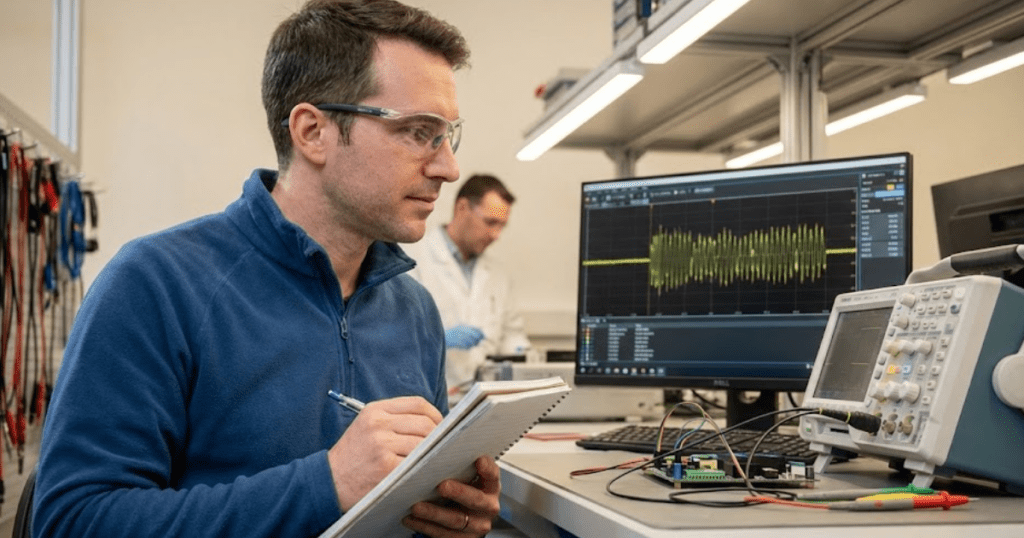
Most EMT errors come from mismatched intent, detail, and validation. Models fail when key parasitics are missing, when nonlinear device limits are oversimplified, or when initial conditions are not physically consistent. Time step and solver choices can also create numerical damping that hides the very stress you’re trying to measure. Credible findings come from a small set of disciplined checks, repeated every time the model changes.
Start with a sanity pass on steady-state values before applying any transient event, since an incorrect operating point can poison everything downstream. Confirm that energy storage elements have realistic values, and check that their initial voltages and currents match the pre-event conditions you intended. Run a convergence check on time step, and verify that peak values and ringing frequency do not shift materially as you refine resolution. Then challenge the result by removing one modelling refinement at a time and confirming you understand why the waveform changes.
Good EMT practice also includes a clear stopping rule. When the answer you need is “peak overvoltage at this terminal,” additional model detail that does not move that peak is extra complexity with little value. Teams that build that discipline end up with EMT models that stay usable across multiple studies, because the model is structured around limits and checks, not around maximum detail. SPS SOFTWARE fits well into that mindset because its open modelling style supports inspection and peer review, which is what keeps transient studies defensible over time. Careful execution will always matter more than the most sophisticated network you can draw.