

Contact us
Contact us
Simulation
Simulation

Comparing buck-boost and other DC-DC converter topologies in simulation

Key Takeaways

  • Input voltage range should set topology choice first, because a source that crosses the target output will push a simple buck or boost stage out of regulation.
  • Simulation works best when ideal switching is verified first and losses are added in steps, since that keeps the source of each waveform change visible.
  • Parasitics and duty cycle limits carry more weight than clean nominal values, especially in battery-fed systems such as electric vehicle converters.

Buck boost selection starts with the input voltage range, not the converter name.

A lithium-ion cell commonly spans about 3.0 V to 4.2 V during use, which means any pack built from those cells will cross meaningful voltage limits as charge falls. That single fact separates easy converter choices from risky ones. If your source stays fully above or fully below the load target, a simple buck or boost stage will usually fit. If the source crosses the target, a buck boost converter will be the safer model to start with.

That framing matters in simulation because topology errors look acceptable until duty cycle, current ripple, and device stress are checked across the full input range. You are not choosing between three names that do the same job with small differences. You’re choosing the current path that will shape losses, control effort, and usable operating range. Good models make that visible early, before bench work turns a clean schematic into a noisy surprise.

Buck boost fits sources that cross the target voltage
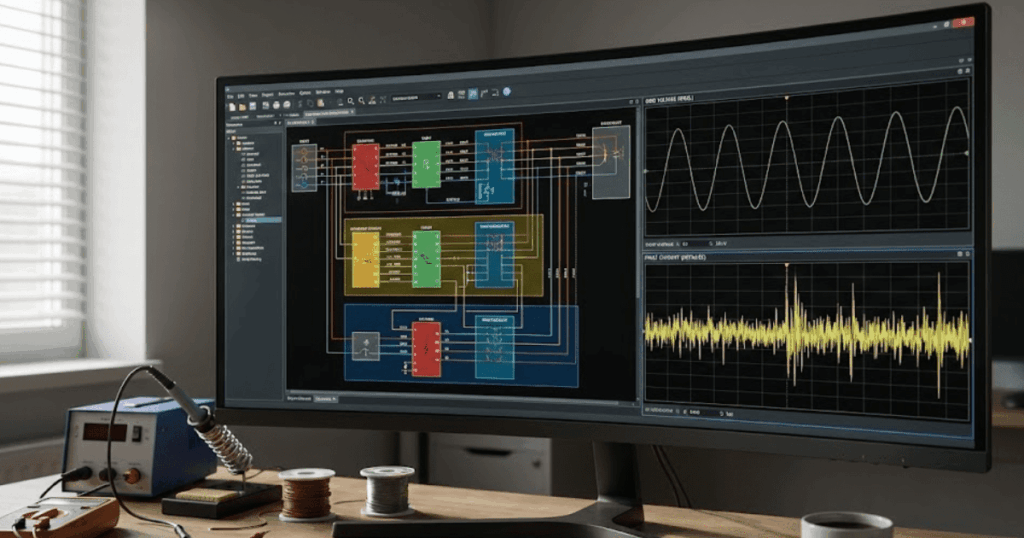
A buck boost converter fits best when your input voltage will move above and below the required output during normal operation. That operating window is the main reason to choose it. It will regulate across the full span where a buck stage or a boost stage alone will lose control at one end.

A battery pack feeding a 48 V bus shows the pattern clearly. Fresh off charge, the pack might sit above 48 V, so a buck stage will work. Near depletion, the same pack can drop below 48 V, so the circuit now needs boost action. A buck boost converter covers both conditions without handing regulation from one stage to another.

This matters because many early models are built around nominal voltage only. That shortcut hides the exact operating points where duty cycle rises, current ripple worsens, and thermal stress starts climbing. If you size the converter around minimum and maximum input first, topology choice becomes much more obvious.

“If you size the converter around minimum and maximum input first, topology choice becomes much more obvious.”

Buck boost action comes from storing energy then releasing it

A buck boost converter works by storing energy in an inductor during one switch state and releasing that energy to the output during another. The control loop adjusts how long each state lasts. That timing lets the stage produce an output above or below the input, depending on circuit form and duty cycle.

A simple inverting buck boost shows the sequence well. When the switch closes, current ramps through the inductor and energy builds in its magnetic field. When the switch opens, the inductor forces current through the diode into the output capacitor and load. The average output level follows the duty ratio, so longer on time raises conversion effect.

You will see the same idea in non-inverting forms used in many power systems. The details differ, but the modelling priority stays the same. Watch inductor current, switch current, and capacitor ripple first. Those waveforms tell you more about converter health than the output voltage alone.

Buck stages cut voltage with simpler current paths

A buck converter lowers voltage with a simpler current path than a buck boost converter, which makes it easier to model and usually easier to control. It fits when the minimum input always stays above the target output. Source current is also more continuous, which often reduces input filtering effort.

A 24 V supply feeding a regulated 12 V controller rail is a clean buck case. The switch applies the input to the inductor for part of each cycle, and the inductor averages that pulsed energy into a lower direct current output. Output ripple is set mainly by switching frequency, inductor value, capacitor size, and parasitic resistance.

You will usually pick buck first when the voltage window allows it because fewer stressed conditions need to be checked. Duty cycle stays in a comfortable middle range more often. That usually means easier compensation, lower peak current, and fewer surprises when the model moves from ideal parts to practical ones.

Boost stages raise voltage through inductor energy transfer

A boost converter raises voltage by charging an inductor from the source and then forcing that stored energy into the load at a higher output potential. It works well when the maximum input always stays below the target output. The tradeoff is that source current and switch stress rise sharply as duty cycle approaches its upper limit.

A 12 V battery feeding a 24 V auxiliary bus is a typical boost case. The inductor charges while the switch is on, and the output capacitor supports the load during that interval. When the switch turns off, the inductor current adds to the source through the diode, which lifts the output above the source voltage.

You should treat high duty cycle results with suspicion, even when the output looks stable. Small errors in switch loss, diode drop, or inductor resistance will distort efficiency quickly. That is why boost models need a close look at current ripple and thermal rise before you accept a neat voltage trace as success.

Simulation should begin with ideal switching then add losses

The best way to simulate a direct current to direct current converter is to start with an ideal switching model, verify waveforms and regulation, and then add non-ideal effects one group at a time. That order keeps faults visible. It also helps you see which parameter actually changes behaviour instead of masking several problems at once.

A useful first pass uses an ideal switch, ideal diode, nominal input sweep, and a resistive load. Once duty cycle and waveforms look correct, you add practical loss terms and compare the shift in average output, ripple, and current peaks. SPS SOFTWARE fits this workflow well because the model structure stays open enough for you to inspect each element instead of treating the converter as a sealed block.

  • Start with switch timing that gives the expected output across the full input range.
  • Add diode drop and switch on resistance before tuning the control loop again.
  • Insert inductor winding resistance so current ripple and heating move closer to bench values.
  • Include capacitor equivalent series resistance because ripple voltage will rise quickly without it.
  • Model dead time and gate delay when switching loss or cross conduction matters.

That sequence will save time because each added loss has a visible signature. If output voltage collapses after resistance is added, the topology or magnetics are likely undersized. If only ripple changes, capacitor choice or frequency will need attention before control tuning starts.

Duty cycle limits explain most topology tradeoffs

Duty cycle limits explain most of the practical difference between buck, boost, and buck-boost choices. When the required duty cycle sits near 0% or 100%, current stress, loss sensitivity, and control margin all worsen. A topology that keeps duty cycle moderate across your operating window will usually produce the cleaner design.

A buck stage is comfortable when input stays well above output, because the required duty ratio stays below unity with margin. A boost stage becomes strained as output rises far above input. A buck boost stage keeps regulation across a wider span, but it pays for that range with more current stress and more parts to tune.

Use this checkpoint before you commit to a topology.Read the result as a practical signal from the model.
If minimum input stays above target output, a buck stage will usually fit the range.Duty cycle will stay away from its upper limit, which keeps stress easier to manage.
If maximum input stays below target output, a boost stage will usually fit the range.High load points still need close loss checks because current will climb quickly.
If input crosses target output, a buck boost stage will hold regulation across the window.Current ripple and control effort will rise compared with a single-purpose stage.
If the model needs duty cycle near the limits, it is warning you about margin.Magnetics, switching loss, and transient recovery will become harder to contain.

Buck boost suits EV batteries that cross the bus

A buck boost converter suits electric vehicle power stages when battery voltage will cross the required bus or subsystem voltage over charge state, temperature, and load. That condition appears often in traction support rails, auxiliary buses, and battery interfacing stages. The topology keeps regulation intact when a buck stage or boost stage alone would fall out of range.

An electric vehicle battery does not sit at one fixed number during use, and that is why this topology matters. Global battery electric car sales reached about 14 million in 2023, equal to roughly 18% of all car sales. A wide and growing installed base means more engineers are modelling battery-fed converters across full operating windows rather than around nominal pack values.

A practical case is a high-voltage pack feeding a lower auxiliary rail during one mode and accepting power from a lower source during another. The exact control scheme will vary, but your model should always sweep minimum pack voltage, maximum pack voltage, and step load conditions. That is where converter choice stops being academic and starts showing its fit.

“Good converter selection comes from that discipline, because the right stage is the one that keeps its behaviour when the ideal parts are gone.”

Parasitics decide if simulated gains survive hardware build
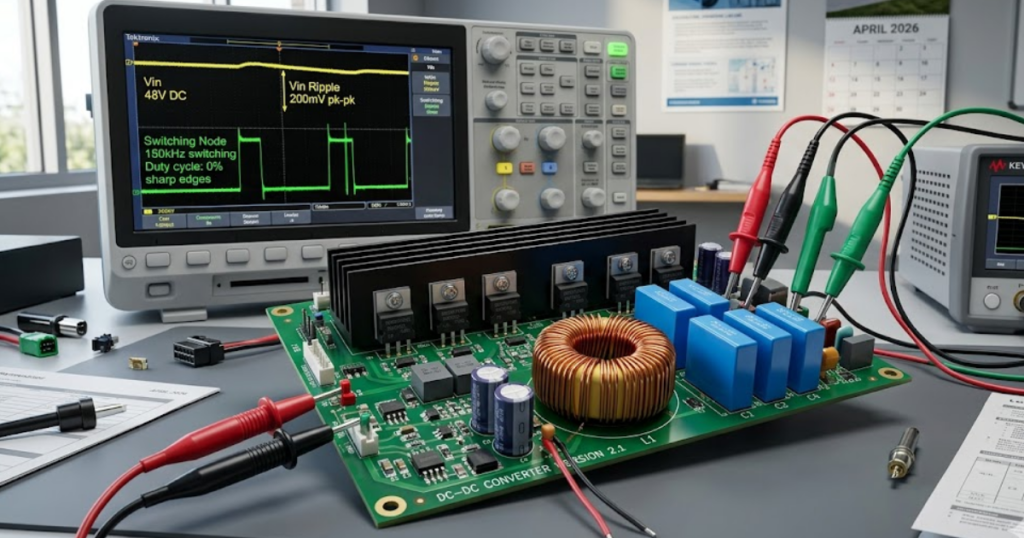
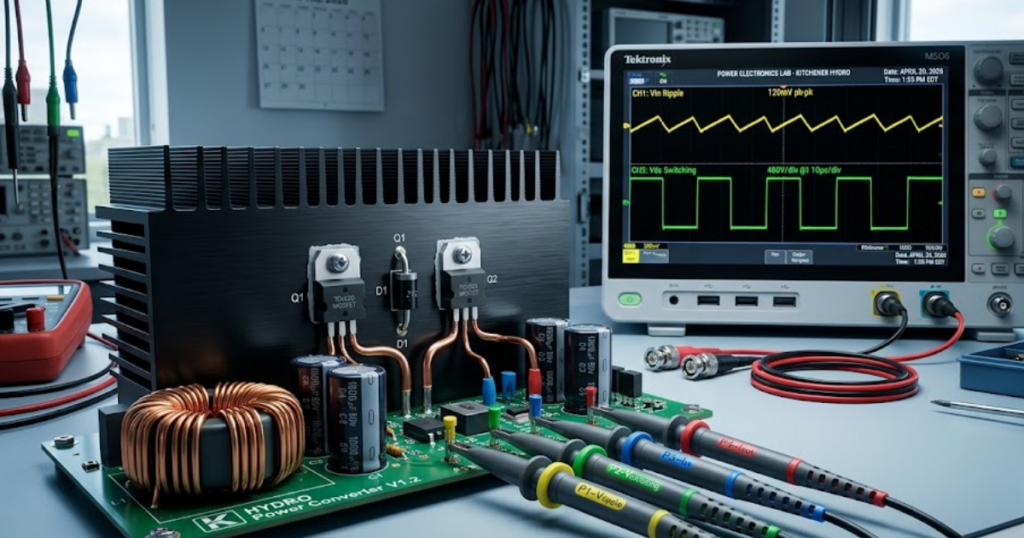
Parasitics decide whether a converter that looks strong in simulation will still behave once copper resistance, capacitor loss, layout inductance, and device timing enter the picture. These effects are not small corrections. They will reshape ripple, peak current, voltage overshoot, and efficiency enough to overturn an early topology choice.

A bench build often exposes this gap at the switching node. The ideal model shows clean transitions, while the hardware shows ringing, extra heating, and output ripple that seemed absent before. That usually traces back to ignored equivalent series resistance, loop inductance, or recovery behaviour. Once those terms are present, the best topology is the one that still meets the target with margin rather than the one that looked best on a clean schematic.

That is the useful habit to keep after the first successful run. SPS SOFTWARE works best when you treat every component as inspectable and editable, then tighten the model until it explains the waveform you expect to measure. Good converter selection comes from that discipline, because the right stage is the one that keeps its behaviour when the ideal parts are gone.


Simulation

Understanding voltage stability analysis through simulation

Key Takeaways

  • Voltage stability analysis works best when you track reactive power margin, equipment limits, and control saturation instead of relying on voltage magnitude alone.
  • PV curves, QV studies, and dynamic simulation answer different questions, so the right study sequence will save time and improve the quality of your engineering judgment.
  • Protection coordination, feeder load behaviour, and inverter current limits will decide whether simulated margin is credible enough to support operating or planning choices.

Voltage stability analysis in simulation works when you treat reactive power margin as the main signal, not voltage magnitude alone.

Voltage collapse rarely starts as a single low-voltage reading. It starts when generators, capacitor banks, static compensators, or inverter controls run out of reactive support while transfer stress keeps rising. Wind and solar produced 13.4% of global electricity in 2023, which means more grids now depend on converter behaviour that must be represented properly in stability studies. Good voltage stability analysis will show you where the weak buses are, which limits bind first, and how protection will react when voltage recovery slows.

Useful simulation comes from disciplined model choices, not from a single study type. You’re trying to answer a practical engineering question about margin, collapse risk, or corrective action. That means your model will need credible load behaviour, realistic control limits, and a study method matched to the disturbance or loading pattern you care about. If those pieces are wrong, the plots will look clean and still tell you the wrong story.

“The key measure is reactive power margin.”

Voltage stability is about reactive power margin

Voltage stability is the ability of a power system to maintain acceptable voltage after load growth, switching, or a disturbance. The key measure is reactive power margin. A bus can sit near nominal voltage and still be close to collapse. That is why voltage magnitude alone won’t tell you enough.

Consider a transmission corridor feeding a heavy urban load pocket on a hot evening. Tap changers keep distribution voltage near target, induction motors draw more reactive current, and a nearby generator reaches its reactive limit. The voltage profile can still look acceptable for a short period, yet the system has almost no extra support left. A small line outage or another step in loading will push the bus toward the nose of the power-voltage curve.

This matters because voltage instability is usually a limit problem before it becomes a visible low-voltage problem. You need to track generator reactive ceilings, switched compensation steps, transformer tap action, and load sensitivity to voltage. If you don’t, you’ll confuse a healthy operating point with a fragile one. Good analysis starts with the question, “How much support is left before controls saturate?”

Start simulation with a credible network model

A credible network model includes the parameters and controls that actually shape voltage response under stress. You need correct line data, transformer taps, shunt devices, generator limits, load composition, and control logic. If any of those are simplified too far, the margin you calculate won’t match field behaviour.

A practical setup begins with a solved base case and a clear study boundary. A feeder study needs feeder regulators, capacitor switching logic, and motor-rich loads. A bulk system study needs generator excitation, reactive capability limits, and transfer paths that reflect the operating condition you’re testing. In SPS SOFTWARE, that execution step is useful because you can inspect and edit model equations and protection settings instead of accepting a closed result.

The fastest way to lose confidence in voltage stability analysis is to skip basic model checks. Use this minimum checklist before you start stressing the system.

  • Confirm the base case power flow matches the intended operating condition.
  • Check every reactive source for realistic limits and control priorities.
  • Represent loads with voltage sensitivity that fits the study area.
  • Verify transformer tap ranges, deadbands, and time delays.
  • Include protection elements that will trip before collapse is complete.

Use PV curves to locate weak buses first

PV curve analysis is the quickest way to find where voltage stability margin is thin. You increase loading or transfer stress step by step and watch how bus voltage responds. The weak buses are the ones that approach the nose first. Those buses deserve your attention before deeper studies begin.

A common workflow stresses a transfer corridor from a generation area into a load area while monitoring several buses. One bus will usually show a sharper voltage drop and a smaller loadability margin than the others. That bus becomes the anchor point for corrective action screening. You can then test shunt support, generator redispatch, or tap adjustments and see which measure shifts the nose to a safer operating point.

PV curves are valuable because they turn a vague concern about collapse into a ranked map of weak locations. They also keep you from spreading effort across the whole network when the limiting problem is local. You’ll get the most value when each step respects equipment limits and control actions. If reactive ceilings are ignored, the curve will look better than the system really is.

Use QV studies when reactive limits dominate

QV studies answer a narrower but very important question. They show how much reactive injection a bus needs to maintain a chosen voltage level. That makes them useful when the main issue is local support deficiency. They are less about loadability and more about reactive deficiency at a specific location.

A weak substation bus near a large motor load is a good case. The PV curve can confirm that the area has poor margin, but the QV curve will show how much reactive support is required to hold 1.0 per unit or another target. That makes capacitor sizing, static compensation studies, and support placement more concrete. You’re no longer guessing which bus needs help or how much help it needs.

QV results become especially important after generator reactive limits are reached or after a line outage changes local VAR supply. They also expose cases where a bus needs support that a distant source can’t deliver effectively because of transmission reactance. If your question is “Where do I place support and how much is required?” a QV study will answer it more directly than a PV curve.

Dynamic simulation tests the path toward voltage collapse

Dynamic simulation shows how the system moves from a disturbance toward recovery or collapse over time. It captures control action, delay, saturation, and protection logic that static studies cannot represent fully. That is why it is essential after PV and QV studies identify weak areas. Static margin tells you the distance to trouble, while dynamic response shows the route.

A bus fault cleared after several cycles can leave motors stalled, transformer taps moving, and reactive devices switching in sequence. A static study will miss that timing. An RMS model can show slow voltage recovery after fault clearing, and a more detailed electromagnetic model can show converter current limiting or control interaction during the same event. Those details matter when the operating point is already close to its reactive ceiling.

Use this checkpoint to match the study method to the question you’re asking.

Study approachWhat it tells you clearlyWhen it is the best fit
Base case power flow reviewIt confirms that voltages, flows, and reactive outputs match the operating condition you intend to study.Use it before any stability test so every later result starts from a credible state.
Power-voltage curve analysisIt ranks weak buses by showing where voltage collapses first as loading or transfer stress rises.Use it when you need a quick view of margin and bus weakness across the network.
Reactive-voltage curve analysisIt shows how much local reactive support is required to hold a chosen voltage at a bus.Use it when placement and sizing of var support are the main questions.
RMS disturbance simulationIt captures slower control action such as excitation, tap changes, motor recovery, and protection timing.Use it after a fault, outage, or switching event when time response will shape the outcome.
Electromagnetic transient simulationIt resolves converter limits and short-term control interaction that are too detailed for steady-state methods.Use it for inverter-rich areas or when switching and control detail will alter voltage recovery.
Protection coordination reviewIt shows which elements will trip first and how those trips alter the stability margin you thought you had.Use it before final judgement so the simulated margin reflects the actual protection scheme.

Distribution networks need load models that match behaviour

Distribution voltage stability studies will fail if load models are too simple. Feeders are shaped by motors, thermostatic loads, rooftop generation, regulator action, and unbalance. Constant power assumptions can overstate or understate collapse risk. You need behaviour that matches the actual feeder mix.

A long feeder serving air conditioning, small commercial motors, and distributed generation will respond very differently from a feeder made mostly of resistive heating. After a fault or voltage dip, motor stalling can hold reactive consumption high while regulators and capacitor controls respond with delay. If your model treats all of that as a static constant power block, the predicted recovery will look smoother than the feeder will actually deliver.

Distribution studies also need attention to where controls act and how quickly they act. Tap changers can support customer voltage while pushing the upstream system closer to its limit. Capacitor banks can help one section and worsen another if switching logic is poorly timed. You can’t study voltage collapse risk on a feeder as if it were a reduced bulk bus. The feeder’s composition is the study.

Grids with high renewable share need inverter limits

Renewable-heavy grids need explicit inverter current limits, control priorities, and reactive support settings in the model. Converter-based resources do not respond like synchronous machines. When voltage drops, their controls will follow current limits and protection thresholds. If those limits are missing, the simulated margin will be overstated.

A solar plant tied to a weak grid offers a clear case. During a voltage dip, the inverter controller will often prioritise reactive current support up to a current ceiling. Past that ceiling, active power support falls and further voltage support is capped. Solar photovoltaic generation rose by almost 320 TWh in 2023, the largest annual increase ever recorded, which makes this modelling detail important for modern stability studies.

You’ll also need to represent plant-level voltage control, collector system impedance, and grid code settings that govern fault ride-through. A generic source behind a reactance won’t capture those limits. That shortcut might be acceptable for rough screening, but it won’t support a credible judgment about collapse risk. If your network is rich in inverter-based resources, the voltage stability model has to reflect converter physics and control logic.

“A margin that exists only before a relay trip is not usable margin.”

Protection coordination must reflect voltage stability limits

Power system protection coordination is part of voltage stability analysis because protection will define the final outcome once voltage recovery slows or current rises. A margin that exists only before a relay trip is not usable margin. You need the study to reflect the same trip logic the field equipment will enforce.

A delayed undervoltage trip on a wind plant, a load-shedding stage on a weak feeder, or an overexcitation limiter on a generator can each alter the path from disturbance to collapse. One setting can preserve service long enough for voltage recovery, while another can remove support and deepen the dip. That is why protection review belongs inside the simulation workflow instead of after it. If the relay clears first, your PV or QV result won’t be the whole answer.

The best engineering judgment comes from lining up margins, control limits, and protection timing in one consistent model. SPS SOFTWARE fits naturally in that workflow because open models make it easier to inspect the assumptions behind network response and relay action. You’re not looking for a dramatic plot. You’re looking for a study result that still makes sense when the system is stressed, the controls saturate, and the protection acts exactly as set.

Simulation

Supporting reproducible research with physics-based simulation models

Key Takeaways

  • Reproducible EMT research starts when you treat the simulation run as a complete, rerunnable record that includes the model, numerics, inputs, and tool versions.
  • Physics-based model transparency matters as much as results, because readers need to inspect equations, assumptions, and control logic to trust that the same study is being rerun.
  • Most repeatability failures come from small, undocumented choices such as time step, event timing, initialization, and post-processing, so disciplined run manifests and portable study packaging should be standard practice.

Reproducible simulation research fails most often when authors treat a simulator run as a screenshot instead of a record you can rerun. A large survey found 70% of researchers had tried and failed to reproduce another scientist’s experiments. EMT research carries extra risk because small numerical and modelling choices can shift waveforms, trip logic, and protection outcomes.

“You can make EMT power system results repeatable when you publish the model, the numerics, and the run conditions as a single package.”

The practical stance is simple: reproducibility is a design requirement for your study, not a clean-up task after you’ve written results. Physics-based modelling makes that achievable because equations, parameters, and assumptions can be inspected and challenged. Your job is to keep every hidden decision visible, from solver tolerances to initial conditions, so a reviewer or lab partner can rerun the study and reach the same technical conclusions.

Define reproducible simulation research in EMT power system studies

Reproducible EMT research means an independent reader can run your simulation model and obtain the same key plots and metrics within a stated tolerance. It includes the full model, all inputs, and the numerical settings used to generate results. It also includes tool versions and any external scripts. It is stricter than claiming similar behaviour.

For EMT work, “same result” should be defined in engineering terms, not aesthetics. If your claim depends on peak current, DC link ripple, PLL stability, or protection pickup time, you need a numeric acceptance band for those outputs. That band should reflect numerical noise you expect from different machines, not the spread you get from undocumented parameter choices.

It also helps to separate three levels of repeatability so your readers know what to expect. Repeatable runs on the same computer test basic run control. Reproducing on a different computer tests tool versioning, floating point differences, and hidden dependencies. Reproducing in another simulator tests modelling assumptions, and that requires even clearer documentation of physics-based equations and control logic.

Specify model transparency requirements for physics-based power system modelling

Transparent physics-based models expose equations, parameters, and component limits so others can inspect what your study actually simulates. You should be able to trace any plotted waveform back to a component model and a parameter value. Control blocks must be readable, not compiled into opaque artefacts. If a value is tuned, the tuning target must be stated.

Start with a tight “model contract” that defines what is inside the scope and what is not. If you use an averaged converter model, state the switching details you removed and why that is acceptable for your claim. If you include detailed switching, state how you represent device losses, dead time, and saturation. Readers do not need every intermediate note, but they do need every assumption that changes physics.

Transparency also includes naming and structure. Consistent signal names, clear subsystem boundaries, and readable units reduce the risk that another researcher wires something incorrectly and blames the tool. When a model is clear enough for a graduate student to audit, it is usually clear enough for a reviewer to trust.

Control numerical settings that most often break reproducibility

EMT reproducibility breaks when solver choices, time step, interpolation, and event handling are treated as defaults. Time step and tolerances directly affect switching ripple, control stability margins, and protection timing. Event timing rules, such as breaker operation and fault insertion, must be specified precisely. You should publish these settings as part of the study definition, not as simulator trivia.

Consider a grid fault study on a 2 MW inverter model where your claim depends on the first 10 ms of current limiting. A fixed time step of 5 µs can show a different peak and a different limiter activation instant than 20 µs, even with identical controller gains, because sampling, discretization, and switch event alignment shift. If the paper reports only the controller diagram and omits the numerical settings, another lab can “replicate” the model and still miss your headline result.

Set explicit rules for how you choose numerics. Start with a time step justified by the fastest dynamics you keep, then confirm key outputs are stable under a smaller step. State any filters or decimation used for plots so readers do not confuse display smoothing with physical damping. When your results depend on threshold crossings, record the detection method and the comparison tolerance.

Record inputs, initial conditions, and solver versions consistently

Repeatable EMT studies require a complete run record that captures every input, initial state, and tool version used. Initial conditions matter because controls, machine states, and network voltages can settle into different trajectories. Versioning matters because solvers, libraries, and numerical fixes change behaviour. If you can’t recreate your own figures six months later, nobody else will.

Use a run manifest that travels with the model and gets updated every time you regenerate results. Treat it like a lab notebook entry with strict fields, not free text. When you work with teams, a manifest becomes the shared reference that prevents quiet drift between “the model” and “the results.”

  • Simulation tool name, exact version, and operating system details
  • Solver type, fixed or variable step, time step, and error tolerances
  • All input files with checksums and a single source of parameter values
  • Initial condition method, including any power flow or steady-state pre-run
  • Event schedule with timestamps for faults, switching, and controller mode changes

The same discipline applies to scripts used for plotting and post-processing. If a plot uses windowing, resampling, or filtering, record the settings and the code version. A clean run record turns review comments into quick reruns instead of weeks of reconstruction.

Package and share EMT studies so others can rerun

“Sharing for reproducibility means shipping a runnable bundle, not a diagram and a parameter table.”

A complete package includes model files, the run manifest, input datasets, and the plotting scripts that generate published figures. File paths must be relative and portable so the project opens on a new machine without manual repair. Your goal is a single command or click that reproduces the outputs you cite.

Packaging works best when you separate editable source from generated artefacts. Keep source models, parameter sets, and scripts under version control, and store generated plots in a results folder tied to a specific commit. Archive the exact run bundle associated with a submission so later edits do not overwrite the provenance of published figures.

Some teams standardize this workflow inside SPS SOFTWARE because open, editable component models and clear parameterization make it easier to bundle what matters for reruns. The tool choice matters less than the habit: if the recipient cannot inspect and execute what you used, the study cannot be reproduced.

Detect common reporting gaps that block repeatable results

The fastest way to improve reproducibility is to look for gaps reviewers repeatedly hit: missing numerics, missing initial conditions, and missing event definitions. These omissions are not minor, because EMT outputs can shift with tiny differences. A separate survey finding showed 52% of researchers agree there is a significant reproducibility crisis. That pattern matches what power system reviewers see when simulation results can’t be rerun.

A simple self-test catches most issues before submission. Another person on your team should be able to clone the study bundle, run it on a clean machine, and regenerate every figure without asking you questions. If they need an email thread to find solver settings, a parameter file, or the exact event timing, the paper is not ready for scrutiny.

Reproducibility checkpointWhat you must recordWhat a rerunner can verify quickly
Model transparencyEditable equations, readable control logic, and parameter sourcesEvery plotted signal traces to a model element and value
Numerical configurationSolver type, step size, tolerances, and event timing rulesKey peaks and timing match within your stated tolerance band
Initial conditionsPre-run method, power flow assumptions, and state initialization filesStartup transients and steady-state values align with reported baselines
Inputs and disturbancesParameter sets, external data, and a timestamped event scheduleFaults, switching, and mode changes occur at identical times
Provenance and packagingTool versions, run manifest, and portable file structureThe study runs on a clean machine without path fixes

Good reproducibility feels strict, but it pays off in calmer review cycles and cleaner internal handoffs. Teams that treat modelling as a publishable artifact, not a personal workspace, build credibility that accumulates over time. SPS SOFTWARE fits best when you want that discipline supported by transparent, inspectable physics-based models, yet the outcome still depends on your run records and packaging habits.

Electrical Engineering, Simulation

When Hardware Testing Becomes More Reliable With Digital Models

Key Takeaways

  • Digital testing confidence comes from validated models that set expected ranges, limits, and pass criteria before any hardware stress.
  • Pre-test insights are most useful when they prioritise operating corners and the minimum measurements needed to prove or disprove key assumptions.
  • Reliable hardware testing improves when teams treat model mismatches as structured feedback, then update parameters, limits, and test sequences with discipline.

Hardware testing in power systems and power electronics fails when you treat first power-up as a discovery exercise. A model that matches your system’s physics turns testing into confirmation, because you arrive with expected waveforms, limits, and pass criteria instead of guesses. That matters because a single bad test can damage equipment, delay schedules, and put people at risk. Power interruptions alone cost the U.S. economy about $44 billion per year, and poor validation upstream is one way those costs show up downstream.

Digital testing confidence comes from disciplined model validation, not from running more simulations. Accurate models help predict behaviour because they capture the right structure, parameters, and control logic, then prove those assumptions against what you can measure. When you use modelling to get pre-test insights, you decide what to measure, what to limit, and what to try first, before any risky switching or fault work starts. The result is fewer surprises, cleaner test data, and faster root-cause work when results differ from expectations.

“Validated digital models make hardware tests more predictable and safer.”

Digital models set test expectations before hardware power-up

A digital model supports hardware testing when it defines expected signals and limits before you apply power. You use it to predict steady-state values, transient ranges, and protection thresholds. That gives you a baseline for judging anomalies during commissioning. It also reduces risk because you can pre-plan current, voltage, and thermal margins.

A practical case is a lab team preparing to commission a 250 kW grid-forming inverter feeding a small microgrid bus. The first simulation run uses the intended filter values, controller gains, and a range of grid impedances that could exist at the point of connection. You walk into the lab knowing the expected inrush, the settling time after a load step, and the waveform quality at the terminals. If the measured current spikes exceed the model’s upper bound, you stop and investigate the setup rather than pushing ahead.

Test expectations work best when they’re written down as checkable statements, not as plots you glance at once. You’ll also get more value if you treat the model as a contract between design, controls, and test teams, with a clear list of assumptions that can be challenged. That mindset keeps the model from becoming a “nice to have” file that nobody trusts under pressure. It also forces a system behaviour study to stay tied to measurements you can actually take in the lab.

Model output you should haveCheckpoint you set before first power-upWhy it makes testing more reliable
Expected steady-state voltages and currents at key nodesInstrument ranges and alarm limits match predicted operating bandsYou avoid saturating sensors and you spot abnormal conditions early
Step response to load changes and setpoint changesPass criteria include settling time and overshoot limitsYou separate tuning issues from wiring and measurement errors
Protection pickup levels and trip timing assumptionsTrip thresholds are reviewed with the model as a referenceYou reduce nuisance trips and avoid unsafe test escalation
Loss and thermal estimates under test profilesCooling checks and run durations align to predicted heatingYou prevent damage during long sweeps or repeated transients
Sensitivity to uncertain parameters such as impedance and delayWorst-case corners are prioritized in the test planYou find weak points early instead of late and expensive retests

Pre-test studies find operating corners, limits, and needed measurements

Pre-test studies give you pre-test insights that shape what you test first and what you postpone. They identify operating corners where stability, protection, or thermal limits tighten. They also tell you which measurements will settle the biggest uncertainties. You gain confidence because your first hardware runs target the highest information value with the lowest risk.

That inverter commissioning case becomes manageable once the model sweeps the parameter ranges that you can’t know exactly on day one. You’ll see which combinations of grid impedance and controller gains create oscillations, and which ones stay well damped. You also learn where measurement quality matters, such as current sensor bandwidth during switching transients or voltage probe placement during fault tests. When the model flags a narrow stability margin, you plan smaller steps and shorter run times until the behaviour matches expectations.

  • Grid or load impedance corners that push damping and stability limits
  • Worst-case DC-link voltage and ripple under expected transients
  • Peak phase current and di/dt that set safe ramp rates
  • Protection coordination limits that affect trip timing and thresholds
  • Signals that must be logged at high resolution for root-cause work

These studies will only help if you treat the results as test inputs, not as design trivia. If a sweep shows that a 10% change in delay shifts stability, you will prioritise validating timing paths and sampling assumptions. If a sweep shows that impedance uncertainty dominates, you will plan a quick impedance characterization step before aggressive testing. The point is simple: pre-test work earns its keep when it reduces the number of “unknown unknowns” you carry into the lab.

Model validation methods that build confidence in digital test results

Model validation builds digital testing confidence when you prove structure and parameters against measurements you can trust. You validate in layers, starting with component checks and moving to subsystem behaviour. Each check tightens uncertainty and reduces the chance of matching data for the wrong reason. The goal is a model that fails loudly when assumptions are wrong.

Inadequate software testing has been estimated to cost $59.5 billion per year in the U.S. economy, and control-heavy power hardware suffers from the same pattern of late, expensive discovery. Your validation plan should include basic conservation checks, timing checks, and sensitivity checks before you compare complex waveforms. If the model predicts energy creation or loss that violates physics, it’s telling you something is structurally wrong. If small parameter changes cause large output swings, you learn where measurement effort will pay back.

Transparent models help here because you can inspect equations and assumptions instead of treating blocks as opaque. SPS SOFTWARE supports physics-based modelling with editable component detail, which matters during validation because you can trace results to parameters you can measure and defend. You’ll still need to manage fidelity choices, since switching detail, numerical step size, and controller timing can all shift outcomes. Validation is not about making plots line up once; it’s about showing the model stays honest across the operating band you plan to test.

Accurate models predict system behaviour under faults and control changes

Accurate models predict behaviour under faults and control changes because they capture interactions, not just steady-state points. Faults expose coupling among control loops, protection logic, and network impedance. Control changes expose timing, saturation, and limit handling. When those mechanisms are represented correctly, the model becomes a reliable way to anticipate failure modes before hardware sees them.

The inverter commissioning scenario is a good stress test for model fidelity because the “interesting” behaviour often happens during abnormal events. A voltage sag can push current limits and trigger control mode changes within a few cycles. A close-in fault can drive protection trips, then create a restart sequence with inrush and synchronization steps. If the model includes realistic limits, delays, and trip logic, you can predict which event sequences are safe to attempt and which ones require additional interlocks.

Prediction does not mean perfect matching of every oscillation. It means the model gets the dominant mechanism right and predicts the direction and magnitude of change when you vary a condition. You’ll also learn which parts of the design are robust and which rely on tuned settings that drift with hardware tolerances. That clarity supports better test sequencing, because you can keep early runs inside well-understood regions and expand outward with control over risk.

Turn model outputs into test sequences, safety checks, and criteria

Model outputs become useful in the lab when they translate into a test sequence with clear stop rules. You map predicted ranges to instrument settings, interlocks, and pass criteria. You also use the model to order tests from low-risk, high-information runs to higher-stress cases. This turns testing into a controlled comparison between predicted and measured behaviour.

In the inverter case, the sequence typically starts with low-voltage functional checks, then low-power synchronization, then incremental load steps, and only then controlled disturbance tests. The model tells you what “normal” looks like at each stage, so you can gate progress on clear criteria such as waveform distortion limits, current peaks, or temperature rise over a fixed duration. If the measured response differs, you pause at the smallest test that still reproduces the mismatch, because that isolates causes faster than jumping to a harsher run.

This is also where you decide what to log and at what resolution. A model that predicts the key state variables helps you avoid collecting a pile of signals that won’t answer the hard questions later. You’ll also decide which parameters you will identify from early data, then push back into the model to tighten later predictions. That loop is the practical bridge between modelling and safe hardware execution.

Common modelling mistakes that reduce trust during hardware testing

“Hardware testing becomes more reliable once the model earns its role as the reference, and once teams agree that mismatches are learning opportunities, not reasons to abandon the process.”

Trust breaks when a model hides assumptions, skips limits, or treats unknown parameters as fixed facts. It also breaks when the model is too detailed to validate, so nobody can explain why it matches. A reliable workflow keeps the model simple enough to defend and detailed enough to predict the test outcomes you care about. That balance is a management choice as much as a technical one.

The most common failure mode is validating against a single “good looking” waveform while ignoring sensitivity and uncertainty. Another is leaving out saturations, dead time, sampling delay, or protection latch behaviour, then acting surprised when hardware reacts sharply. Poor alignment between measurement points and model variables is also a quiet problem, because you end up comparing signals that are not truly equivalent. When those issues stack up, engineers stop using the model for pre-test insights and revert to guesswork under schedule pressure.

Disciplined execution fixes this, and it’s more important than any one tool. You’ll get better outcomes when you treat validation as a checklist of falsifiable claims, keep assumptions visible, and update parameters based on early measurements. SPS SOFTWARE fits well into that style because transparent, physics-based models are easier to challenge and refine when the lab data disagrees.

Electrical Engineering, Modelling, Simulation

7 Converter Models Every Engineer Should Build First

Key Takeaways

  • Start with baseline rectification and a buck stage so your waveforms pass simple, repeatable checks.
  • Add nonideal details one at a time so switch based models stay explainable and debuggable.
  • Select the next model by the behaviour you must explain and by time step limits, not by topology novelty.

Build seven starter converter models and you’ll stop guessing about switching behaviour. Ripple and modulation will turn into signals you can verify. We’ll review results against the same baseline set.

New engineers keep asking what converter models should engineers build first. We can answer that with simple circuits that validate fast.

How these converter models build practical modelling confidence

A focused set of converter types links circuit states to waveforms you measure. Start with switch based modelling so commutation and ripple are visible. Add averaged versions only after switching passes checks. That routine sharpens DC and DC/AC modelling without hiding mistakes behind control.

Freeze control at fixed duty ratio and validate energy flow first. SPS SOFTWARE helps when you need open, inspectable component models.

Keep a single probe list across all models and sweep one parameter at a time. Power balance and volt second checks will catch most errors early.

“Power balance and volt second checks will catch most errors early.”

7 converter models engineers should build first

These seven models follow a practical order. Each circuit adds one concept and needs a plotted validation signal. Build each once with ideal devices, then once with one nonideal detail.

1. Uncontrolled diode rectifier as the baseline DC source

An uncontrolled diode rectifier teaches commutation without control or gate logic. Model a single phase bridge feeding a DC capacitor and a resistive load. Plot diode current pulses and DC bus voltage, then verify ripple rises with load current. Add a small source inductance, watch overlap conduction stretch pulses, and lower the bus. Measure diode conduction angle and input current crest factor so you can spot unrealistic source models. Save the DC bus ripple plot for later comparisons. This rectifier becomes the DC link you’ll reuse for inverter and motor load tests.

2. Buck converter for duty cycle and ripple understanding

A buck converter is a clean starting point for dc dc modelling because the checks are direct. Use an ideal switch, diode, inductor, capacitor, and a resistive load with a fixed duty cycle. Confirm average output voltage tracks duty times input during continuous conduction. Sweep the switching frequency and confirm that the inductor ripple current drops as the frequency rises. Step the load and confirm the output settles with a transient set by L and C. People asking how do you model DC DC converters should start here, then reuse its probes on every new topology.

3. Boost converter for non-ideal switching behaviour

A boost converter makes nonideal switching visible because current transitions are sharp. Build the ideal circuit first, then add one detail such as diode reverse recovery. Plot switch current at turn on and compare it to inductor current, since a spike will appear once recovery is present. Plot switch voltage at turn off and confirm transient peak and ringing grow when you add stray inductance. Add a small RC snubber and confirm peak voltage drops while losses rise. This model also provides a quick test of time-step resolution at the switching frequency.

4. Buck boost converter to expose mode transitions

A buck boost converter exposes operating modes that break assumptions about polarity and conduction. Model the inverting buck boost with fixed duty and a resistive load, then track output voltage sign and inductor current. Sweep duty from 0.2 to 0.8 and verify the gain curve steepens as duty rises. Lighten the load until inductor current hits zero and discontinuous conduction appears. Compare measured gain in that mode to the continuous conduction estimate and note the mismatch. Mode detection should be based on state variables.

5. Isolated flyback converter for magnetics interaction

A flyback converter forces magnetics into your model because magnetizing inductance stores energy. Use a coupled inductor element with turns ratio, magnetizing inductance, and leakage inductance. Add a clamp so switch voltage stays bounded when leakage energy releases. Validate the primary current ramp during the on interval and the reset during the off interval. Check that magnetizing current returns to the expected level each cycle, which confirms reset is working. Plot magnetizing current peak so you can spot saturation risk. Increase leakage inductance and confirm the clamp absorbs energy.

6. Single phase voltage source inverter with ideal switches

A single phase voltage source inverter is a fast step into dc ac modelling because the switching function is easy to see. Model a full bridge on a stiff DC link and drive it with a basic PWM pattern. Run an RL load and plot output voltage, load current, and ripple near the switching frequency. Swap PWM for a square wave and compare RMS current and peak current. Add an LC output filter and confirm that switching ripple drops as phase lag increases. Teams asking how can teams set up basic dc ac models can start with this inverter plus an RL load.

“Build each once with ideal devices, then once with one nonideal detail.”

7. Three phase inverter with basic modulation and load dynamics

A three phase inverter teaches phase relationships, line to line voltages, and load dynamics in one model. Start with a balanced three phase RL load and sinusoidal modulation at a fixed modulation index. Validate balanced phase currents and confirm line to line voltages match the expected fundamental magnitude. Sweep the modulation index and confirm that the fundamental voltage scales linearly until saturation. Feed the DC link from your rectifier model and watch bus ripple print into phase voltages. Add a small load imbalance and confirm phase currents shift as expected.

Uncontrolled diode rectifier as the baseline dc sourceIt gives you a DC link with visible diode commutation.
Buck converter for duty cycle and ripple understandingIt teaches duty ratio and ripple checks you can trust.
Boost converter for non-ideal switching behaviourIt shows nonideal effects as stress at switching edges.
Buck boost converter to expose mode transitionsIt forces you to detect operating modes from plotted states.
Isolated flyback converter for magnetics interactionIt links magnetics settings to current ramps and stress.
Single phase voltage source inverter with ideal switchesIt turns DC into AC with simple modulation validation.
Three phase inverter with basic modulation and load dynamicsIt ties modulation, loads, and DC bus ripple in one place.

How to choose which converter model to build next

Pick the next model based on the converter types you need to explain. Switching loss work requires switch-based modelling, while control tuning often works with an averaged power stage once waveforms are trusted. Time step limits and switching frequency set hard boundaries on model detail.

Start from the closest existing model and add one feature, such as dead time or a nonlinear load. SPS SOFTWARE fits well when you need editable models that students and senior engineers can read without translation.

Treat model building like a checklist sport. Clear probes and pass fail plots will keep reviews calm.

Electrical Engineering, Modelling, Simulation

Why EMT Precision Matters For Recreating Electrical Events With Confidence

Key Takeaways

  • EMT precision is a timing problem first, so waveform checks must focus on early cycles and fast transients.
  • High detail modelling earns its cost only when it reproduces limits, logic states, and device interactions seen in recordings.
  • A small set of repeatable waveform checks will keep event recreation honest and reviewable.

Accurate event recreation lets you replay a disturbance and trust the cause you identify. Published estimates place the annual U.S. cost of power outages between $28 billion and $169 billion, so wrong findings cost real time and money. You can’t fix what you can’t explain. EMT precision turns waveforms into evidence.

EMT precision matters because disturbances live in timing, not averages. A replay that matches RMS values but misses the first cycles will point you at the wrong device or setting. High detail modelling adds effort, so it needs checks you can run and repeat. The goal stays simple: match the waveform parts your study will use.

EMT accuracy defines how closely simulations reproduce electrical events

EMT accuracy means your simulated voltage and current traces match measured waveforms on the same timeline. The match has to hold before the disturbance, during the first cycles, and through recovery. Phase, polarity, and sequence must line up, not just magnitude. If those checks fail, event recreation becomes unreliable.

A common case is replaying a feeder fault captured at a substation. You align pre fault loading, apply the fault at the recorded time, and compare the voltage dip depth against the recorder. You also check current peaks and their decay, since DC offset and saturation shape early cycles. The recovery shape matters too, such as a slow return linked to stalled motors.

Accuracy is a set of pass/fail checks tied to what you need to decide next. Protection studies care about the first cycles because pickup and trip logic live there. Control studies care about the next few hundred milliseconds where limiters and synchronizing logic settle. Treat accuracy as a checklist, and your disturbance reproduction stays repeatable. It also keeps debates focused on measurable gaps.

“EMT precision turns waveforms into evidence.”

Precise event recreation depends on capturing fast switching and transients

Precise event recreation depends on capturing the fast physics that shape the first milliseconds. EMT precision comes from modelling switching, conduction states, saturation, and line effects at a time step that can resolve them. Some inverter connected generator models run with time steps as low as 1–2 µs, which shows how quickly key dynamics move. Coarser steps will blur peaks and shift event timing.

Capacitor bank switching is a clear illustration. The recorder often shows a voltage spike and bus ringing, not a clean step. Matching that ringing needs correct capacitor and reactor values, realistic upstream impedance, and a switch model that represents the closing instant. Small timing error will move the peak enough to break the match.

Transformer energization, breaker pole timing, and cable energization also create short bursts that set initial conditions. A replay can look close after 200 ms, yet internal controller states will already be wrong. Treat the first milliseconds as a gate check. That habit prevents long, late-night tuning sessions.

High detail modelling reveals disturbance behavior hidden by averaged models

High detail modelling reveals behavior that averaged models hide when limits and nonlinearities dominate. EMT will show current clipping, phase jumps, harmonic injection, and brief control mode switches that are smoothed out in averaged representations. Those details decide if equipment rides through, trips, or recovers cleanly. If the disturbance reproduction needs that decision, you need EMT detail.

An inverter ride through event during a close in fault shows the difference fast. An averaged model can hold current proportional to voltage and recover smoothly once voltage returns. A detailed EMT model will show current limiting, mode switching, and a short oscillation as synchronizing logic re locks. That short window can explain either a second protection pickup or a negative-sequence current spike.

Detail also exposes interaction between devices. Two converters can look stable in isolation and still fight through a weak network, producing repeated limiter hits after clearing. With EMT detail, you can test fixes you can actually implement, such as adjusting a current limit ramp. Without it, you’ll tune a model to match a story, not the event.

Accurate EMT results improve fault analysis and protection coordination studies

Accurate EMT results improve fault analysis because protection responds to waveform features rather than just RMS values. Relays react to peaks, DC offset, harmonic content, and phase angle shifts. If the replay captures those features, you can test settings changes with confidence. If it does not, you will tune protection to a waveform that never occurred.

A feeder relay that mis operated during a temporary fault and reclose is a practical example. The recorder shows fault current, then transformer inrush after reclose, plus a voltage sag that lasted long enough to trip an undervoltage element. An EMT recreation can separate those contributors at the same bus, including converter current limits that deepen the sag for a few cycles. Once timing is clear, you can adjust delays, pickups, or blocking logic in line with the record.

Coordination also depends on consistency across cases. If the model matches one fault record but fails on a second event elsewhere, topology or equivalents are wrong. EMT makes that gap obvious because it won’t hide timing errors behind averages. That clarity speeds up root cause work. It also reduces risky “trial and error” tuning.

Event replay quality shapes confidence in post incident engineering findings

Replay quality shapes what you will believe after an incident, because familiar looking waveforms feel convincing. A plausible but wrong replay will steer you toward the wrong cause and corrective action. A disciplined replay forces hard questions early, such as breaker status, event time stamps, and controller revision. That discipline turns event recreation into a reliable engineering tool.

A plant trip during a voltage dip shows why. Measured voltage returns, yet the plant stays offline and the operator log shows a latch. A low detail model can’t latch because internal state logic is missing, so the replay suggests the plant should have stayed online. A precise EMT replay that includes latch and reset conditions will reproduce the lockout and show the threshold crossing that triggered it.

The confidence bar should match the consequence of the finding. If the outcome warrants a retrofit, a settings change, or a compliance filing, the replay must stand up to review. Clear assumptions and repeatable waveform checks make that possible. Strong replay quality shortens debate and keeps focus on fixes.

“EMT makes that gap obvious because it won’t hide timing errors behind averages.”

Engineers should prioritize EMT detail based on disturbance study objectives

Better results come from prioritizing EMT detail around the disturbance you need to explain. Start with the signals that must match, then keep explicit models for the devices that shape those signals. Reduce everything else only when the reduction preserves transient response at your observation points. This focus controls model size and keeps run time under control.

A breaker operation at one bus needs detailed switching and nearby network impedance, not full detail everywhere. A corridor interaction between two converter plants needs detailed controls at both ends and enough network detail to preserve coupling. Teams using SPS SOFTWARE often formalize this workflow: define waveform checks, add detail until checks pass, then stop. That habit keeps modelling effort traceable, and it makes peer review simpler.

Study objectiveWaveform checks to passDetail that usually matters
Relay pickup timingEarly cycles current and voltageSaturation and DC offset
Converter ride throughCurrent limit and recoveryControl mode switching
Switching surgePeak voltage and ringingSwitch and line detail
Fault locationDip depth and phase shiftTopology and impedance
Lockout replayThreshold crossingsLogic and timers

Common modelling shortcuts that reduce event recreation fidelity

Event recreation fails most often because small shortcuts stack up until timing no longer matches the record. The plots can still look smooth, so the error hides until pickup or latch behavior shows up in the field and not in the simulation. You avoid most failures by treating each shortcut as a hypothesis with a check. If the check fails, the shortcut goes.

Five shortcuts cause repeat problems in disturbance reproduction:

  • Using a time step too large for switching or saturation
  • Replacing controls with fixed current sources or gains
  • Omitting transformer saturation, inrush, or frequency effects
  • Ignoring event timing details such as pole scatter and delays
  • Forcing initial conditions that don’t match pre fault flows

Each shortcut breaks a different part of the replay, and the fix is clear once you see the mismatch. A too large time step will shift peaks and pickup times. Missing logic will erase latches and resets that operators see in logs. Teams that keep non negotiable waveform checks will stay honest over time. SPS SOFTWARE fits naturally when you need transparent, editable models you can inspect as carefully as you inspect the recordings.

Modelling, Simulation

5 Practices Integration Teams Use To Keep Models Consistent

Key Takeaways

  • Model consistency improves when shared parameters, data, and assumptions are explicitly documented.
  • Parameter alignment stays stable when ownership, naming, units, and shared reference data are enforced early.
  • A clean model handoff remains repeatable when assumptions and parameter changes are validated and recorded at every boundary.

Model consistency will improve when integration work treats models like interfaces, not just files. A single mismatch in units, defaults, or assumptions will turn into hours of rework. Defects follow. Clean handoffs will feel boring, and that’s the point.

Parameter alignment and data clarity come from making intent explicit before anyone starts “fixing” numbers. Integration teams sit between experts and owners. Your job is to standardize what gets owned, what gets checked, and what must be traceable. That discipline prevents surprises during model handoff.

Why model consistency breaks down during integration work

Model consistency breaks when teams exchange models without a shared contract for parameters, data, and assumptions. People patch mismatches locally, and those patches become silent forks. The model still runs, but outputs drift. Nobody knows which value is authoritative. Confusion spreads fast.

A model handoff from a controls group to a network group exposes this. One side assumes per-unit base values, the other uses absolute units, and the same conversion is applied twice. Plots look stable. Current limits and protection thresholds are now wrong, so debugging starts in the wrong place.

Fixing this takes more than asking for cleaner files. You need a set of practices that catch mismatches before they become local workarounds. We’ll get better results by policing interfaces and traceability, not by polishing every block. Rework drops when the contract is clear.

“The model still runs, but outputs drift.”

5 practices integration teams use to keep models consistent

Model consistency comes from repeatable constraints that make mismatches visible early. Each practice targets a different failure mode: ownership gaps, unit drift, copied data, hidden assumptions, and unreviewed edits. When you apply all five parameters, parameter alignment becomes routine rather than late-stage firefighting.

Start with the practices that touch the most shared surfaces: ownership, naming, and units. Add central reference data and handoff validation next. Leave review checkpoints for last so they stay short.

1. Define shared parameter ownership before models move between teams

Shared parameters need an owner, a scope, and an edit rule, or they will drift the moment two teams touch them. Ownership is not about control; it sets who approves changes and who gets notified. One simple ownership map will prevent conflicting defaults and duplicate “master” copies. The owner also maintains default values and a short public change log.

A handoff often involves repeating settings such as base frequency, nominal voltage, or controller gains. One team tweaks a gain to pass a test, another team later “fixes” a different copy, and results split. Assigning a single owner ensures a single source and a clear review path for shared parameters. Keep ownership limited to values that cross boundaries or affect acceptance checks.

2. Lock naming conventions and units before integration begins

Naming and units are the quickest ways to lose data clarity, because small inconsistencies can hide in almost-the-same variables. A locked convention makes mismatches obvious and stops translation work that wastes expert time. Unit rules also prevent errors that look like physics problems when they’re really bookkeeping.

A common integration bug occurs when a parameter called Vbase in one model and V_nom in another has different units, like kV versus V. Someone connects the models, sees values that look reasonable, and moves on. A required unit tag and a naming pattern will flag the mismatch before you trust plots. Keep the convention small: name, unit, reference frame, and sign. If a value is unitless, it must be stated as such in writing.

3. Centralize reference data instead of copying parameters downstream

Copied reference data creates silent forks, because teams adjust copies to fit local tests. Centralizing shared data keeps parameter alignment stable and lets you track changes without chasing spreadsheets. Data clarity improves when every model points to the same dataset and the same version.

Store network base values, device ratings, and test profiles in a single editable reference that models read at build time. If a feeder impedance gets updated after a field review, the change lands once and dependent models update on the next run. Teams working in SPS SOFTWARE often keep that reference versioned and inspectable, so edits stay visible and reproducible. Keep engineering truth separate from temporary tuning, using a local override layer that never writes back.

4. Validate assumptions at every model handoff point

Assumptions will leak across teams unless you check them during the handoff itself. A handoff validation step confirms initial conditions, solver settings, saturation limits, and signal scaling before deeper tests begin. That keeps model consistency tied to intent, not just identical numbers.

One group might start from steady initial states, another starts from zero and ramps up. Both are valid, but mixing them creates false failures that burn days. A short checklist that includes start-up mode, sampling rate, and limiters will catch this early. Pair it with a small acceptance run that produces a known signature, like expected RMS values and expected protection triggers. Record these assumptions in a handoff note attached to the model package every time.

“A required unit tag and a naming pattern will flag the mismatch before you trust plots.”

5. Track parameter changes with lightweight review checkpoints

Parameter alignment is not a one-time task; it is a stream of edits across weeks of work. Lightweight review checkpoints stop silent drift without adding heavy gates. The goal is visible intent, so future handoffs don’t depend on someone’s memory. Shared means anything that affects interface signals, scaling, ratings, or acceptance plots.

Set a checkpoint any time shared parameters change: what changed, why it changed, and what tests were rerun. A short sign-off from the owning team prevents quick fixes that break later integration. The change note also answers “when did this start?” in minutes instead of hours. If you can’t explain the change in one sentence, the checkpoint blocks it until you can. Keep checkpoints asynchronous and focused solely on shared interfaces.

Define shared parameter ownership before models move between teamsAssigning clear ownership prevents multiple teams from silently changing the same parameter in different ways.
Lock naming conventions and units before integration beginsConsistent names and units make mismatches visible early, rather than hiding errors within valid-looking values.
Centralize reference data instead of copying parameters downstreamUsing a single shared source for reference data prevents forked values from drifting as teams tune models locally.
Validate assumptions at every model handoff pointExplicitly checking startup conditions, limits, and scaling ensures results reflect intent rather than setup differences.
Track parameter changes with lightweight review checkpointsSimple change reviews keep shared parameters traceable so fixes do not introduce new integration problems later.

Applying these practices across handoffs and integration stages

Clean model handoff is a workflow, not a template. Start with ownership and units, then central reference data, then handoff validation and reviews. You’ll know it’s working when discussions shift from “which number is right” to “which assumption is intended.” Results become predictable.

Roll this out one boundary at a time. Pick a shared interface, define shared parameters, and run the same acceptance check after every handoff for two weeks. Add the change checkpoint only after the basics stick, or reviews turn into arguments. The sequence matters because clarity has to come first.

Long-term consistency comes from keeping shared models teachable and inspectable. SPS SOFTWARE works best when the team treats parameters and assumptions as part of the model, rather than as hidden notes. That discipline makes the next integration calmer and easier to debug. New people join and ask hard questions.

1 2 3

Get started with SPS Software

Contact us
Privacy Settings
We use cookies to enhance your experience while using our website. If you are using our Services via a browser you can restrict, block or remove cookies through your web browser settings. We also use content and scripts from third parties that may use tracking technologies. You can selectively provide your consent below to allow such third party embeds. For complete information about the cookies we use, data we collect and how we process them, please check our Privacy Policy
Youtube
Consent to display content from - Youtube
Vimeo
Consent to display content from - Vimeo
Google Maps
Consent to display content from - Google
Spotify
Consent to display content from - Spotify
Sound Cloud
Consent to display content from - Sound
Cart Overview