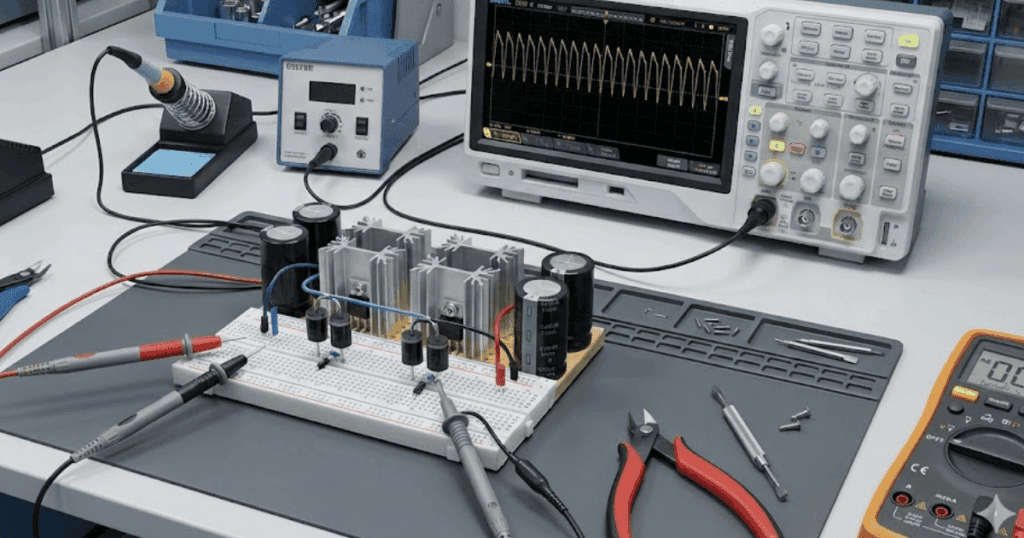
Guide expliquant ce que mesure un test à double impulsion, comment mettre en place une simulation et comment estimer l'énergie de commutation avant de passer au matériel de banc d'essai.
Ce guide explique comment effectuer une analyse harmonique et une analyse de la qualité de l'énergie dans le cadre d'une simulation en domaine temporel, modéliser des charges non linéaires, calculer la distorsion harmonique totale et vérifier les limites au niveau des barrages concernés.
La plage de tension d'entrée doit déterminer en premier lieu le choix de la topologie, car une source dont la tension dépasse la tension de sortie souhaitée fera sortir de régulation un simple étage abaisseur ou élévateur.
La simulation donne de meilleurs résultats lorsqu'on vérifie d'abord la commutation idéale et qu'on ajoute les pertes par étapes, car cela permet de garder une bonne visibilité sur l'origine de chaque variation de la forme d'onde.
Les pertes parasites et les limites du rapport cyclique ont plus d'importance que les valeurs nominales pures, en particulier dans les systèmes alimentés par batterie, tels que les convertisseurs des véhicules électriques.
Le choix d'un convertisseur buck-boost dépend d'abord de la plage de tension d'entrée, et non du nom du convertisseur.
Une cellule lithium-ion affiche généralement une tension comprise entre 3,0 V et 4,2 V en fonctionnement, ce qui signifie que tout bloc-batterie constitué de ces cellules franchira des limites de tension significatives à mesure que la charge diminue. Ce simple fait permet de distinguer les choix de convertisseurs simples de ceux qui présentent un risque. Si votre source reste entièrement au-dessus ou entièrement en dessous de la tension cible de la charge, un simple étage abaisseur ou élévateur conviendra généralement. Si la source franchit la tension cible, un convertisseur abaisseur-élévateur constituera le modèle le plus sûr pour commencer.
Ce cadre est important en simulation, car les erreurs de topologie peuvent sembler acceptables tant que le rapport cyclique, l'ondulation de courant et la contrainte subie par le composant n'ont pas été vérifiés sur toute la plage d'entrée. Il ne s'agit pas de choisir entre trois options qui remplissent la même fonction avec de légères différences. Il s'agit de choisir le cheminement du courant qui déterminera les pertes, l'effort de commande et la plage de fonctionnement utile. Les bons modèles permettent de visualiser cela dès le début, avant que les essais sur banc ne transforment un schéma impeccable en une surprise pleine de perturbations.
Le circuit buck-boost convient aux sources dont la tension dépasse la tension cible
Un convertisseur buck-boost est particulièrement adapté lorsque la tension d'entrée varie au-dessus et en dessous de la tension de sortie requise en fonctionnement normal. Cette plage de fonctionnement est la principale raison de le choisir. Il assure une régulation sur toute la plage, là où un étage buck ou un étage boost seul perdrait le contrôle à l'une des extrémités.
Un bloc-batterie alimentant un bus de 48 V illustre clairement ce principe. À peine rechargé, le bloc peut afficher une tension supérieure à 48 V, ce qui permet d'utiliser un étage abaisseur. À l'approche de l'épuisement, ce même bloc peut descendre en dessous de 48 V, et le circuit nécessite alors un étage élévateur. Un convertisseur abaisseur-élévateur couvre ces deux cas de figure sans passer la régulation d'un étage à l'autre.
Cela est important car de nombreux modèles initiaux sont conçus uniquement en fonction de la tension nominale. Cette simplification masque les points de fonctionnement précis où le rapport cyclique augmente, l'ondulation de courant s'aggrave et les contraintes thermiques commencent à s'accentuer. Si l'on dimensionne d'abord le convertisseur en fonction des valeurs minimales et maximales de l'entrée, le choix de la topologie devient beaucoup plus évident.
« Si l'on dimensionne d'abord le convertisseur en fonction des valeurs minimales et maximales de l'entrée, le choix de la topologie devient beaucoup plus évident. »
Le principe du circuit buck-boost repose sur le stockage puis la restitution d'énergie
Un convertisseur élévateur à découpage fonctionne en stockant de l'énergie dans une bobine d'inductance lors d'un état de commutation et en libérant cette énergie vers la sortie lors d'un autre état. La boucle de régulation ajuste la durée de chaque état. Ce timing permet au circuit de produire une tension de sortie supérieure ou inférieure à la tension d'entrée, en fonction de la configuration du circuit et du rapport cyclique.
Un simple circuit buck-boost inverseur illustre bien ce processus. Lorsque le commutateur se ferme, le courant traverse progressivement l'inductance et de l'énergie s'accumule dans son champ magnétique. Lorsque le commutateur s'ouvre, l'inductance force le courant à traverser la diode pour alimenter le condensateur de sortie et la charge. Le niveau de sortie moyen dépend du rapport cyclique ; ainsi, un temps de conduction plus long augmente le rendement de conversion.
Vous retrouverez ce même principe dans les configurations non inverseuses utilisées dans de nombreux systèmes d'alimentation. Les détails varient, mais la priorité en matière de modélisation reste la même. Observez d'abord le courant de l'inductance, le courant de commutation et l'ondulation du condensateur. Ces formes d'onde vous en disent plus sur l'état du convertisseur que la seule tension de sortie.
Le convertisseur abaisse la tension de sortie grâce à des circuits de courant plus simples
Un convertisseur abaisseur réduit la tension en utilisant un circuit de courant plus simple que celui d'un convertisseur abaisseur-élévateur, ce qui le rend plus facile à modéliser et généralement plus simple à contrôler. Il est adapté lorsque la tension d'entrée minimale reste toujours supérieure à la tension de sortie souhaitée. Le courant d'entrée est également plus régulier, ce qui réduit souvent les efforts de filtrage à l'entrée.
Une alimentation de 24 V alimentant une ligne de commande régulée à 12 V constitue un cas typique de circuit abaisseur. Le commutateur applique la tension d'entrée à l'inductance pendant une partie de chaque cycle, et l'inductance lisse cette énergie pulsée pour produire une tension de sortie continue plus faible. L'ondulation de sortie dépend principalement de la fréquence de commutation, de la valeur de l'inductance, de la capacité du condensateur et de la résistance parasite.
En général, on choisit d'abord la configuration « buck » lorsque la plage de tension le permet, car cela nécessite de vérifier moins de conditions de contrainte. Le rapport cyclique reste ainsi plus souvent dans une plage intermédiaire confortable. Cela se traduit généralement par une compensation plus aisée, un courant de crête plus faible et moins de surprises lorsque le modèle passe de composants idéaux à des composants réels.
Les étages d'amplification augmentent la tension grâce au transfert d'énergie par inductance
Un convertisseur élévateur augmente la tension en chargeant une inductance à partir de la source, puis en injectant cette énergie stockée dans la charge à un niveau de tension de sortie plus élevé. Il fonctionne bien lorsque la tension d'entrée maximale reste toujours inférieure à la tension de sortie souhaitée. En contrepartie, le courant de source et les contraintes sur le commutateur augmentent fortement à mesure que le rapport cyclique s'approche de sa limite supérieure.
Une batterie de 12 V alimentant un bus auxiliaire de 24 V constitue un cas typique de conversion élévatrice. L'inductance se charge lorsque le commutateur est activé, et le condensateur de sortie alimente la charge pendant cette période. Lorsque le commutateur est désactivé, le courant de l'inductance s'ajoute à la tension de source via la diode, ce qui fait passer la tension de sortie au-dessus de la tension de source.
Il convient de considérer avec méfiance les résultats indiquant un cycle de service élevé, même lorsque la sortie semble stable. De légères erreurs au niveau des pertes du commutateur, de la chute de tension des diodes ou de la résistance de l'inductance peuvent rapidement fausser le rendement. C'est pourquoi, dans les modèles élévateurs, il est nécessaire d'examiner attentivement l'ondulation du courant et l'élévation de température avant de considérer une courbe de tension impeccable comme un résultat satisfaisant.
La simulation doit commencer par un commutation idéale, puis intégrer les pertes
La meilleure façon de simuler un convertisseur courant continu-courant continu consiste à partir d'un modèle de commutation idéal, à vérifier les formes d'onde et la régulation, puis à ajouter les effets non idéaux un par un. Cet ordre permet de garder les défauts visibles. Il permet également de déterminer quel paramètre modifie réellement le comportement, au lieu de masquer plusieurs problèmes à la fois.
Une première approche utile consiste à utiliser un commutateur idéal, une diode idéale, un balayage d'entrée nominal et une charge résistive. Une fois que le rapport cyclique et les formes d'onde semblent corrects, vous ajoutez les termes de perte réels et comparez l'évolution de la puissance de sortie moyenne, de l'ondulation et des pics de courant. Le logiciel SPS s'adapte bien à ce processus, car la structure du modèle reste suffisamment ouverte pour vous permettre d'examiner chaque élément, plutôt que de traiter le convertisseur comme un bloc fermé.
Commencez par choisir une synchronisation de commutation qui donne le résultat escompté sur toute la plage d'entrée.
Tenez compte de la chute de tension de la diode et de la résistance à l'état passant avant de réajuster la boucle de régulation.
Ajouter une résistance dans l'enroulement de l'inductance afin que l'ondulation du courant et l'échauffement se rapprochent des valeurs de laboratoire.
Il faut tenir compte de la résistance série équivalente du condensateur, car sans cela, la tension d'ondulation augmentera rapidement.
Modéliser le temps mort et le retard de gâchette lorsque les pertes de commutation ou la conduction croisée sont importantes.
Cette procédure permet de gagner du temps, car chaque perte ajoutée se traduit par un signe distinctif. Si la tension de sortie chute après l'ajout d'une résistance, cela signifie probablement que la topologie ou les composants magnétiques sont sous-dimensionnés. Si seule l'ondulation varie, il faudra alors se pencher sur le choix des condensateurs ou la fréquence avant de procéder au réglage du système de commande.
Les limites du rapport cyclique expliquent la plupart des compromis liés à la topologie
Les limites du rapport cyclique expliquent en grande partie la différence pratique entre les options « buck », « boost » et « buck-boost ». Lorsque le rapport cyclique requis avoisine 0 % ou 100 %, la contrainte de courant, la sensibilité aux pertes et la marge de contrôle s'aggravent toutes. Une topologie qui maintient un rapport cyclique modéré sur toute la plage de fonctionnement permet généralement d'obtenir une conception plus propre.
Un étage abaisseur fonctionne sans problème lorsque la tension d'entrée reste nettement supérieure à la tension de sortie, car le rapport cyclique requis reste largement inférieur à l'unité. Un étage élévateur est mis à rude épreuve lorsque la tension de sortie dépasse largement celle d'entrée. Un étage abaisseur-élévateur assure une régulation sur une plage plus large, mais cette plage s'accompagne d'une contrainte de courant plus importante et d'un plus grand nombre de composants à régler.
Utilisez ce point de contrôle avant de valider une topologie.
Interprétez le résultat comme un signal concret fourni par le modèle.
Si la tension d'entrée minimale reste supérieure à la tension de sortie cible, un étage abaisseur convient généralement à cette plage.
Le rapport cyclique restera en deçà de sa limite supérieure, ce qui facilite la gestion des contraintes.
Si la puissance d'entrée maximale reste inférieure à la puissance de sortie visée, un étage d'amplification suffira généralement à couvrir cette plage.
Les points de forte charge nécessitent tout de même une surveillance étroite des pertes, car le courant augmente rapidement.
Si la tension d'entrée dépasse la tension de sortie cible, un étage buck-boost maintiendra la régulation sur toute la plage.
Les ondulations de courant et l'effort de régulation augmenteront par rapport à un étage à usage unique.
Si le modèle nécessite un rapport cyclique proche des limites, il vous avertit que la marge est réduite.
Les problèmes liés à la magnétisation, aux pertes de commutation et à la récupération transitoire seront de plus en plus difficiles à maîtriser.
Les convertisseurs buck-boost conviennent aux batteries de véhicules électriques qui traversent le bus
Un convertisseur buck-boost est adapté aux étages de puissance des véhicules électriques lorsque la tension de la batterie dépasse la tension requise du bus ou du sous-système en fonction de l'état de charge, de la température et de la charge. Cette situation se produit fréquemment dans les circuits d'alimentation de traction, les bus auxiliaires et les étages d'interfaçage avec la batterie. Cette topologie permet de maintenir une régulation stable alors qu'un étage buck ou boost seul sortirait de la plage de fonctionnement.
La capacité d'une batterie de véhicule électrique n'est pas constante pendant son utilisation, et c'est pourquoi cette topologie revêt une importance particulière. Les ventes mondiales de voitures électriques à batterie ont atteint environ 14 millions d'unités en 2023, soit environ 18 % de l'ensemble des ventes de voitures. Le parc automobile, vaste et en pleine expansion, incite de plus en plus d'ingénieurs à modéliser les convertisseurs alimentés par batterie sur l'ensemble de leur plage de fonctionnement, plutôt que sur la base des valeurs nominales du pack.
Un cas concret est celui d'un bloc d'alimentation haute tension qui alimente un rail auxiliaire de niveau inférieur dans un mode donné et qui est lui-même alimenté par une source de niveau inférieur dans un autre mode. Le schéma de commande précis variera, mais votre modèle doit toujours prendre en compte la tension minimale du bloc, la tension maximale du bloc et les conditions de charge par paliers. C'est là que le choix du convertisseur cesse d'être purement théorique et commence à démontrer son adéquation.
« C'est cette rigueur qui permet de bien choisir un convertisseur, car le circuit idéal est celui qui conserve son comportement même lorsque les composants parfaits viennent à manquer. »
Les parasites déterminent si les gains simulés sont conservés lors de la construction du matériel
Les effets parasites déterminent si un convertisseur qui semble performant en simulation se comportera toujours de la même manière une fois pris en compte la résistance du cuivre, les pertes des condensateurs, l'inductance due à la disposition des composants et le timing des composants. Ces effets ne se limitent pas à de simples corrections mineures. Ils modifient suffisamment l'ondulation, le courant de crête, le dépassement de tension et le rendement pour remettre en cause un choix de topologie initial.
La réalisation d'un banc d'essai met souvent en évidence cette lacune au niveau du nœud de commutation. Le modèle théorique présente des transitions nettes, tandis que le matériel révèle des oscillations, un échauffement supplémentaire et une ondulation de sortie qui semblaient absentes auparavant. Cela s'explique généralement par la négligence de la résistance série équivalente, de l'inductance de boucle ou du comportement de récupération. Une fois ces paramètres pris en compte, la meilleure topologie est celle qui atteint toujours l'objectif avec une marge de sécurité, plutôt que celle qui semblait la plus performante sur un schéma théorique.
C'est une bonne habitude à conserver après une première simulation réussie. Le logiciel SPS donne les meilleurs résultats lorsque vous considérez chaque composant comme pouvant être examiné et modifié, puis que vous affinez le modèle jusqu'à ce qu'il reproduise la forme d'onde que vous vous attendez à mesurer. C'est cette rigueur qui permet de bien choisir le convertisseur, car le circuit idéal est celui qui conserve son comportement même lorsque les composants parfaits viennent à manquer.
L'analyse de la stabilité de la tension donne de meilleurs résultats lorsque l'on tient compte de la marge de puissance réactive, des limites des équipements et de la saturation des systèmes de commande, plutôt que de se baser uniquement sur l'amplitude de la tension.
Les courbes PV, les études QV et la simulation dynamique permettent de répondre à des questions différentes ; c'est pourquoi un ordre d'étude bien choisi vous fera gagner du temps et améliorera la qualité de votre analyse technique.
La coordination de la protection, le comportement de la charge des lignes d'alimentation et les limites de courant des onduleurs détermineront si la marge simulée est suffisamment fiable pour étayer les choix opérationnels ou de planification.
L'analyse de la stabilité de tension en simulation fonctionne lorsque l'on considère la marge de puissance réactive comme le signal principal, et non pas uniquement l'amplitude de la tension.
Une chute de tension commence rarement par une simple mesure de tension faible. Elle survient lorsque les générateurs, les batteries de condensateurs, les compensateurs statiques ou les commandes des onduleurs ne sont plus en mesure d’assurer le soutien réactif nécessaire, alors que les contraintes de transfert ne cessent d’augmenter. L’énergie éolienne et solaire a représenté 13,4 % de la production mondiale d’électricité en 2023, ce qui signifie que davantage de réseaux dépendent désormais du comportement des convertisseurs, lequel doit être correctement pris en compte dans les études de stabilité. Une bonne analyse de la stabilité de la tension vous indiquera où se trouvent les nœuds faibles, quelles limites s'appliquent en premier et comment la protection réagira lorsque la récupération de tension ralentit.
Une simulation utile repose sur des choix de modèles rigoureux, et non sur un type d'étude unique. Vous cherchez à répondre à une question d'ingénierie concrète concernant la marge de sécurité, le risque d'effondrement ou les mesures correctives. Cela signifie que votre modèle devra intégrer un comportement de charge crédible, des limites de contrôle réalistes et une méthode d'étude adaptée au type de perturbation ou de charge qui vous intéresse. Si ces éléments ne sont pas corrects, les graphiques auront l'air irréprochables, mais vous donneront tout de même une image erronée de la situation.
« Le paramètre clé est la marge de puissance réactive. »
La stabilité de la tension dépend de la marge de puissance réactive
La stabilité de tension désigne la capacité d'un réseau électrique à maintenir une tension acceptable après une augmentation de la charge, une commutation ou une perturbation. La marge de puissance réactive en est l'indicateur clé. Un nœud peut se situer près de la tension nominale tout en étant au bord de la défaillance. C'est pourquoi la valeur de la tension à elle seule ne suffit pas à fournir toutes les informations nécessaires.
Imaginons un couloir de transport alimentant une zone urbaine à forte charge lors d'une soirée chaude. Les changeurs de prises maintiennent la tension de distribution proche de la valeur cible, les moteurs à induction absorbent davantage de courant réactif et un générateur situé à proximité atteint sa limite réactive. Le profil de tension peut encore sembler acceptable pendant un court instant, mais le réseau n'a pratiquement plus aucune marge de manœuvre. Une petite coupure de ligne ou une nouvelle augmentation de la charge poussera le nœud vers le sommet de la courbe puissance-tension.
C'est important car l'instabilité de tension constitue généralement un problème limitant avant de se traduire par un problème visible de sous-tension. Il est nécessaire de surveiller les limites réactives des générateurs, les paliers de compensation commutés, le réglage des prises des transformateurs et la sensibilité de la charge à la tension. Si vous ne le faites pas, vous risquez de confondre un point de fonctionnement stable avec un point fragile. Une bonne analyse commence par la question suivante : « Quelle marge de manœuvre reste-t-il avant que les systèmes de contrôle n'atteignent leur limite ? »
Lancer la simulation à partir d'un modèle de réseau fiable
Un modèle de réseau fiable intègre les paramètres et les commandes qui déterminent réellement la réponse en tension en cas de sollicitation. Il faut disposer de données de ligne exactes, des informations sur les prises de transformateur, les dispositifs de dérivation, les limites des générateurs, la composition de la charge et la logique de commande. Si l'un de ces éléments est trop simplifié, la marge que vous calculerez ne correspondra pas au comportement réel sur le terrain.
Une configuration pratique commence par un cas de base résolu et un périmètre d'étude clairement défini. Une étude de ligne d'alimentation nécessite des régulateurs de ligne, une logique de commutation des condensateurs et des charges à forte intensité de moteurs. Une étude de réseau de gros nécessite l'excitation des générateurs, les limites de capacité réactive et des voies de transfert qui reflètent les conditions d'exploitation que vous testez. Dans SPS SOFTWARE, cette étape d'exécution est utile car elle vous permet d'examiner et de modifier les équations du modèle et les paramètres de protection, au lieu de vous contenter d'un résultat figé.
Le moyen le plus rapide de perdre confiance dans l'analyse de la stabilité de tension est de négliger les vérifications de base du modèle. Utilisez cette liste de contrôle minimale avant de commencer à soumettre le système à des contraintes.
Vérifiez que le flux de puissance du cas de base correspond aux conditions de fonctionnement prévues.
Vérifiez pour chaque source réactive les limites réalistes et les priorités en matière de contrôle.
Représentez des charges dont la sensibilité à la tension correspond à la zone étudiée.
Vérifier les plages de prise du transformateur, les zones de non-réponse et les délais.
Prévoir des dispositifs de sécurité qui se déclencheront avant que l'effondrement ne soit complet.
Utilisez les courbes PV pour localiser en premier lieu les bus défaillants
L'analyse de la courbe PV est le moyen le plus rapide de repérer les points où la marge de stabilité de tension est faible. Il s'agit d'augmenter progressivement la charge ou la contrainte de transfert et d'observer la réaction de la tension des barres. Les barres les plus fragiles sont celles qui atteignent en premier le point de rupture. Ce sont ces barres-là qui méritent votre attention avant de passer à des analyses plus approfondies.
Un scénario courant consiste à mettre l'accent sur un couloir de transfert reliant une zone de production à une zone de charge, tout en surveillant plusieurs barres omnibus. L'une d'entre elles présente généralement une chute de tension plus marquée et une marge de charge plus faible que les autres. Cette barre omnibus devient alors le point de référence pour l'évaluation des mesures correctives. Vous pouvez ensuite tester le recours à des shunts, le redispatching des générateurs ou les réglages des prises, et déterminer quelle mesure permet de ramener le système vers un point de fonctionnement plus sûr.
Les courbes de performance (PV) sont précieuses car elles transforment une vague crainte de défaillance en une cartographie hiérarchisée des points faibles. Elles vous évitent également de disperser vos efforts sur l'ensemble du réseau alors que le problème limitant est local. Vous en tirerez le meilleur parti si chaque étape tient compte des limites des équipements et des mesures de contrôle. Si les seuils de réaction sont ignorés, la courbe donnera une image plus favorable de l'état réel du système.
Recourir aux études QV lorsque les limites de réactivité sont prépondérantes
Les études QV répondent à une question plus ciblée, mais très importante. Elles indiquent la quantité d'injection réactive dont un bus a besoin pour maintenir un niveau de tension donné. Elles s'avèrent donc utiles lorsque le problème principal réside dans un déficit de soutien local. Elles portent moins sur la capacité de charge que sur un déficit réactif à un endroit précis.
Un bus de sous-station faible situé à proximité d'une charge motrice importante en est un bon exemple. La courbe PV permet de confirmer que la marge est insuffisante dans cette zone, mais la courbe QV indiquera la quantité de puissance réactive nécessaire pour maintenir un rapport de 1,0 par unité ou tout autre objectif. Cela rend le dimensionnement des condensateurs, les études de compensation statique et le placement des dispositifs de compensation plus concrets. Vous n'avez plus à deviner quel bus a besoin d'aide ni quelle quantité d'aide il lui faut.
Les résultats de l'analyse QV revêtent une importance particulière lorsque les limites de réactance des générateurs sont atteintes ou lorsqu'une coupure de ligne modifie l'apport local en VAR. Ils mettent également en évidence les cas où un nœud nécessite un soutien qu'une source distante ne peut fournir efficacement en raison de la réactance de transport. Si votre question est « Où dois-je placer le soutien et quelle quantité est nécessaire ? », une étude QV y répondra de manière plus directe qu'une courbe PV.
La simulation dynamique permet d'étudier le processus menant à l'effondrement de tension
La simulation dynamique montre comment le système évolue, au fil du temps, d'une perturbation vers un rétablissement ou un effondrement. Elle rend compte des actions de régulation, des délais, de la saturation et de la logique de protection, que les études statiques ne peuvent pas représenter pleinement. C'est pourquoi elle est indispensable une fois que les études PV et QV ont identifié les points faibles. La marge statique indique la distance qui sépare le système d'un problème, tandis que la réponse dynamique en montre le cheminement.
Un défaut sur un bus qui se résout après plusieurs cycles peut entraîner le blocage des moteurs, le déplacement des prises du transformateur et la commutation séquentielle des dispositifs réactifs. Une étude statique ne permettra pas de saisir cette chronologie. Un modèle RMS peut mettre en évidence une reprise lente de la tension après la résolution du défaut, tandis qu'un modèle électromagnétique plus détaillé peut montrer la limitation du courant du convertisseur ou l'interaction des commandes au cours du même événement. Ces détails sont importants lorsque le point de fonctionnement est déjà proche de sa limite réactive maximale.
Utilisez ce point de contrôle pour adapter la méthode d'étude à la question que vous vous posez.
Méthodologie de l'étude
Ce que cela vous indique clairement
Quand c'est le choix idéal
Analyse du flux d'énergie dans le scénario de référence
Cela permet de vérifier que les tensions, les courants et les puissances réactives correspondent bien aux conditions de fonctionnement que vous souhaitez étudier.
Utilisez-le avant tout test de stabilité afin que chaque résultat ultérieur parte d'un état fiable.
Analyse de la courbe puissance-tension
Il classe les barres de faible résistance en indiquant où la tension chute en premier lorsque la charge ou la contrainte de transfert augmente.
Utilisez-le lorsque vous avez besoin d'un aperçu rapide des marges et des points faibles du réseau.
Analyse de la courbe tension-réactance
Cela montre l'importance de la puissance réactive locale nécessaire pour maintenir une tension donnée sur un bus.
Utilisez-le lorsque l'emplacement et le dimensionnement du support var constituent les principaux enjeux.
Simulation des perturbations RMS
Il prend en compte les actions de commande plus lentes, telles que l'excitation, les changements de prise, la remise en marche du moteur et les délais de protection.
Utilisez-le après un défaut, une coupure ou un événement de commutation, lorsque le temps de réponse déterminera l'issue.
Simulation des transitoires électromagnétiques
Elle permet de résoudre les problèmes liés aux limites des convertisseurs et aux interactions de régulation à court terme, qui sont trop complexes pour être traités par les méthodes en régime permanent.
Utilisez-le dans les zones où les onduleurs sont nombreux ou lorsque les détails de la commutation et de la commande peuvent influencer la récupération de tension.
Examen de la coordination des mesures de protection
Cela montre quels éléments se déclencheront en premier et comment ces déclenchements modifient la marge de stabilité que vous pensiez avoir.
Utilisez-le avant le jugement définitif afin que la marge simulée reflète le dispositif de protection réel.
Les réseaux de distribution ont besoin de modèles de charge qui reflètent le comportement réel
Les études de stabilité de la tension de distribution échoueront si les modèles de charge sont trop simplistes. Les boucles de distribution sont influencées par les moteurs, les charges thermostatiques, la production sur les toits, l'action des régulateurs et les déséquilibres. Les hypothèses de puissance constante peuvent surestimer ou sous-estimer le risque d'effondrement. Il faut un comportement qui corresponde à la composition réelle des boucles de distribution.
Une longue ligne d'alimentation desservant des systèmes de climatisation, des petits moteurs commerciaux et des installations de production décentralisée réagira très différemment d'une ligne composée principalement de charges de chauffage résistives. Après un défaut ou une chute de tension, le calage des moteurs peut maintenir la consommation réactive à un niveau élevé, tandis que les régulateurs et les commandes de condensateurs réagissent avec un certain retard. Si votre modèle traite l'ensemble de ces éléments comme un bloc de puissance statique constant, la reprise prévue apparaîtra plus régulière que celle que la ligne d'alimentation fournira réellement.
Les études de distribution doivent également tenir compte de l'endroit où les dispositifs de contrôle interviennent et de la rapidité avec laquelle ils agissent. Les changeurs de prises peuvent maintenir la tension chez le client tout en poussant le réseau en amont à la limite de ses capacités. Les batteries de condensateurs peuvent aider un tronçon tout en en détériorant un autre si la logique de commutation n'est pas correctement synchronisée. On ne peut pas étudier le risque d'effondrement de tension sur une ligne de distribution comme s'il s'agissait d'un bus principal à capacité réduite. C'est la composition même de la ligne de distribution qui fait l'objet de l'étude.
Les réseaux à forte part d'énergies renouvelables nécessitent des restrictions au niveau des onduleurs
Les réseaux à forte proportion d'énergies renouvelables nécessitent, dans le modèle, la définition explicite de limites de courant pour les onduleurs, de priorités de commande et de paramètres de soutien réactif. Les ressources basées sur des convertisseurs ne se comportent pas comme des machines synchrones. En cas de chute de tension, leurs commandes respectent les limites de courant et les seuils de protection. Si ces limites ne sont pas définies, la marge simulée sera surestimée.
Une centrale solaire raccordée à un réseau fragile en est un exemple frappant. Lors d'une chute de tension, le contrôleur de l'onduleur donne souvent la priorité au soutien en courant réactif jusqu'à un seuil maximal. Au-delà de ce seuil, le soutien en puissance active diminue et le soutien supplémentaire en tension est plafonné. La production photovoltaïque solaire a augmenté de près de 320 TWh en 2023, soit la plus forte hausse annuelle jamais enregistrée, ce qui rend ce détail de modélisation essentiel pour les études de stabilité actuelles.
Vous devrez également modéliser le contrôle de la tension au niveau de la centrale, l'impédance du système de collecteurs et les paramètres du code de réseau qui régissent la capacité à résister aux défauts. Une source générique placée derrière une réactance ne permettra pas de prendre en compte ces limites. Ce raccourci peut être acceptable pour une première évaluation approximative, mais il ne permettra pas de se forger un jugement fiable sur le risque d'effondrement. Si votre réseau compte de nombreuses ressources basées sur des onduleurs, le modèle de stabilité de tension doit refléter les caractéristiques physiques des convertisseurs et leur logique de contrôle.
« Une marge qui n'existe qu'avant le déclenchement d'un relais n'est pas une marge exploitable. »
La coordination des protections doit tenir compte des limites de stabilité de tension
La coordination des protections du réseau électrique fait partie intégrante de l'analyse de la stabilité de la tension, car ce sont les protections qui détermineront le résultat final lorsque la tension mettra du temps à se rétablir ou que le courant augmentera. Une marge qui n'existe qu'avant le déclenchement d'un relais n'est pas une marge exploitable. L'étude doit refléter la même logique de déclenchement que celle que les équipements sur site mettront en œuvre.
Un déclenchement retardé en sous-tension sur un parc éolien, une phase de délestage sur une ligne d'alimentation fragile ou un limiteur de surexcitation sur un générateur peuvent tous modifier le cheminement menant d'une perturbation à un effondrement. Un réglage peut maintenir le service suffisamment longtemps pour permettre la remontée de tension, tandis qu'un autre peut supprimer le soutien et aggraver la chute de tension. C'est pourquoi l'examen des protections doit s'inscrire dans le flux de travail de simulation plutôt qu'après celui-ci. Si le relais se déclenche en premier, votre résultat PV ou QV ne constituera pas la réponse complète.
Le meilleur jugement technique résulte de l'intégration des marges, des limites de contrôle et des délais de protection au sein d'un modèle cohérent. SPS SOFTWARE s'intègre naturellement dans ce flux de travail, car les modèles ouverts facilitent la vérification des hypothèses qui sous-tendent la réponse du réseau et le fonctionnement des relais. Vous ne recherchez pas un graphique spectaculaire. Vous recherchez un résultat d'étude qui reste valable lorsque le système est soumis à des contraintes, que les commandes sont saturées et que la protection se déclenche exactement comme prévu.
Une recherche en EMT reproductible commence lorsque vous considérez une simulation comme un enregistrement complet et réutilisable, comprenant le modèle, les paramètres numériques, les données d'entrée et les versions des outils.
La transparence des modèles physiques est tout aussi importante que les résultats, car les lecteurs doivent pouvoir vérifier les équations, les hypothèses et la logique de contrôle pour avoir l'assurance que la même étude peut être reproduite.
La plupart des problèmes de reproductibilité proviennent de petits choix non documentés, tels que le pas de temps, la synchronisation des événements, l'initialisation et le post-traitement ; c'est pourquoi l'utilisation systématique de manifestes d'exécution rigoureux et de paquets d'étude portables devrait être la norme.
Les recherches basées sur des simulations reproductibles échouent le plus souvent lorsque les auteurs considèrent une session de simulation comme une simple capture d'écran plutôt que comme un enregistrement pouvant être relancé. Une vaste enquête a révélé que 70 % des chercheurs avaient tenté, sans succès, de reproduire les expériences d'un autre scientifique. La recherche en matière de systèmes de protection électrique (EMT) comporte un risque supplémentaire, car de légers ajustements dans les paramètres numériques et les choix de modélisation peuvent modifier les formes d'onde, déclencher la logique de protection et influencer les résultats de protection.
« Vous pouvez garantir la reproductibilité des résultats du système d'alimentation EMT en publiant le modèle, les données numériques et les conditions d'exécution sous la forme d'un ensemble unique. »
En pratique, le principe est simple : la reproductibilité est une exigence de conception pour votre étude, et non une tâche de mise au point à effectuer après la rédaction des résultats. La modélisation physique permet d'y parvenir, car les équations, les paramètres et les hypothèses peuvent être examinés et remis en question. Votre rôle consiste à rendre visible chaque décision implicite, des tolérances du solveur aux conditions initiales, afin qu'un évaluateur ou un collègue de laboratoire puisse réexécuter l'étude et parvenir aux mêmes conclusions techniques.
Définir la recherche en simulation reproductible dans le cadre des études sur les réseaux électriques EMT
Une recherche EMT reproductible signifie qu'un lecteur indépendant peut exécuter votre modèle de simulation et obtenir les mêmes graphiques et indicateurs clés, dans les limites d'une tolérance définie. Elle comprend le modèle complet, toutes les données d'entrée et les paramètres numériques utilisés pour générer les résultats. Elle inclut également les versions des outils et les éventuels scripts externes. Cette exigence est plus stricte que le simple fait d'affirmer un comportement similaire.
Dans le domaine de l'électrotechnique, la notion de « résultat identique » doit être définie en termes techniques, et non d'esthétique. Si votre argumentation repose sur le courant de crête, l'ondulation du circuit intermédiaire, la stabilité de la boucle PLL ou le temps de déclenchement des protections, vous devez définir une plage d'acceptabilité numérique pour ces paramètres de sortie. Cette plage doit refléter le bruit numérique auquel vous vous attendez pour différentes machines, et non la dispersion résultant de choix de paramètres non documentés.
Il est également utile de distinguer trois niveaux de reproductibilité afin que vos lecteurs sachent à quoi s'attendre. Les exécutions reproductibles sur le même ordinateur permettent de vérifier le contrôle de base des exécutions. La reproduction sur un autre ordinateur permet de tester la gestion des versions des outils, les différences liées aux nombres à virgule flottante et les dépendances cachées. La reproduction dans un autre simulateur permet de vérifier les hypothèses de modélisation, ce qui nécessite une documentation encore plus claire des équations physiques et de la logique de contrôle.
Préciser les exigences en matière de transparence des modèles pour la modélisation physique des réseaux électriques
Les modèles transparents basés sur la physique mettent en évidence les équations, les paramètres et les limites des composants, permettant ainsi à d'autres personnes de vérifier ce que votre étude simule réellement. Vous devriez pouvoir remonter, à partir de n'importe quelle courbe tracée, jusqu'au modèle du composant et à la valeur du paramètre correspondant. Les blocs de contrôle doivent être lisibles et ne pas être compilés en artefacts opaques. Si une valeur est ajustée, l'objectif de cet ajustement doit être clairement indiqué.
Commencez par un « contrat type » précis qui définit clairement ce qui relève du champ d'application et ce qui n'en relève pas. Si vous utilisez un modèle de convertisseur moyen, précisez les détails de commutation que vous avez omis et expliquez pourquoi cela est acceptable dans le cadre de votre argumentation. Si vous incluez des détails de commutation, indiquez comment vous modélisez les pertes au niveau des composants, les temps morts et la saturation. Les lecteurs n'ont pas besoin de connaître chaque étape intermédiaire, mais ils doivent connaître toutes les hypothèses qui modifient les lois physiques.
La transparence passe également par la dénomination et la structure. Des noms de signaux cohérents, des limites de sous-systèmes clairement définies et des unités lisibles réduisent le risque qu'un autre chercheur effectue un raccordement incorrect et en impute la responsabilité à l'outil. Lorsqu'un modèle est suffisamment clair pour qu'un étudiant de troisième cycle puisse le vérifier, il l'est généralement assez pour qu'un évaluateur puisse s'y fier.
Contrôlez les paramètres numériques qui compromettent le plus souvent la reproductibilité
La reproductibilité de l'EMT est compromise lorsque les choix de solveur, le pas de temps, l'interpolation et la gestion des événements sont considérés comme des valeurs par défaut. Le pas de temps et les tolérances ont une incidence directe sur l'ondulation de commutation, les marges de stabilité de régulation et la synchronisation des protections. Les règles de synchronisation des événements, telles que le déclenchement des disjoncteurs et l'insertion de défauts, doivent être spécifiées avec précision. Ces paramètres doivent être intégrés à la définition de l'étude, et non pas laissés au hasard du simulateur.
Prenons l'exemple d'une étude de défaut de réseau sur un modèle d'onduleur de 2 MW où votre conclusion repose sur les 10 premières millisecondes de limitation de courant. Un pas de temps fixe de 5 µs peut donner un pic différent et un instant d'activation du limiteur différent de celui obtenu avec un pas de 20 µs, même avec des gains de contrôleur identiques, en raison du décalage lié à l'échantillonnage, à la discrétisation et à l'alignement des événements de commutation. Si l'article ne présente que le schéma du contrôleur et omet les paramètres numériques, un autre laboratoire peut « reproduire » le modèle tout en passant à côté de votre résultat principal.
Définissez des règles claires concernant le choix des paramètres numériques. Commencez par un pas de temps justifié par la dynamique la plus rapide que vous conservez, puis vérifiez que les résultats clés restent stables avec un pas plus petit. Précisez les filtres ou les techniques de décimation utilisés pour les graphiques afin que les lecteurs ne confondent pas le lissage de l'affichage avec l'amortissement physique. Lorsque vos résultats dépendent du franchissement de seuils, indiquez la méthode de détection et la tolérance de comparaison.
Enregistrer systématiquement les données d'entrée, les conditions initiales et les versions du solveur
Pour que les études EMT soient reproductibles, il faut disposer d'un rapport d'exécution complet qui consigne chaque donnée d'entrée, l'état initial et la version des outils utilisés. Les conditions initiales sont importantes car les commandes, l'état des machines et les tensions du réseau peuvent évoluer selon des trajectoires différentes. La version des outils est importante car les solveurs, les bibliothèques et les corrections numériques peuvent modifier le comportement. Si vous ne parvenez pas à reproduire vos propres résultats six mois plus tard, personne d'autre n'y parviendra.
Utilisez un manifeste d'exécution qui accompagne le modèle et qui est mis à jour à chaque fois que vous régénérez les résultats. Considérez-le comme une entrée de cahier de laboratoire comportant des champs obligatoires, et non comme du texte libre. Lorsque vous travaillez en équipe, ce manifeste devient la référence commune qui empêche tout décalage insidieux entre « le modèle » et « les résultats ».
Nom de l'outil de simulation, version exacte et informations sur le système d'exploitation
Type de solveur, pas fixe ou variable, pas de temps et tolérances d'erreur
Tous les fichiers d'entrée comportant des sommes de contrôle et une seule source de valeurs de paramètres
Méthode des conditions initiales, y compris tout calcul de flux de puissance ou simulation préliminaire en régime permanent
Chronologie des événements avec horodatage des défauts, des commutations et des changements de mode du contrôleur
La même rigueur s'applique aux scripts utilisés pour le traçage et le post-traitement. Si un tracé fait appel au fenêtrage, au rééchantillonnage ou au filtrage, notez les paramètres et la version du code. Un enregistrement clair permet de transformer les commentaires de révision en exécutions rapides, plutôt qu'en semaines de reconstruction.
Compiler et partager les études EMT afin que d'autres puissent les réexécuter
« Partager dans un souci de reproductibilité, c'est fournir un ensemble prêt à l'emploi, et non un schéma et un tableau de paramètres. »
Un ensemble complet comprend les fichiers de modèles, le manifeste d'exécution, les ensembles de données d'entrée et les scripts de traçage qui génèrent les figures publiées. Les chemins d'accès aux fichiers doivent être relatifs et portables afin que le projet puisse s'ouvrir sur une nouvelle machine sans intervention manuelle. Votre objectif est de pouvoir reproduire les résultats que vous citez à l'aide d'une seule commande ou d'un simple clic.
Pour optimiser la gestion des fichiers, il est préférable de séparer les sources modifiables des artefacts générés. Placez les modèles sources, les jeux de paramètres et les scripts sous contrôle de version, et stockez les graphiques générés dans un dossier « résultats » associé à un commit spécifique. Archivez le bundle d'exécution exact lié à une soumission afin que les modifications ultérieures n'écrasent pas la traçabilité des figures publiées.
Certaines équipes standardisent ce processus de travail au sein de SPS SOFTWARE, car les modèles de composants ouverts et modifiables, associés à une paramétrisation claire, facilitent le regroupement des éléments essentiels pour les nouvelles exécutions. Le choix de l'outil importe moins que l'habitude : si le destinataire ne peut pas examiner et exécuter ce que vous avez utilisé, l'étude ne peut pas être reproduite.
Identifier les lacunes courantes dans les rapports qui empêchent d'obtenir des résultats reproductibles
Le moyen le plus rapide d'améliorer la reproductibilité consiste à repérer les lacunes que les évaluateurs soulignent régulièrement : données chiffrées manquantes, conditions initiales manquantes et définitions d'événements manquantes. Ces omissions ne sont pas anodines, car les résultats des modèles EMT peuvent varier en fonction de différences infimes. Une autre enquête a révélé que 52 % des chercheurs s'accordent à dire qu'il existe une crise majeure de reproductibilité. Ce constat correspond à ce que constatent les évaluateurs des réseaux électriques lorsque les résultats de simulation ne peuvent pas être reproduits.
Un simple auto-test permet de détecter la plupart des problèmes avant la soumission. Un autre membre de votre équipe devrait être capable de cloner le dossier de l'étude, de l'exécuter sur une machine vierge et de régénérer toutes les figures sans avoir à vous poser de questions. S'il a besoin d'un fil de discussion par e-mail pour trouver les paramètres du solveur, un fichier de paramètres ou la chronologie exacte des événements, l'article n'est pas prêt à être soumis à un examen minutieux.
Contrôle de la reproductibilité
Ce que vous devez noter
Ce qu'un rediffuseur peut vérifier rapidement
Transparence du modèle
Équations modifiables, logique de commande lisible et sources de paramètres
Chaque signal tracé correspond à un élément et à une valeur du modèle
Configuration numérique
Type de solveur, pas de calcul, tolérances et règles de synchronisation des événements
Les pics clés et les durées correspondent à la plage de tolérance que vous avez indiquée
Conditions initiales
Méthode de pré-exécution, hypothèses relatives aux flux de puissance et fichiers d'initialisation d'état
Les transitoires au démarrage et les valeurs en régime permanent correspondent aux valeurs de référence indiquées
Entrées et perturbations
Ensembles de paramètres, données externes et calendrier d'événements horodatés
Les défauts, les commutations et les changements de mode se produisent simultanément
Origine et conditionnement
Versions des outils, manifeste d'exécution et structure des fichiers portables
L'étude s'exécute sur une machine vierge, sans modifications du chemin d'accès
Une bonne reproductibilité peut sembler contraignante, mais elle se traduit par des cycles de révision plus sereins et des transferts internes plus clairs. Les équipes qui considèrent la modélisation comme un artefact publiable, et non comme un espace de travail personnel, acquièrent une crédibilité qui s'accumule au fil du temps. SPS SOFTWARE est la solution idéale lorsque vous souhaitez que cette discipline s'appuie sur des modèles physiques transparents et vérifiables, même si le résultat final dépend toujours de vos journaux d'exécution et de vos pratiques de packaging.
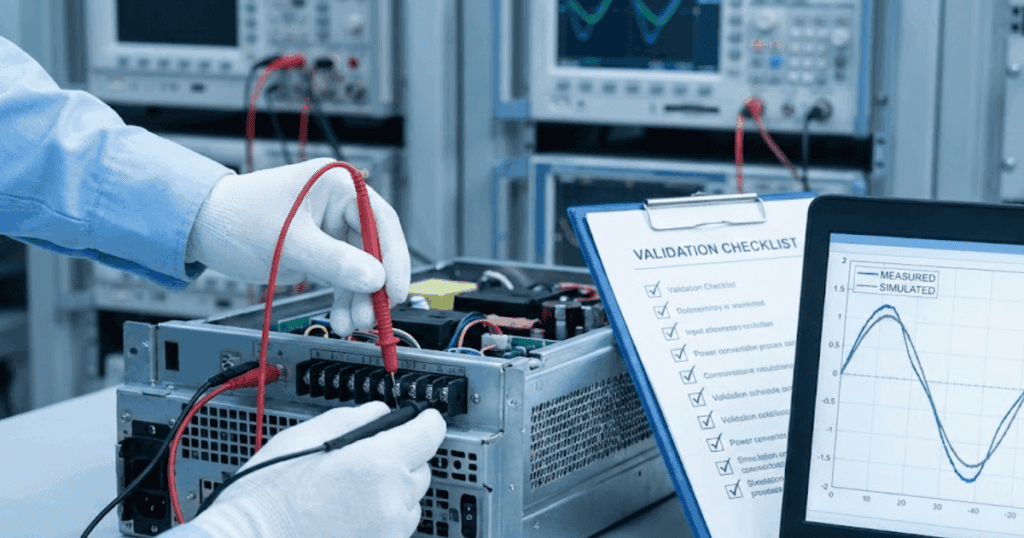
La fiabilité des tests numériques repose sur des modèles validés qui définissent les plages, les limites et les critères de réussite attendus avant toute contrainte matérielle.
Les informations préalables au test sont particulièrement utiles lorsqu'elles hiérarchisent les points critiques et les mesures minimales nécessaires pour confirmer ou infirmer les hypothèses clés.
Les tests matériels fiables s'améliorent lorsque les équipes traitent les incompatibilités entre modèles comme des retours structurés, puis mettent à jour les paramètres, les limites et les séquences de test avec rigueur.
Les tests matériels dans les systèmes d'alimentation et l'électronique de puissance échouent lorsque vous considérez la première mise sous tension comme un exercice de découverte. Un modèle qui correspond à la physique de votre système transforme les tests en confirmation, car vous obtenez les formes d'onde, les limites et les critères de réussite attendus au lieu de devinettes. Cela est important, car un seul test incorrect peut endommager l'équipement, retarder les calendriers et mettre les personnes en danger. À elles seules, les coupures de courant coûtent environ 44 milliards de dollars par an à l'économie américaine, et une mauvaise validation en amont est l'une des causes de ces coûts en aval.
La fiabilité des tests numériques repose sur une validation rigoureuse des modèles, et non sur la multiplication des simulations. Des modèles précis permettent de prédire le comportement, car ils capturent la structure, les paramètres et la logique de contrôle appropriés, puis vérifient ces hypothèses par rapport à ce que vous pouvez mesurer. Lorsque vous utilisez la modélisation pour obtenir des informations avant les tests, vous décidez ce qu'il faut mesurer, ce qu'il faut limiter et ce qu'il faut essayer en premier, avant de commencer tout travail risqué de commutation ou de dépannage. Il en résulte moins de surprises, des données de test plus claires et un travail plus rapide sur les causes profondes lorsque les résultats diffèrent des attentes.
« Les modèles numériques validés rendent les tests matériels plus prévisibles et plus sûrs. »
Les modèles numériques définissent les attentes des tests avant la mise sous tension du matériel
Un modèle numérique facilite les tests matériels en définissant les signaux attendus et les limites avant la mise sous tension. Il permet de prédire les valeurs en régime permanent, les plages transitoires et les seuils de protection. Vous disposez ainsi d'une base de référence pour évaluer les anomalies lors de la mise en service. Il réduit également les risques, car vous pouvez planifier à l'avance les marges de courant, de tension et thermiques.
Un cas pratique est celui d'une équipe de laboratoire qui se prépare à mettre en service un onduleur de 250 kW formant un réseau et alimentant un petit bus de micro-réseau. La première simulation utilise les valeurs de filtre prévues, les gains du contrôleur et une gamme d'impédances de réseau qui pourraient exister au point de connexion. Vous entrez dans le laboratoire en connaissant le courant d'appel prévu, le temps de stabilisation après une variation de charge et la qualité de la forme d'onde aux bornes. Si les pics de courant mesurés dépassent la limite supérieure du modèle, vous vous arrêtez et examinez la configuration plutôt que de continuer.
Les attentes en matière de test fonctionnent mieux lorsqu'elles sont consignées par écrit sous forme d'énoncés vérifiables, plutôt que sous forme de graphiques que l'on consulte rapidement. Vous en tirerez également davantage de valeur si vous considérez le modèle comme un contrat entre les équipes de conception, de contrôle et de test, avec une liste claire d'hypothèses pouvant être remises en question. Cette approche empêche le modèle de devenir un fichier « sympa à avoir » auquel personne ne se fie en cas de pression. Elle oblige également l'étude du comportement du système à rester liée aux mesures que vous pouvez réellement effectuer en laboratoire.
Résultats du modèle que vous devriez obtenir
Point de contrôle que vous avez défini avant la première mise sous tension
Pourquoi cela rend les tests plus fiables
Tensions et courants attendus en régime permanent aux nœuds clés
Les plages des instruments et les limites d'alarme correspondent aux bandes de fonctionnement prévues.
Vous évitez la saturation des capteurs et détectez rapidement les conditions anormales.
Réponse transitoire aux variations de charge et aux variations de consigne
Les critères de réussite comprennent le temps de stabilisation et les limites de dépassement.
Vous séparez les problèmes de réglage des erreurs de câblage et de mesure.
Niveaux de protection et hypothèses relatives au déclenchement
Les seuils de déplacement sont revus en se référant au modèle.
Vous réduisez les déplacements inutiles et évitez les tests dangereux.
Estimations des pertes et des valeurs thermiques selon les profils testés
Les contrôles de refroidissement et les durées de fonctionnement s'alignent sur le chauffage prévu.
Vous évitez les dommages lors de balayages longs ou de transitoires répétés.
Sensibilité aux paramètres incertains tels que l'impédance et le retard
Les cas les plus défavorables sont prioritaires dans le plan de test.
Vous détectez les points faibles tôt plutôt que tard, ce qui vous évite des tests coûteux.
Les études préliminaires permettent de déterminer les angles de fonctionnement, les limites et les mesures nécessaires.
Les études préliminaires vous fournissent des informations qui vous permettent de déterminer ce que vous allez tester en premier et ce que vous allez reporter. Elles identifient les limites opérationnelles en matière de stabilité, de protection ou de température. Elles vous indiquent également quelles mesures permettront de lever les plus grandes incertitudes. Vous gagnez en confiance, car votre premier matériel cible la valeur informative la plus élevée avec le risque le plus faible.
La mise en service de cet onduleur devient gérable une fois que le modèle a balayé les plages de paramètres que vous ne pouvez pas connaître avec précision dès le premier jour. Vous verrez quelles combinaisons d'impédance du réseau et de gains du contrôleur créent des oscillations, et lesquelles restent bien amorties. Vous apprendrez également où la qualité des mesures est importante, par exemple la bande passante du capteur de courant pendant les transitoires de commutation ou le placement de la sonde de tension pendant les tests de défaut. Lorsque le modèle signale une marge de stabilité étroite, vous planifiez des étapes plus petites et des durées d'exécution plus courtes jusqu'à ce que le comportement corresponde aux attentes.
Impédance de réseau ou de charge qui repousse les limites d'amortissement et de stabilité
Pire cas de tension et d'ondulation du bus CC sous transitoires attendus
Courant de phase de crête et di/dt qui définissent des vitesses de rampe sûres
Limites de coordination de la protection qui affectent le moment du déclenchement et les seuils
Signaux qui doivent être enregistrés à haute résolution pour le travail sur les causes profondes
Ces études ne seront utiles que si vous considérez les résultats comme des données de test et non comme des détails de conception. Si un balayage montre qu'un changement de 10 % dans le retard modifie la stabilité, vous donnerez la priorité à la validation des chemins de synchronisation et des hypothèses d'échantillonnage. Si un balayage montre que l'incertitude d'impédance est prépondérante, vous planifierez une étape rapide de caractérisation de l'impédance avant de procéder à des tests agressifs. Le principe est simple : le travail préalable aux tests est utile lorsqu'il réduit le nombre d'« inconnues inconnues » que vous apportez au laboratoire.
Méthodes de validation des modèles qui renforcent la confiance dans les résultats des tests numériques
La validation des modèles renforce la fiabilité des tests numériques lorsque vous vérifiez la structure et les paramètres par rapport à des mesures fiables. Vous effectuez la validation par étapes, en commençant par vérifier les composants, puis en passant au comportement des sous-systèmes. Chaque vérification réduit l'incertitude et diminue le risque de faire correspondre des données pour de mauvaises raisons. L'objectif est d'obtenir un modèle qui échoue de manière flagrante lorsque les hypothèses sont erronées.
On estime que les tests logiciels inadéquats coûtent 59,5 milliards de dollars par an à l'économie américaine, et le matériel électrique à forte intensité de contrôle souffre du même problème de détection tardive et coûteuse. Votre plan de validation doit inclure des contrôles de conservation de base, des contrôles de synchronisation et des contrôles de sensibilité avant de comparer des formes d'onde complexes. Si le modèle prédit une création ou une perte d'énergie qui enfreint les lois de la physique, cela signifie que quelque chose ne va pas au niveau de la structure. Si de petits changements de paramètres entraînent d'importantes variations de rendement, vous saurez où vos efforts de mesure seront les plus rentables.
Les modèles transparents sont utiles dans ce cas, car ils permettent d'inspecter les équations et les hypothèses au lieu de traiter les blocs comme des éléments opaques. SPS SOFTWARE prend en charge la modélisation physique avec des détails de composants modifiables, ce qui est important lors de la validation, car vous pouvez retracer les résultats jusqu'aux paramètres que vous pouvez mesurer et défendre. Vous devrez toujours gérer les choix de fidélité, car le changement de détail, la taille des pas numériques et le timing du contrôleur peuvent tous modifier les résultats. La validation ne consiste pas à aligner les graphiques une seule fois, mais à montrer que le modèle reste fidèle sur toute la bande de fonctionnement que vous prévoyez de tester.
Des modèles précis prédisent le comportement du système en cas de défaillances et de changements de contrôle.
Les modèles précis prédisent le comportement en cas de défaillances et de changements de contrôle, car ils capturent les interactions, et pas seulement les points d'équilibre. Les défaillances exposent les couplages entre les boucles de contrôle, la logique de protection et l'impédance du réseau. Les changements de contrôle exposent la synchronisation, la saturation et la gestion des limites. Lorsque ces mécanismes sont représentés correctement, le modèle devient un moyen fiable d'anticiper les modes de défaillance avant que le matériel ne les détecte.
Le scénario de mise en service de l'onduleur est un bon test de résistance pour la fidélité du modèle, car les comportements « intéressants » se produisent souvent lors d'événements anormaux. Une chute de tension peut repousser les limites de courant et déclencher des changements de mode de contrôle en quelques cycles. Un défaut proche peut déclencher des disjoncteurs de protection, puis créer une séquence de redémarrage avec des étapes d'appel et de synchronisation. Si le modèle inclut des limites, des délais et une logique de déclenchement réalistes, vous pouvez prédire quelles séquences d'événements peuvent être tentées en toute sécurité et lesquelles nécessitent des verrouillages supplémentaires.
La prédiction ne signifie pas une correspondance parfaite entre chaque oscillation. Elle signifie que le modèle identifie correctement le mécanisme dominant et prédit la direction et l'ampleur du changement lorsque vous modifiez une condition. Vous apprendrez également quelles parties de la conception sont robustes et lesquelles dépendent de réglages ajustés qui varient en fonction des tolérances matérielles. Cette clarté permet un meilleur séquençage des tests, car vous pouvez conserver les premières exécutions dans des zones bien comprises et les étendre vers l'extérieur tout en contrôlant les risques.
Transformez les résultats des modèles en séquences de test, contrôles de sécurité et critères.
Les résultats du modèle deviennent utiles en laboratoire lorsqu'ils se traduisent par une séquence de tests avec des règles d'arrêt claires. Vous mappez les plages prévues aux réglages des instruments, aux verrouillages et aux critères de réussite. Vous utilisez également le modèle pour classer les tests, des essais à faible risque et à forte information aux cas plus stressants. Les tests deviennent ainsi une comparaison contrôlée entre le comportement prévu et le comportement mesuré.
Dans le cas d'un onduleur, la séquence commence généralement par des contrôles fonctionnels à basse tension, puis par une synchronisation à faible puissance, suivie d'étapes de charge incrémentielles, et enfin par des tests de perturbation contrôlés. Le modèle vous indique ce qui est « normal » à chaque étape, ce qui vous permet de contrôler la progression en fonction de critères clairs tels que les limites de distorsion des formes d'onde, les pics de courant ou l'augmentation de température sur une durée déterminée. Si la réponse mesurée diffère, vous faites une pause au niveau du test le plus petit qui reproduit encore la discordance, car cela permet d'isoler les causes plus rapidement que de passer à un test plus sévère.
C'est également à ce stade que vous décidez ce qu'il faut enregistrer et à quelle résolution. Un modèle qui prédit les variables d'état clés vous aide à éviter de collecter une multitude de signaux qui ne répondront pas aux questions difficiles par la suite. Vous déciderez également quels paramètres vous identifierez à partir des premières données, puis réintégrerez dans le modèle afin d'affiner les prédictions ultérieures. Cette boucle constitue le lien pratique entre la modélisation et l'exécution matérielle sécurisée.
Erreurs courantes de modélisation qui réduisent la confiance lors des tests matériels
« Les tests matériels gagnent en fiabilité dès lors que le modèle s'impose comme référence et que les équipes s'accordent à considérer les divergences comme des opportunités d'apprentissage plutôt que comme des raisons d'abandonner le processus. »
La confiance s'effrite lorsqu'un modèle cache des hypothèses, ignore des limites ou traite des paramètres inconnus comme des faits avérés. Elle s'effrite également lorsque le modèle est trop détaillé pour être validé, de sorte que personne ne peut expliquer pourquoi il correspond. Un workflow fiable permet de conserver un modèle suffisamment simple pour être défendu et suffisamment détaillé pour prédire les résultats des tests qui vous intéressent. Cet équilibre relève autant d'un choix managérial que technique.
Le mode de défaillance le plus courant consiste à valider une seule forme d'onde « satisfaisante » tout en ignorant la sensibilité et l'incertitude. Un autre consiste à omettre les saturations, les temps morts, les retards d'échantillonnage ou le comportement du verrouillage de protection, puis à s'étonner lorsque le matériel réagit brusquement. Un mauvais alignement entre les points de mesure et les variables du modèle est également un problème discret, car vous finissez par comparer des signaux qui ne sont pas vraiment équivalents. Lorsque ces problèmes s'accumulent, les ingénieurs cessent d'utiliser le modèle pour obtenir des informations avant les tests et reviennent à des conjectures sous la pression du calendrier.
Une exécution rigoureuse permet de remédier à cela, et elle est plus importante que n'importe quel outil. Vous obtiendrez de meilleurs résultats si vous considérez la validation comme une liste de contrôle des affirmations falsifiables, si vous gardez les hypothèses visibles et si vous mettez à jour les paramètres en fonction des premières mesures. Le logiciel SPS SOFTWARE s'inscrit parfaitement dans cette approche, car les modèles transparents basés sur la physique sont plus faciles à remettre en question et à affiner lorsque les données de laboratoire ne concordent pas.
Commencez par une rectification de base et une étape de buck afin que vos formes d'onde passent des contrôles simples et reproductibles.
Ajoutez les détails non idéaux un par un afin que les modèles basés sur les commutateurs restent explicables et débogables.
Sélectionnez le modèle suivant en fonction du comportement que vous devez expliquer et des limites de pas de temps, et non en fonction de la nouveauté de la topologie.
Construisez sept modèles de convertisseurs de démarrage et vous n'aurez plus à deviner le comportement de commutation. L'ondulation et la modulation se transformeront en signaux que vous pourrez vérifier. Nous examinerons les résultats par rapport au même ensemble de référence.
Les nouveaux ingénieurs ne cessent de demander quels modèles de convertisseurs les ingénieurs doivent construire en premier. Nous pouvons répondre à cette question en leur conseillant des circuits simples qui se valident rapidement.
Comment ces modèles de convertisseurs renforcent la confiance dans la modélisation pratique
Un ensemble ciblé de types de convertisseurs relie les états des circuits aux formes d'onde que vous mesurez. Commencez par une modélisation basée sur les commutateurs afin que la commutation et l'ondulation soient visibles. N'ajoutez les versions moyennes qu'après avoir vérifié que la commutation est correcte. Cette routine affine la modélisation CC et CC/CA sans masquer les erreurs derrière le contrôle.
Gel du contrôle à un rapport de service fixe et validation préalable du flux d'énergie. Le LOGICIEL SPS est utile lorsque vous avez besoin de modèles de composants ouverts et inspectables.
Conservez une liste unique de sondes pour tous les modèles et balayez un paramètre à la fois. Les vérifications de l'équilibre de puissance et de la seconde de tension permettront de détecter la plupart des erreurs à un stade précoce.
« Les vérifications de l'équilibre de puissance et du volt-seconde permettent de détecter la plupart des erreurs à un stade précoce. »
7 modèles de convertisseurs que les ingénieurs devraient construire en premier
Ces sept modèles suivent un ordre pratique. Chaque circuit ajoute un concept et nécessite un signal de validation tracé. Construisez chacun d'eux une fois avec des dispositifs idéaux, puis une fois avec un détail non idéal.
1. Redresseur à diodes non contrôlé comme source de courant continu de référence
Un redresseur à diodes non contrôlé enseigne la commutation sans contrôle ni logique de porte. Modélisez un pont monophasé alimentant un condensateur CC et une charge résistive. Tracez les impulsions de courant des diodes et la tension du bus CC, puis vérifiez que l'ondulation augmente avec le courant de charge. Ajoutez une petite inductance de source, observez les impulsions de conduction qui se chevauchent et abaissez le bus. Mesurez l'angle de conduction des diodes et le facteur de crête du courant d'entrée afin de repérer les modèles de source irréalistes. Enregistrez le graphique de l'ondulation du bus CC pour pouvoir le comparer ultérieurement. Ce redresseur devient le lien CC que vous réutiliserez pour les tests de charge de l'onduleur et du moteur.
2. Convertisseur abaisseur pour comprendre le cycle de service et l'ondulation
Un convertisseur abaisseur est un bon point de départ pour la modélisation CC-CC, car les vérifications sont directes. Utilisez un commutateur idéal, une diode, une inductance, un condensateur et une charge résistive avec un rapport cyclique fixe. Vérifiez que la tension de sortie moyenne suit le rapport cyclique d'entrée pendant la conduction continue. Balayez la fréquence de commutation et vérifiez que le courant d'ondulation de l'inductance diminue à mesure que la fréquence augmente. Augmentez progressivement la charge et vérifiez que la sortie se stabilise avec un transitoire défini par L et C. Les personnes qui se demandent comment modéliser les convertisseurs CC-CC devraient commencer par là, puis réutiliser ses sondes sur chaque nouvelle topologie.
3. Convertisseur élévateur pour comportement de commutation non idéal
Un convertisseur élévateur rend visible la commutation non idéale, car les transitions de courant sont brusques. Construisez d'abord le circuit idéal, puis ajoutez un détail tel que la récupération inverse de la diode. Tracez le courant du commutateur à la mise sous tension et comparez-le au courant de l'inductance, car un pic apparaîtra dès que la récupération sera présente. Tracez la tension du commutateur à la mise hors tension et confirmez que le pic transitoire et l'oscillation augmentent lorsque vous ajoutez une inductance parasite. Ajoutez un petit snubber RC et vérifiez que la tension de crête diminue tandis que les pertes augmentent. Ce modèle permet également de tester rapidement la résolution temporelle à la fréquence de commutation.
4. Convertisseur élévateur-abaisseur pour exposer les transitions de mode
Un convertisseur abaisseur-élévateur expose des modes de fonctionnement qui remettent en cause les hypothèses relatives à la polarité et à la conduction. Modélisez le convertisseur abaisseur-élévateur inverseur avec un rapport cyclique fixe et une charge résistive, puis suivez le signe de la tension de sortie et le courant de l'inductance. Balayez le rapport cyclique de 0,2 à 0,8 et vérifiez que la courbe de gain s'accentue à mesure que le rapport cyclique augmente. Allégez la charge jusqu'à ce que le courant de l'inductance atteigne zéro et qu'une conduction discontinue apparaisse. Comparez le gain mesuré dans ce mode à l'estimation de la conduction continue et notez l'écart. La détection du mode doit être basée sur des variables d'état.
5. Convertisseur à découpage isolé pour interaction magnétique
Un convertisseur à découpage impose des composants magnétiques à votre modèle, car l'inductance de magnétisation stocke de l'énergie. Utilisez un élément inducteur couplé avec un rapport de transformation, une inductance de magnétisation et une inductance de fuite. Ajoutez une pince afin que la tension du commutateur reste limitée lorsque l'énergie de fuite est libérée. Vérifiez la rampe de courant primaire pendant l'intervalle de marche et la réinitialisation pendant l'intervalle d'arrêt. Vérifiez que le courant de magnétisation revient au niveau attendu à chaque cycle, ce qui confirme que la réinitialisation fonctionne. Tracez le pic de courant de magnétisation afin de pouvoir repérer le risque de saturation. Augmentez l'inductance de fuite et vérifiez que la pince absorbe l'énergie.
6. Onduleur à source de tension monophasée avec commutateurs idéaux
Un onduleur à source de tension monophasée permet de se familiariser rapidement avec la modélisation CC-CA, car la fonction de commutation est facile à comprendre. Modélisez un pont complet sur un bus CC rigide et pilotez-le avec un motif PWM de base. Exécutez une charge RL et tracez la tension de sortie, le courant de charge et l'ondulation près de la fréquence de commutation. Remplacez le PWM par une onde carrée et comparez le courant RMS et le courant de crête. Ajoutez un filtre de sortie LC et vérifiez que l'ondulation de commutation diminue à mesure que le déphasage augmente. Les équipes qui se demandent comment mettre en place des modèles CC-CA de base peuvent commencer par cet onduleur et une charge RL.
« Construisez chaque fois avec des dispositifs idéaux, puis une fois avec un détail non idéal. »
7. Onduleur triphasé avec modulation de base et dynamique de charge
Un onduleur triphasé permet d'étudier les relations entre les phases, les tensions entre phases et la dynamique de charge dans un seul modèle. Commencez avec une charge RL triphasée équilibrée et une modulation sinusoïdale à un indice de modulation fixe. Vérifiez que les courants de phase sont équilibrés et que les tensions entre phases correspondent à la valeur fondamentale attendue. Balayez l'indice de modulation et vérifiez que la tension fondamentale évolue de manière linéaire jusqu'à saturation. Alimentez le bus CC à partir de votre modèle de redresseur et observez l'ondulation du bus se répercuter sur les tensions de phase. Ajoutez un léger déséquilibre de charge et vérifiez que les courants de phase se décalent comme prévu.
Redresseur à diodes non contrôlé comme source de courant continu de référence
Il vous fournit une liaison CC avec commutation à diodes visible.
Convertisseur abaisseur pour comprendre le rapport cyclique et l'ondulation
Il enseigne les vérifications fiables du rapport cyclique et des ondulations.
Convertisseur élévateur pour comportement de commutation non idéal
Il montre des effets non idéaux tels que des contraintes au niveau des bords de commutation.
Convertisseur élévateur-abaisseur pour exposer les transitions de mode
Cela vous oblige à détecter les modes de fonctionnement à partir des états représentés graphiquement.
Convertisseur à découpage isolé pour interaction magnétique
Il relie les paramètres magnétiques aux rampes de courant et aux contraintes.
Onduleur monophasé à source de tension avec commutateurs idéaux
Il transforme le courant continu en courant alternatif avec une simple validation de modulation.
Onduleur triphasé avec modulation de base et dynamique de charge
Il relie la modulation, les charges et l'ondulation du bus CC en un seul endroit.
Comment choisir le prochain modèle de convertisseur à construire
Choisissez le modèle suivant en fonction des types de convertisseurs que vous devez expliquer. Le travail sur les pertes de commutation nécessite une modélisation basée sur les commutateurs, tandis que le réglage des commandes fonctionne souvent avec un étage de puissance moyen une fois que les formes d'onde sont fiables. Les limites de pas de temps et la fréquence de commutation fixent des limites strictes aux détails du modèle.
Commencez par le modèle existant le plus proche et ajoutez une fonctionnalité, telle que le temps mort ou une charge non linéaire. Le logiciel SPS SOFTWARE est idéal lorsque vous avez besoin de modèles modifiables que les étudiants et les ingénieurs chevronnés peuvent lire sans traduction.
Considérez la création de modèles comme un sport de checklist. Des sondes claires et des graphiques de réussite/échec permettront de garder le calme lors des révisions.