
Contact us
Contact us
Simulation
OPAL-RT engineers discussing real-time power system models at a whiteboard filled with electrical calculations.
Simulation

9 Benefits & Applications of Electrical Simulation

Electrical simulation lets you test, tune, and trust your design long before hardware arrives. When you can iterate in software, you remove guesswork and cut back on costly rework. Your data gets stronger, your confidence grows, and your team stays focused on outcomes that matter. That is how programmes stay on schedule and projects move from idea to validated system.

Engineers, researchers, and technical leads across energy, aerospace, automotive, and academia need proof under constraints. Budgets are tight, lab time is scarce, and hardware is never as early as you want it. Simulation closes those gaps by giving you a safe, rapid, and measurable path from concept to controller. With the right tools, you gain repeatability, traceability, and clarity across every phase.

Why electrical simulation is essential for power system design

Electrical simulation strengthens engineering workflow at every step of power system design. Early in a project, it clarifies requirements and boundary conditions, so your team avoids costly false starts. As designs mature, it offers a controlled setting to test controls, study interactions, and predict response to faults or unusual operating points. Late in the cycle, it supports validation against standards and improves handoff to test rigs and field trials.

For electrical power systems, the stakes are high because interactions between components can be nonlinear, fast, and tightly coupled. Grid codes, safety constraints, and performance targets create a narrow window for acceptable behaviour. Simulation lets you probe outside that window without risk, then guide the design back into a safe and efficient zone. The result is less uncertainty, faster learning, and higher assurance when hardware finally arrives.

9 benefits of electrical simulation for engineers and researchers

Effective teams rely on repeatable methods, trusted data, and rapid feedback that keeps projects on track. Electrical simulation delivers those qualities through validated models, real-time execution options, and rich analysis workflows. You reduce reliance on scarce lab resources and gain the ability to test many more scenarios than physical hardware would ever allow. Stronger coverage, better insight, and clear traceability translate into measurable gains across quality, cost, and schedule.

1. Improves accuracy in electrical power systems analysis

Accurate models sharpen your understanding of electrical power systems and reduce surprises during integration. With parameter identification and system identification methods, you can calibrate models against measured data. That process helps expose hidden assumptions, fix unit errors, and align control targets with physical limits. When models match reality, your simulations become a trustworthy guide for design choices.

High fidelity is not only about detailed component equations but also about the quality of operating scenarios. Load profiles, network contingencies, and switching events must reflect plausible conditions to produce reliable results. Simulation lets you sweep through parameter ranges to stress the design and quantify margins. You end up with traceable evidence that supports safety cases, standards compliance, and internal reviews.

2. Reduces cost and time of physical prototyping

Virtual prototypes let you evaluate architecture decisions before committing to boards, cabinets, or field wiring. You can compare topologies, control strategies, and component ratings with minimal expense. That early clarity avoids excess capital tied up in hardware iterations and saves lab time for the most promising options. Teams that simulate first also find integration issues sooner, when fixes are cheaper and quicker.

Procurement delays and supply constraints often limit how fast a physical prototype can advance. Simulation keeps progress moving while parts ship, reducing idle time for engineers and testers. You can refine control code, validate protection settings, and build automated test suites that later run on hardware. When the prototype shows up, many issues are already resolved, and the build stage moves faster.

3. Enhances performance validation with Electrical modeling software

Electrical modeling software brings structure and consistency to how you validate performance. From block-based modelling to equation-level tools, you can create repeatable test benches that probe efficiency, response time, harmonic content, and stability. These test benches capture requirements as executable checks, so performance expectations remain clear as designs change. Your validation work becomes transparent, reviewable, and easy to audit.

Tool-integrated solvers support multi-rate, switched, and stiff systems that appear often in power electronics and drives. You can pair average models for controls exploration with detailed switching models for waveform accuracy. That mix helps you converge faster, then confirm edge cases with precision. With the right configuration, performance evidence is easy to regenerate and share with technical leaders and auditors.

4. Supports safer electrical system testing before deployment

Testing safety features on physical systems can expose people and equipment to risk. Simulation lets you trigger faults, miswire conditions, and extreme operating points without harm. Protection logic, alarms, and failsafes can be evaluated thoroughly, including timing, selectivity, and recovery behaviour. This approach raises confidence that safety functions will respond correctly under stress.

Hardware-in-the-loop (HIL) adds another layer by running controls against a real-time digital plant. You can validate trip thresholds, isolation states, and restart sequences while hardware sees realistic signals. The test setting stays controlled, repeatable, and observable, which helps teams diagnose issues quickly. Safer experiments lead to quicker learning, fewer incidents, and stronger compliance outcomes.

Electrical simulation lets you test, tune, and trust your design long before hardware arrives.

5. Optimizes renewable energy integration into power systems

Renewable assets introduce variability, inverter-driven dynamics, and grid code requirements that change project complexity. Simulation supports sizing, dispatch strategies, and control tuning for photovoltaic arrays, wind generation, and storage. Grid studies, including short-circuit levels and voltage stability, are easier to conduct repeatedly with consistent conditions. You can analyse impacts at feeder, plant, and transmission levels to guide planning.

Converter control is central to renewable performance, and its tuning benefits from many trials under different conditions. Simulation allows targeted sweeps of irradiance, wind speed, and state of charge to quantify margins. You can test ride-through capability, frequency response, and reactive power support with clarity. The end result is a better plan for interconnection that reduces risk for operations teams.

6. Provides flexibility through advanced Electrical system design software

Electrical system design software gives you the flexibility to adapt models, interfaces, and workflows to each project. Open standards, support for scripting, and import of third-party formats help teams reuse assets they already trust. That flexibility reduces friction between research and test groups, so models stay useful across the programme. When tools adapt to your process, productivity improves naturally.

Integration across design, verification, and HIL is most effective when models serve multiple purposes. The same plant model that guides architecture discussion can feed controller tests and later power hardware tests. With careful configuration, you maintain a single source of truth from concept to validation. That continuity reduces rework, shortens onboarding time, and improves knowledge transfer.

7. Strengthens reliability with predictive fault analysis

Reliability grows when you study failure modes before they show up on a bench. Simulation lets you stage faults at different locations, durations, and severities to learn how systems respond. You can measure recovery time, thermal stress, and control stability after disturbances. That evidence supports design updates that improve robustness without oversizing.

Predictive analysis pairs well with statistical methods that quantify confidence in performance. Monte Carlo studies reveal which parameters drive risk, guiding sensor selection and tolerance targets. You can also evaluate maintenance strategies by testing detection thresholds and alarm logic. The combination of foresight and data reduces unplanned downtime and costly service events.

8. Delivers real-time insights for hardware-in-the-loop applications

Real-time execution brings controller code into contact with a digital plant that behaves like the intended system. Hardware-in-the-loop (HIL) exposes timing bugs, interface quirks, and corner cases that desktop runs may miss. When plant models run on dedicated processors, you can evaluate control tasks at their actual rates. That visibility helps you tune gains, adjust filters, and refine sequencing based on measured response.

Real-time platforms support communication buses, I/O conditioning, and timing that mirror lab setups. Engineers test start-up, shut-down, and fault handling with accurate latency and deterministic behaviour. The work produces evidence that software, hardware, and protection act as a coherent whole. With clearer insight, teams reduce risk before power-up on a high-energy test bench.

9. Expands opportunities for innovation in electrical power systems

When simulation lowers risk and cost, teams have space to try new ideas. You can experiment with novel topologies, adaptive control strategies, and different component mixes without committing to builds. Evidence from these trials helps justify investment in prototypes that truly merit fabrication. Creativity grows when iteration is fast, safe, and measurable.

Innovation also benefits from collaboration across engineering groups, research teams, and labs. Shared models, standard interfaces, and reproducible tests keep everyone aligned on targets. A healthy modelling culture makes it easier to compare approaches and converge on stronger designs. Over time, this practice raises the quality bar across electrical power systems projects.

Effective use of simulation is not only about tools but also about method. Clear requirements, validated models, and disciplined test plans build a steady pipeline of trusted results. Teams that invest in these habits see gains across quality, cost, and schedule. Strong methods, paired with capable platforms, deliver the outcomes stakeholders expect.

Common examples of electrical systems that benefit from simulation

Engineers often ask for practical context, and examples help crystallize where simulation brings the most value. Power electronics, grid applications, and complex controls share similar modelling needs that reward careful study. Effective planning calls for clear test objectives, well-defined operating points, and realistic disturbances. A short sampling of applications shows how these patterns play out from lab to field trials.

  • Microgrids with distributed energy resources: Coordinating storage, photovoltaic arrays, and controllable loads calls for studies of islanding, reconnection, and protection selectivity. Simulation helps size assets, tune droop controls, and verify black start sequences before installation.
  • Electric vehicle powertrains and charging systems: Traction inverters, battery management, and onboard chargers require detailed studies of efficiency, thermal headroom, and electromagnetic compatibility. Simulation supports control development, charger interoperability, and grid impact analysis for depots.
  • Aerospace power distribution and actuation: Weight, redundancy, and strict safety constraints create tight margins for power conversion and distribution. Simulation provides evidence for fault clearing, load sharing, and transient response under flight profiles.
  • Industrial motor drives and converters: High performance speed and torque control relies on precise models of machines, sensors, and power stages. Simulation validates control laws, switching strategies, and protection limits across duty cycles.
  • Protection and control systems for substations: Coordination of relays, breakers, and communication links must be proven for many contingencies. Simulation tests zone boundaries, timing, and sensitivity to ensure dependable clearing without nuisance trips.
  • High-voltage direct current and flexible AC transmission: HVDC links and FACTS devices influence stability, power flow, and voltage regulation across networks. Simulation validates controller interactions, filter design, and converter behaviour across operating ranges.
  • Wind and solar inverter systems: Variable resources introduce fast dynamics and grid code requirements that must be addressed in design. Simulation confirms ride-through capability, reactive power support, and curtailment policies with confidence.

Examples of electrical systems like these demonstrate how careful modelling supports better engineering choices. Strong coverage of operating conditions keeps risk low when projects move to lab tests and field trials. Evidence from simulation also helps align stakeholders on budgets, timelines, and acceptance criteria. Clarity at this stage shortens the path to commissioning and improves long-term reliability.

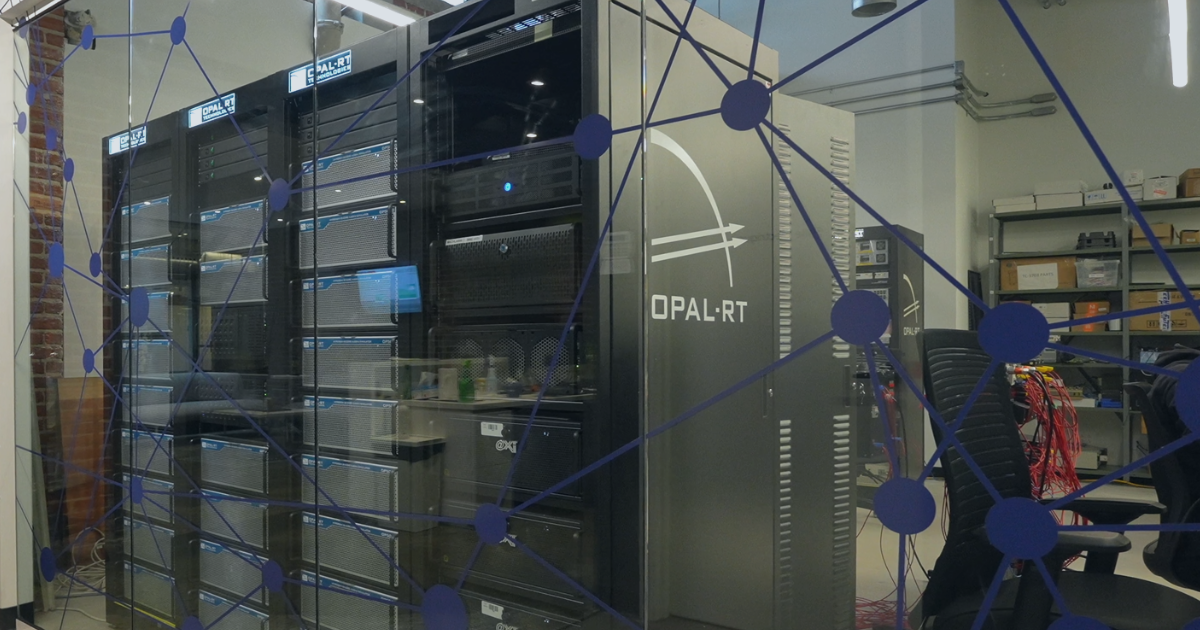
Real-time execution brings controller code into contact with a digital plant that behaves like the intended system.

How OPAL-RT supports your electrical system simulation needs

OPAL-RT focuses on the challenges you face every day in energy, aerospace, automotive, and academia. Real-time digital simulators with CPU and field-programmable gate array (FPGA) resources give you deterministic performance, precise timing, and repeatable I/O conditions. The RT-LAB software suite connects modelling tools you already use, including MATLAB/Simulink, FMI/FMU, and Python, so teams can keep trusted workflows. Toolboxes such as HYPERSIMeHS, and ARTEMiS help you move from averaged models to switching detail, then into hardware-in-the-loop (HIL) without rework.

For teams building complex controls, OPAL-RT supports model-in-the-loop (MIL), software-in-the-loop (SIL), and HIL validation across power electronics, protection, and grid studies. Open interfaces, broad protocol coverage, and modular I/O let you integrate new rigs or extend existing labs with confidence. Cloud and AI workflows are available for test automation and data management, which speeds analysis and improves repeatability. You get a practical path from concept to physical testing, supported by a partner known for precision and reliability.

FAQ

Electrical simulation lets you compare topologies, test control ideas, and size components before any purchase order. You avoid extra board spins, compressed lab schedules, and emergency rework that sprawl budgets. You also create test benches that carry into hardware, so effort spent early keeps paying off. OPAL-RT helps you reduce cost-to-validate with real-time digital simulators and Electrical modeling software that shorten cycles, improve reuse, and keep teams focused on the best build.

You need fidelity, repeatability, and workflow fit across modelling, verification, and hardware handoff. Look for open interfaces, support for FMI/FMU, and strong latency performance for controller studies. Real-time options matter when you want to move from desktop runs to Hardware-in-the-loop (HIL). OPAL-RT offers open, scalable platforms that slot into your toolchain, helping you cut test time, raise confidence, and preserve traceability across phases.

Start with models that reflect grid codes, protection logic, and realistic disturbance cases. Build automated checks for timing, selectivity, and recovery behaviour, then stress them with fault studies. When the same plant models run in real time, your controllers face conditions that match lab equipment. OPAL-RT supports this path with HIL-ready simulators and Electrical power systems libraries, so you can produce clear evidence, minimise risk, and accelerate approvals.

It clarifies inverter control, energy storage interactions, and plant-level coordination, all before site work. You can assess ride-through, reactive support, and dispatch strategies under changing resource conditions. Detailed sweeps show margins that inform protection, sizing, and interconnection. OPAL-RT provides tools for high-fidelity studies and real-time execution, helping you raise performance while keeping commissioning smooth and predictable.

Once control timing, I/O behaviour, and communication buses affect outcomes, desktop runs stop telling the whole story. HIL exposes task jitter, sensor scaling, and start-up sequences under conditions that feel like the lab. You keep the safety of software while gaining timing accuracy for controllers. OPAL-RT makes this step practical with real-time hardware and RT-LAB integration, so you shorten debug, improve coverage, and reach sign-off sooner.

Team working at computer desks in a modern office environment, focusing on a visible workstation.
Simulation

How to Simulate Smart Grids & Renewable Energy Systems Effectively

Modern power grids are integrating renewable energy, and the only way to do it confidently—without blackouts or budget overruns—is by testing every scenario in high-fidelity simulation beforehand. Renewable capacity is surging worldwide; by 2025, renewable energy is expected to surpass coal as the leading source of electricity globally. Engineers are racing to connect more solar panels, wind farms, and battery systems to the grid, but they face a critical challenge: traditional testing methods cannot keep up with the complexity and speed of these new systems. 

Variable generation and power-electronics-driven resources introduce fast transients and intricate control interactions that static studies or slow simulations often miss. The result? Costly surprises like instability, equipment damage, or project delays can emerge late in development. High-fidelity, real-time simulation has therefore become not a luxury but a necessity for modern grids as it provides a safe, realistic proving ground to catch issues early, optimise designs, and ultimately deploy renewable technologies with confidence in grid stability.

Renewable Grid Complexity Outpaces Traditional Testing Methods

Power grids were once relatively predictable, but the surge in renewables and distributed energy resources has introduced a level of complexity that conventional testing can’t handle. Unlike the slow-moving mechanical generators of the past, today’s inverter-based solar and wind systems react to grid disturbances in milliseconds. A fault or fluctuation in one corner of the network can trigger unexpected behaviour in these fast-acting devices, something many legacy planning models fail to predict. Most utilities have not fully adjusted their studies or equipment settings to account for this new reality, leaving blind spots in reliability planning. In fact, a single line fault in California knocked nearly 1.2 GW of solar generation offline, an incident underscoring how older simulations missed inverter control nuances.

Traditional off-line simulations and sparse field tests struggle to capture such rapidly unfolding events. That’s why grid regulators are now pushing for more advanced modelling approaches. The North American Electric Reliability Corporation (NERC), for example, urges utilities to adopt electromagnetic transient domain analysis, as it can portray fast grid events far more accurately than phasor-type models ever could. In short, renewable-rich grids are outpacing old testing methods, and without new strategies, engineers risk flying blind as they integrate high levels of renewables.

Real-Time Digital Twins Offer a Risk-Free Testing Ground

The solution gaining momentum is the use of real-time digital twins of the power system as a risk-free testing ground. A real-time digital twin is essentially a high-fidelity software replica of the grid (or a portion of it) that runs in sync with actual time. This setup allows engineers to plug in real controller hardware or detailed models of equipment and observe true-to-life performance without any danger to people or infrastructure. Engineers can provoke rare faults, crank up a wind farm’s output abruptly, or simulate a battery inverter’s rapid switching, all to see how the integrated system responds.

It’s no wonder that hardware-in-the-loop (HIL) simulation has become a go-to approach for integrating renewables into the grid. This technique merges physical devices with the digital twin so that new controllers, protection relays, or even power electronics can be tested under realistic grid conditions early in development. HIL lets utilities and vendors refine complex control algorithms in a controlled, repeatable environment long before equipment is installed in the field. Critically, this method also exposes how devices behave during extreme conditions that are impossible or impractical to test on an actual grid. With no risk to actual equipment, teams can iterate endlessly to iron out bugs and optimise settings, confident that the real network will be stable from day one.

High-fidelity, real-time simulation has therefore become not a luxury but a necessity for modern grids—it provides a safe, realistic proving ground to catch issues early, optimise designs, and ultimately deploy renewable technologies with confidence in grid stability.

Best Practices for Effective Smart Grid Simulation

Effective smart grid simulation is not achieved by technology alone as it also requires a thoughtful strategy. Seasoned engineers follow a set of best practices to make sure their simulations truly de-risk projects and yield actionable insights:

  • Use high-fidelity models for critical components: Represent the grid’s behaviour in detail by using electromagnetic transient (EMT) models for anything involving power electronics or fast dynamics. High-fidelity modelling captures fast transients and control nuances that simpler models overlook, ensuring the simulation reflects reality for complex renewable interactions.
  • Incorporate HIL testing early: Don’t wait until final prototyping to involve real hardware. Connect controller hardware or even power equipment to the real-time simulator during development; running real devices in the loop uncovers integration issues in a safe environment instead of during on-site commissioning. Early HIL testing keeps costly surprises out of later project stages.
  • Simulate a wide range of scenarios: Push your digital twin through scenarios ranging from normal operations to worst-case disturbances. This includes sudden loss of generation or load, extreme weather events, and multi-fault scenarios. By exploring these “what if” cases methodically, engineers ensure the grid’s control and protection schemes are robust against extreme conditions.
  • Ensure multi-vendor interoperability: Modern grids often mix equipment from many manufacturers. Use simulation to verify that these components work together. For instance, plug a physical sensor or relay into a real-time simulation to see how it communicates with the grid model. This reveals protocol or timing issues early, ensuring different vendors’ devices truly work in concert.

Following these best practices turns simulation from a theoretical exercise into a powerful decision-support tool. When models are accurate, scenarios exhaustive, and hardware integration tested early, the results of a simulation become something project teams can firmly trust. This rigorous approach directly translates to greater confidence when it’s time to implement changes on the actual grid.

Building Confidence in Grid Innovation with HIL Testing

Catching issues before they hit the grid

Hardware-in-the-loop testing shines at catching problems long before any new grid equipment goes live. Integrating real controllers or control code into a simulated grid lets engineers see how their systems respond under realistic conditions. Software bugs, tuning errors, and hidden interactions often surface during HIL trials—issues that otherwise might only appear during a costly field deployment. Identifying and fixing these problems early means fewer emergency fixes and retrofits later on. This early debugging approach directly shrinks development cycles. HIL simulations have been shown to significantly cut overall development time while still ensuring high system reliability. After HIL testing, teams know their design has been battle-tested virtually, boosting confidence as they move to implementation.

Mastering rare and extreme scenarios

HIL also lets engineers tackle extreme grid scenarios that would be impossible to test on an actual system. For example, operators can simulate a once-in-a-century storm impact on the grid to see how their systems cope. In a controlled real-time simulation, they can trigger a sudden voltage collapse or rapid frequency swing and then fine-tune the control response accordingly. This stress testing reveals how new components behave under duress and whether fail-safes kick in as expected. Engineers can then adjust settings or add safeguards long before such conditions ever occur. In short, even rare “edge case” events are anticipated in these trials, leaving far less uncertainty on the real grid.

Accelerating innovation cycles

Integrating real-time simulation and HIL into the workflow accelerates innovation cycles. Traditionally, developing a new grid control or protection device could take years of repeated design, lab tests, and cautious field trials. Real-time simulation compresses this timeline by allowing concurrent development and testing. Engineers can try new ideas in the digital twin, iterate rapidly, and validate concepts without waiting for hardware prototypes at each step. This approach is already standard in aerospace and automotive development, yielding faster results without sacrificing safety. Now the power sector is following suit—using HIL platforms to prototype complex controls and inverter algorithms in months instead of years. And it’s not just about speed—HIL produces better outcomes. Developers can run far more test cases than would ever be feasible physically, gaining a much deeper understanding of system behaviour. In the end, innovative solutions—move from concept to deployment with full confidence in their reliability.

Following these best practices turns simulation from a theoretical exercise into a powerful decision-support tool.

OPAL-RT Enabling Confident Renewable Integration

That same commitment to rigorous real-time testing drives our work at OPAL-RT, where we’ve always believed engineers should be able to push boundaries in the lab without fearing unforeseen failures. We develop open, high-performance real-time simulators and HIL technology that let users replicate complex electrical networks with high fidelity. These tools give engineers and researchers a safe space to experiment with new control strategies, validate multi-vendor integrations, and prove out designs under all conditions. The goal is simple: when it comes time to implement solutions on the actual grid, nothing comes as a surprise.

This perspective—that real-time simulation is fundamental rather than optional—has guided us from the start. As grids incorporate more renewables, we collaborate with utilities and manufacturers to ensure our simulation platforms meet their most demanding needs. By providing flexible hardware-in-the-loop systems and high-fidelity digital models, we help projects deploy new technologies. Ultimately, our mission is to empower energy innovators to move forward with confidence, knowing thorough simulation paved the way for success.

FAQ

You can usually tell if real-time simulation is needed when your system involves power electronics, inverter-based resources, or complex multi-vendor integrations. Traditional testing often misses fast transient responses, leaving gaps that only high-fidelity models can capture. Real-time simulation allows you to uncover these hidden risks before field deployment. With OPAL-RT, engineers gain a safe testing ground that validates designs under realistic conditions while reducing costly surprises.

Digital twins create a living replica of your system that reacts to inputs and disturbances in real time. This means you can safely test faults, extreme conditions, or new algorithms without risking physical equipment. A properly built digital twin makes it easier to validate interoperability across different devices and manufacturers. OPAL-RT provides digital twin platforms that give you this clarity, helping ensure that grid integration efforts succeed the first time.

Hardware-in-the-loop testing bridges the gap between theory and practice by connecting physical devices to a simulated grid. This exposes hidden interactions, communication issues, and performance shortfalls long before the equipment is deployed. It’s a reliable way to stress test controllers and relays under extreme scenarios. OPAL-RT helps you do this with flexible, open systems that make HIL a core part of grid project workflows, reducing delays and protecting investments.

Yes. When you use simulation to test control strategies, validate protection schemes, and evaluate interoperability early, you avoid late-stage rework. Iterating virtually is faster and safer than waiting for prototypes or field trials. This approach allows you to try out far more scenarios than you could physically, accelerating design cycles. OPAL-RT supports this acceleration with high-fidelity tools that let you deliver renewable integration projects on tighter schedules with confidence.

The outcomes you should expect include improved stability, fewer commissioning issues, and smoother integration of renewable resources. Engineers can catch hidden issues early, validate multi-vendor setups, and fine-tune responses to rare events. The net effect is better reliability and reduced costs over the project lifecycle. OPAL-RT helps you achieve these outcomes by providing proven real-time simulation platforms that give you confidence from development to deployment.

1 2 3

Get started with SPS Software

Contact us
Privacy Settings
We use cookies to enhance your experience while using our website. If you are using our Services via a browser you can restrict, block or remove cookies through your web browser settings. We also use content and scripts from third parties that may use tracking technologies. You can selectively provide your consent below to allow such third party embeds. For complete information about the cookies we use, data we collect and how we process them, please check our Privacy Policy
Youtube
Consent to display content from - Youtube
Vimeo
Consent to display content from - Vimeo
Google Maps
Consent to display content from - Google
Spotify
Consent to display content from - Spotify
Sound Cloud
Consent to display content from - Sound
Cart Overview