


Key Takeaways
- EMT and RMS serve different study purposes because they solve different physics at different time scales.
- Protection detail, converter controls, and subcycle effects are strong signals that EMT is the better fit.
- Model quality depends as much on validated parameters and scope control as it does on simulation detail.
Choose EMT when the study depends on waveform detail, and choose RMS when the study depends on slower electromechanical behaviour.
That split matters more now because converter-based generation keeps adding fast controls to systems that were once dominated by synchronous machines. Wind and solar supplied 13.9% of global electricity in 2023, which means more studies now sit closer to inverter controls, fault response, and switching effects. You will get better answers when your model matches the physics that decides the result. You will get misleading confidence when it does not.
“An electromagnetic transient simulation is built for events where the waveform shape changes the outcome.”
EMT tracks waveforms while RMS tracks phasor behaviour
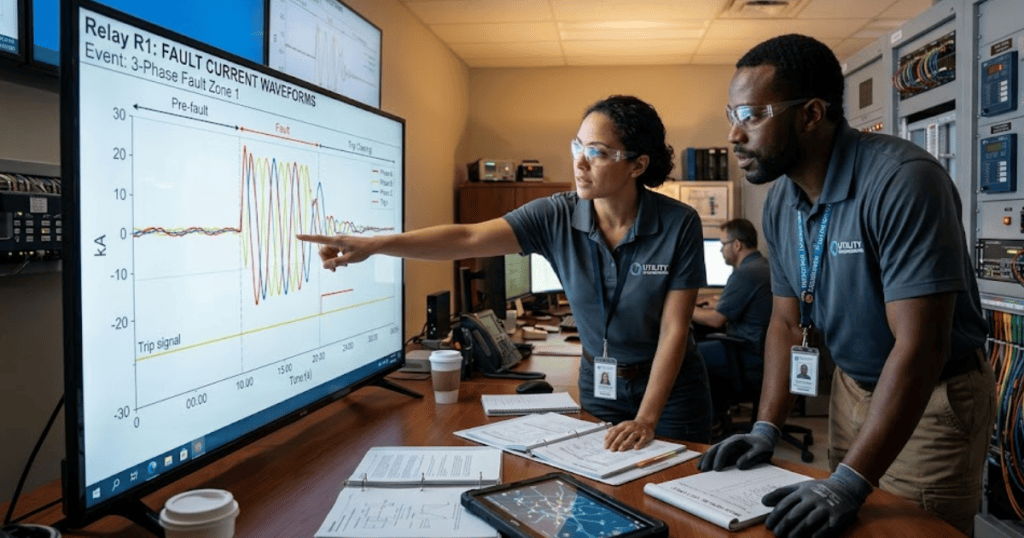
EMT and RMS differ mainly in what they solve and what they ignore. EMT follows instantaneous voltages and currents at very small time steps. RMS replaces fast waveforms with phasors and averaged quantities. You get waveform fidelity from EMT and study speed from RMS.
A feeder fault illustrates the split clearly. EMT will show the exact fault inception angle, the dc offset in current, and the way a breaker or converter responds over microseconds and milliseconds. RMS will show the same event as a balanced or unbalanced phasor disturbance with a much smoother response. That is often enough when you care about voltage recovery, power flow redistribution, or rotor angle movement.
The important point is not model sophistication. It is model relevance. Electromagnetic transient simulation is built for events where the waveform shape changes the outcome. RMS modelling is built for cases where the averaged sinusoidal state carries the answer. If your result depends on what happens within a cycle, the phasor abstraction will hide too much.
RMS models fit stability studies with slower dynamics
RMS models are the right fit when the study question sits on a slower time scale than the power frequency waveform. They capture electromechanical swings, voltage regulation, and frequency response efficiently. They also support large networks and many contingencies without excessive run time. That makes them a practical choice for stability work.
A generator trip study shows why. You usually want to know how frequency dips, how governors respond, how automatic voltage regulators support voltage, and whether rotor angles remain bounded. None of those answers depends on individual switching pulses or travelling wave effects. An RMS model lets you screen many disturbances across a transmission network and compare credible operating cases quickly.
You should still be disciplined about model scope. RMS will not rescue a poor representation of controls, load recovery, or protection logic. It simply gives you a strong fit for slower behaviour. When the pass or fail measure is damping, settling, frequency nadir, or post-fault voltage recovery, RMS will usually give the answer you need with less modelling burden.
EMT models fit studies with subcycle switching behaviour
EMT models fit studies where subcycle detail decides the result. They resolve switching events, fast control loops, saturation effects, and non-sinusoidal waveforms directly. That makes them the correct tool for converter commutation, transformer inrush, and many detailed fault studies. RMS models smooth away those mechanisms.
A transformer energization case is a simple illustration. The inrush current peak depends on residual flux, point-on-wave closing, and core saturation, all of which unfold within fractions of a cycle. An RMS model can approximate the event, but it will not reproduce the actual waveform that a relay, filter, or converter controller sees. The same limit appears with pulse-width-modulated converters and dc-link control interactions.
EMT is not just about getting a prettier waveform. It is about representing the mechanism that causes a trip, an overvoltage, or a control instability. If that mechanism lives inside the cycle, your model needs to live there too. That is why electromagnetic transients matter most when switching detail and non-linear effects are part of the study question.
Study time scale should set your model choice
Time scale is the quickest and most reliable screen for model choice. A study dominated by seconds and electromechanical motion belongs in RMS. A study dominated by microseconds, milliseconds, or point-on-wave effects belongs in EMT. Mixed cases need you to decide which time band actually determines the pass or fail outcome.
Protection and control sequences often look mixed at first glance. A fault may start in microseconds, provoke relay logic over milliseconds, and reshape system frequency over several seconds. Your model choice should follow the decision point, not the event duration. If you only need to know system recovery after a cleared fault, RMS is enough. If you need to know why the relay operated late or why the converter blocked, EMT is the safer choice.
That is also where transparent workflows matter. SPS SOFTWARE gives you a way to keep models inspectable and editable, so you can choose detail level with intent instead of treating the simulator as a black box. Teams work faster when they can see which equations and assumptions are carrying the answer.
| Study focus | What the model choice usually means |
| A frequency dip after a generator trip is mainly a slower system response. | RMS usually fits because waveform shape does not decide the result. |
| A converter control issue appears within a few milliseconds after a fault. | EMT usually fits because fast control interaction is hidden in phasor form. |
| A relay operation depends on fault inception angle or transient distortion. | EMT gives the quantities the relay will actually see during the event. |
| A planning team must screen many contingencies across a large network. | RMS gives broader coverage because the models run faster and scale better. |
| A weak grid study depends on inverter current limits and controller timing. | EMT is usually the safer choice because the deciding physics is too fast for RMS averaging. |
Protection studies often need detail beyond RMS models
Protection studies often need more detail than RMS can provide because relays respond to quantities that change within a cycle. Fault inception angle, current dc offset, current transformer saturation, and voltage transformer transients can alter what the relay measures. EMT will represent those effects directly. RMS will often smooth them into a cleaner event than the relay actually sees.
A distance relay on a long line is a good case. The apparent impedance during the first cycles after a fault can shift because of cvt transients, fault resistance, and waveform distortion. A differential relay can also react badly when current transformer saturation distorts one side more than the other. Those are not minor details when your study asks why a trip happened or why it failed to happen.
RMS still has a place in protection work. It is useful for broad coordination checks, grading margins, and large fault sweeps where the relay measurement process itself is not under test. Once the study moves from settings review to relay behaviour under stress, EMT becomes much more than a refinement. It becomes the model class that matches the protection physics.
Systems with many converters push studies toward EMT
Systems with many converters push modelling toward EMT because converter controls react on time scales that phasor models often compress too aggressively. Grid-following controls, current limits, phase-locked loops, and dc-link dynamics can interact within milliseconds. Those interactions can decide stability, protection response, or equipment stress. RMS can miss them even when the wider network looks slow.
A weak-grid solar plant is a familiar example. Voltage dips, current limiting, and phase tracking can create behaviour that looks stable in an averaged RMS representation but becomes oscillatory or blocked in EMT. That matters more as converter penetration rises. Solar photovoltaic generation rose by 25% in 2023, so you will face more studies where inverter detail is part of the main question.
You do not need EMT for every converter case. A well-validated average-value representation can still support many planning studies. The warning sign appears when control limits, harmonics, dc coupling, or weak-grid interaction sit near the event you care about. Once those features are close to the boundary of acceptable performance, waveform-level modelling stops being optional.
Accuracy gains come with heavier model cost
EMT gives more physical detail, but it also asks for more data, more computation, and more care in model building. RMS asks less from you and often returns answers faster. The better choice is the one that captures the deciding mechanism with the least unnecessary burden. More detail will not help if the extra detail is poorly known.
A plant-level study can illustrate the tradeoff. An RMS network with validated machine and controller models might let you test dozens of contingencies in the time one EMT case takes to set up and run. That speed matters when you are screening operating points, seasonal conditions, or protection settings. EMT becomes costly when switching devices, control blocks, and non-linear elements all require careful parameterization.
False precision is the main risk. An EMT model with guessed controller gains or missing transformer saturation data can look authoritative while answering the wrong question. RMS has its own limits, but it often forces clearer simplification. You will make better choices when you treat model fidelity as a targeted tool rather than a badge of seriousness.
“False precision is the main risk.”
A practical screen for choosing EMT or RMS

You should choose the simplest model that still captures the physics that decides the result. RMS is the right mode when averaged quantities answer the study question. EMT is the right mode when switching, control interaction, fault inception, or relay measurement set the outcome. Clear model purpose will save time and avoid false confidence.
Use this screen before you build or refine a model:
- Choose RMS when your pass or fail metric is frequency, rotor angle, or slower voltage recovery.
- Choose EMT when the result depends on subcycle waveform shape or switching events.
- Choose EMT when relay behaviour depends on saturation, distortion, or point-on-wave effects.
- Choose RMS first when you need broad contingency screening across a large system.
- Choose the model with the best validated parameters when both modes seem plausible.
That judgment gets better with practice, and it improves further when the models stay open enough for you to inspect the assumptions. SPS SOFTWARE fits that kind of work because clear, physics-based modelling helps teams explain results instead of just presenting them. Good studies come from disciplined scope, validated parameters, and the willingness to use less detail when less detail gives the right answer.