
Key Takeaways
- Strong modelling skills for students create a direct link between equations, simulation results, and hardware behaviour, which builds confidence in engineering judgement across courses and projects.
- Engineering modelling basics should span simple circuits, converters, three phase systems, transients, and feedback control, so students can connect early learning fundamentals to more advanced power and grid topics.
- Structured student simulation exercises, including prediction tasks, fault scenarios, and parameter sweeps, help students build repeatable habits instead of relying on trial and error or tool specific tricks.
- Guided modelling work in feeders, small networks, and conversion stages prepares students to reason about system level questions that matter for utilities, research labs, and industrial projects.
- A platform that supports transparent, physics based models and curriculum friendly workflows gives instructors and students a practical way to practise electrical and power system modelling at scale.
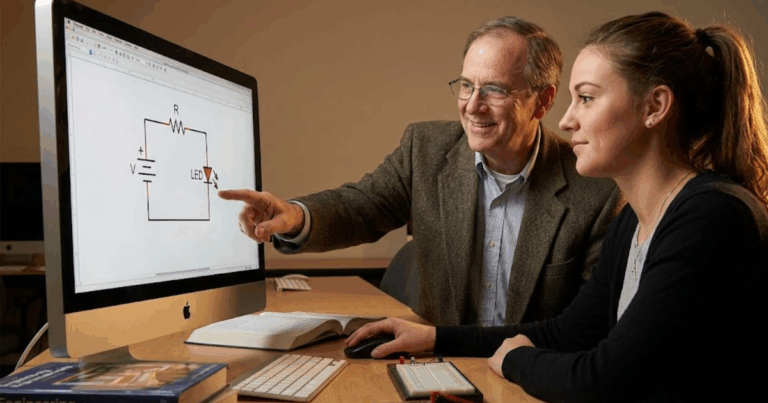
You remember the first time a circuit behaved exactly as your calculations predicted, and how satisfying that moment felt. That feeling is what strong modelling skills give you again and again in labs, projects, and exams. Instead of guessing how a system might respond, you see waveforms, currents, and voltages play out in front of you. Once that connection between equations and system behaviour clicks, every new course in electrical or power engineering starts to feel more manageable.
Many engineering students tell us they feel stuck between theory on the board and hardware on the bench. System modelling closes that gap, letting you test ideas, make mistakes safely, and understand why a design behaves the way it does. For lab instructors and teaching assistants, accessible models turn abstract learning fundamentals into repeatable experiences students can revisit at their own pace. Once you have a solid set of modelling habits, you not only pass courses more confidently, you also build judgement that carries into internships, research projects, and early career roles.
Why modelling skills help students build stronger engineering understanding
Modelling skills for students matter because they create a direct line between course equations and system behaviour on screen. When you adjust a component value and immediately see a change in current, voltage, or speed, the formula in your notes suddenly feels connected to something concrete. That feedback loop helps you notice patterns, such as how resistance shapes power loss or how inductance influences transients, instead of memorizing isolated formulas. Over time, this kind of visual and numerical experimentation trains your intuition, so you can estimate what a system will do before you even hit run on a simulation.
Engineering programmes that emphasise modelling give students more chances to ask productive questions like what happens if this fault lasts longer or how sensitive is this controller to parameter drift. That curiosity is easier to sustain when students can change parameters in seconds instead of reassembling hardware for every scenario. Simulation tools are now a standard expectation in power systems, power electronics, and control teaching, because they let students and researchers probe complex behaviour without expensive lab setups. As you repeat that cycle of predicting, simulating, and explaining results, your engineering understanding grows more connected, and you learn to trust both your calculations and your judgement.
8 modelling skills students need for confident system learning
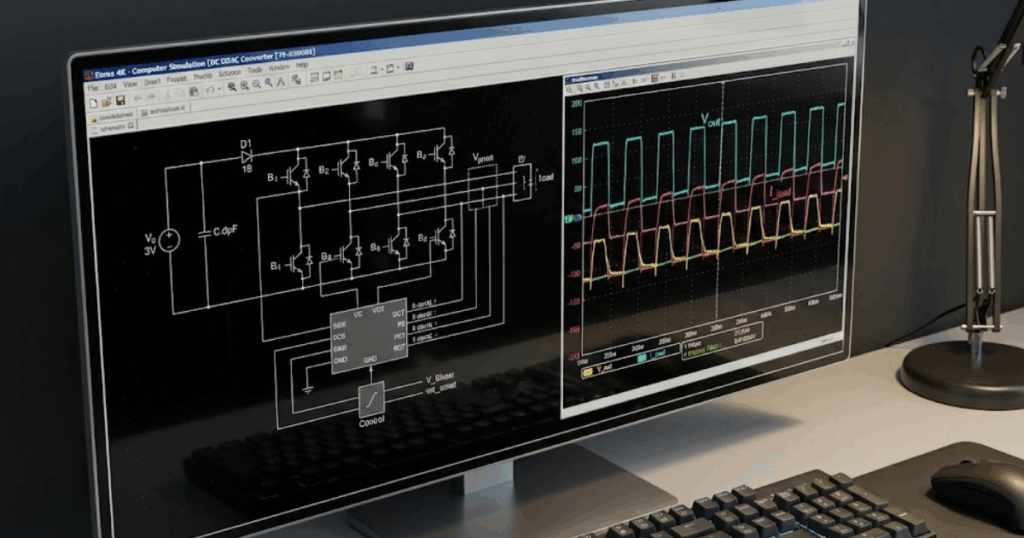
Students often ask which modelling habits will give them the most confidence when courses become more complex. Engineering modelling basics should cover both simple circuits and system level behaviour, so you can connect first year theory to advanced topics later on. The skills in focus here relate to how you set up models, interpret results, and refine your thinking about electrical and power systems. Once you practise these patterns across different assignments and labs, you gain a toolkit that supports clearer reasoning, better documentation, and stronger project outcomes.
1. Building simple electrical circuits to understand core component behaviour
Simple circuit models are where you learn how voltage sources, resistors, capacitors, and inductors behave under basic conditions. Starting with direct current circuits keeps the focus on current paths, voltage drops, and how power flows through each element. As you build series, parallel, and mixed networks, you test Ohm’s law and Kirchhoff relationships instead of just trusting the textbook. Those early simulations also teach you how to set reference nodes, define measurement points, and check that units and magnitudes make sense before you move on.
Once you are comfortable with steady state behaviour, you can introduce sources that vary over time and observe how components respond to ramps, steps, and sinusoidal inputs. You see capacitors charge and discharge, inductors resist sudden changes, and energy shift between elements in ways that match your differential equations. Each of these small experiments helps you spot modelling mistakes quickly, such as misplaced grounds or unrealistic component values. This foundation makes later power electronics and power system models less intimidating, because the basic building blocks already feel familiar.
2. Creating switching converter models to study power electronics fundamentals
Switching converter models introduce you to duty cycles, ripple, and the relationship between switching patterns and averaged behaviour. When you set up a buck, boost, or buck boost converter, you learn how component sizing, switching frequency, and load conditions affect output quality. You also see how parasitic effects, such as non ideal diodes or resistance in inductors, shift performance away from ideal equations. These insights help you judge trade offs between efficiency, size, cost, and control complexity before committing to a hardware prototype.
Working with switching models also trains you to choose appropriate simulation steps, because too coarse a step hides important behaviour and too fine a step wastes time. You learn to view both time domain waveforms and averaged quantities, and to connect switching states to operating modes like continuous or discontinuous conduction. Assignments that ask you to meet a specification such as ripple limits or transient response targets encourage you to iterate between model structure and parameter values. As your confidence grows, you start to recognise recurring converter topologies, and you gain a stronger sense of which structures suit particular power levels or applications.
3. Modelling three-phase systems to understand balanced and unbalanced operation
Three phase modelling skills help you understand how balanced sources and loads create clean power delivery and how imbalances introduce complications. When you build models with phase shifted sources, you see how line and phase quantities relate, and why connections such as delta and wye matter. You can experiment with unbalanced loads, missing phases, or asymmetrical faults, and watch how voltages and currents shift in response. These studies connect naturally to phasor diagrams and symmetrical component theory, turning abstract constructions into measurable quantities on charts.
Three phase models also prepare you for topics like motor control, grid integration, and power quality, since many modern systems rely on multi phase structures. You gain practice setting up measurement blocks for active, reactive, and apparent power, and you see how distortions affect each quantity. This experience makes it easier to understand standards and guidelines related to voltage balance, harmonic limits, and protection thresholds. Students who invest time in these models usually feel more confident when they meet protection, drives, or grid studies later in their programme.
4. Setting up transient studies to follow system behaviour during changes
Transient studies teach you how systems respond to sudden events such as faults, switching actions, or step changes in load or reference signals. You learn to define initial conditions, simulation windows, and appropriate numerical tolerances, so that the results capture the key behaviour without numerical noise. These decisions matter because poor configuration can hide overshoots, oscillations, or instabilities that are important for safety and performance. Careful transient modelling also adds depth to your understanding of energy storage, damping, and resonance in both electrical and electromechanical systems.
Assignments built around transient response often ask you to compare several scenarios, such as faults at different locations or load steps of different magnitudes. That process helps you separate which features of the waveform are tied to model structure and which are tied to parameter values. You also gain practice marking key time points, such as fault clearing or controller saturation, which improves your ability to communicate findings to peers and instructors. Over time you become more comfortable designing tests that stress a system in a controlled way, rather than only checking behaviour in ideal operating points.
“Strong modelling habits across these areas give you a way to connect lectures, labs, and projects into one coherent learning path.“
5. Building control blocks to study feedback behaviour in engineering systems
Control block modelling lets you connect feedback concepts from lectures to actual system responses like overshoot, settling time, and steady state error. You start by building simple proportional, integral, and derivative controllers and observe how each term influences response quality. As you introduce features such as saturation, limits, and anti windup, you learn why controllers that look good on paper may behave poorly in practical settings. Working with block diagrams also strengthens your understanding of reference tracking, disturbance rejection, and the difference between open loop and closed loop behaviour.
Students who practise designing controllers for converters, machines, or small networks gain valuable experience tuning parameters with a clear goal in mind. You learn to balance fast response against noise sensitivity, and to consider how controller bandwidth interacts with plant dynamics. This modelling experience builds a bridge between pure control theory and implementation choices such as sampling rates and digital limits. That bridge becomes important later when you work with embedded targets, test benches, or real time simulations that must respect both numerical and physical constraints.
6. Creating inverter and rectifier models to practise power conversion principles
Inverter and rectifier models help you understand how alternating and direct current systems connect, and how switching patterns shape power quality. You can test different modulation strategies, filter designs, and load conditions, and watch how waveform shape and spectrum respond. Such studies make topics like total harmonic distortion, conduction intervals, and commutation effects far more concrete. They also highlight design choices that affect losses, thermal stress, and electromagnetic compatibility, which are hard to grasp from equations alone.
Working with these converters gives you insight into applications such as renewable interfaces, motor drives, and uninterruptible supplies. You learn to check not only steady state behaviour but also fault conditions, start up sequences, and shut down behaviour. Careful modelling of switching devices and protection elements helps you anticipate stresses that components would face in hardware. Those insights guide better design decisions later when you take on projects that involve higher power levels or stricter standards.
7. Simulating feeders and small networks to strengthen power system reasoning
Feeder and small network models give you practice thinking about how multiple sources, loads, and lines interact as one system. You can vary load placement, line impedance, and source characteristics to see how voltage profiles, fault levels, and losses change. These experiments clarify why concepts like short circuit strength, voltage regulation, and protection coordination matter for safety and reliability. They also help you link per unit calculations to actual equipment ratings, which is an important step for power engineers.
Network modelling encourages you to adopt a systematic approach to naming buses, managing base values, and organising measurements. You begin to recognise typical feeder structures, and you see how small changes in configuration can alter power flow or fault exposure. Students who practise these scenarios feel more prepared for topics like microgrids, distribution planning, and protection studies. That preparation pays off during capstone projects, where models must combine many elements that were once studied separately.
8. Running parameter sweeps to observe how system behaviour shifts with changes
Parameter sweeps teach you to think statistically about models, not just at a single operating point. When you vary values such as resistance, controller gains, or line lengths across a range, you see trends rather than isolated outcomes. This practice is important for understanding sensitivity, robustness, and margins, especially when models are meant to represent equipment that will face uncertainty. You also become more comfortable judging which parameters deserve fine resolution and which can be coarser without losing insight.
Assigning tasks that compare several sweep results encourages students to organise data, create charts, and explain patterns clearly in their reports. You learn to identify safe operating regions, constraint violations, and scenarios where a design no longer meets its specification. These skills transfer easily to research and design work, where you often must justify choices with evidence rather than intuition alone. Parameter sweeps therefore help you move from point based thinking to a structured view of system behaviour over a meaningful range of conditions.
| Modelling skill | Primary concept focus | Typical student outcome | |
| 1 | Building simple electrical circuits | Basic component behaviour, Ohm and Kirchhoff laws | Clear links between equations and simple circuit response |
| 2 | Creating switching converter models | Duty cycle effects, ripple, switching behaviour | Ability to judge trade offs in converter design and meet simple specifications |
| 3 | Modelling three-phase systems | Phase relationships, balance and imbalance | Stronger intuition for three phase quantities and power quality topics |
| 4 | Setting up transient studies | Faults, steps, and dynamic response | Better understanding of stability, overshoot, and critical timings |
| 5 | Building control blocks | Feedback, tuning, and practical limits | Confidence designing and adjusting controllers for different plants |
| 6 | Creating inverter and rectifier models | AC DC conversion, harmonics, filtering | Improved insight into conversion topologies and waveform quality |
| 7 | Simulating feeders and small networks | System interactions, fault levels, voltage profiles | Stronger reasoning about distribution systems and planning questions |
| 8 | Running parameter sweeps | Sensitivity, robustness, safe operating regions | Ability to make evidence based design choices from sets of simulations |
Strong modelling habits across these areas give you a way to connect lectures, labs, and projects into one coherent learning path. Instead of treating each assignment as a new start, you reuse patterns for building, testing, and documenting models across courses. That continuity helps you spot gaps in your understanding early, so you can ask targeted questions and seek extra practice where it matters most. With this foundation in place, you approach more advanced topics such as microgrids, protection, or power electronics control with far more confidence and clarity.
“Once that connection between equations and system behaviour clicks, every new course in electrical or power engineering starts to feel more manageable.“
How students strengthen engineering modelling basics through guided exercises
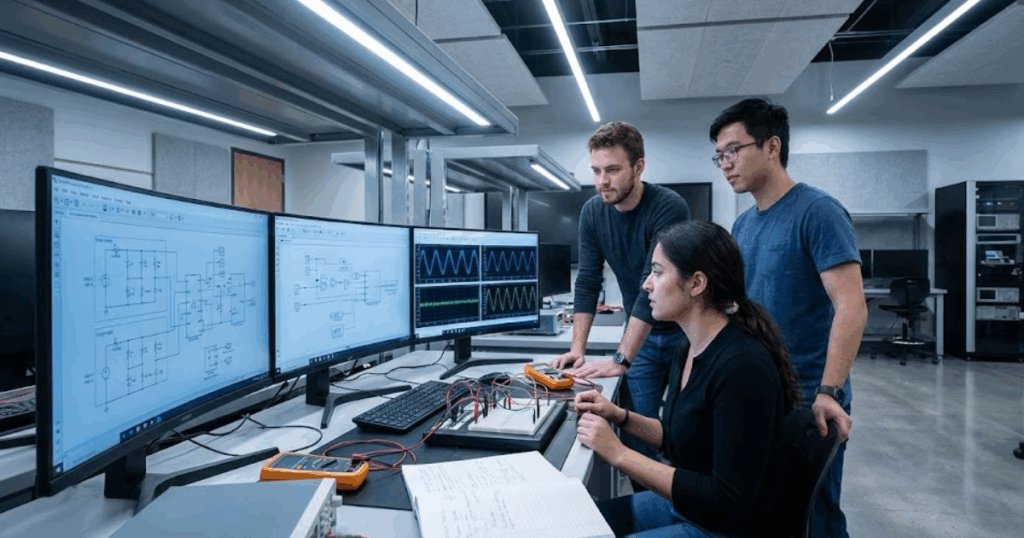
Guided exercises are where engineering modelling basics move from theory to habit. When students work through structured tasks with clear goals, they practise setting up models, interpreting outputs, and reflecting on what they see. Well designed student simulation exercises also make expectations explicit, so you know which techniques to use and which assumptions are acceptable. As your instructors frame activities around learning fundamentals instead of isolated tricks, each exercise becomes another step in a larger modelling journey.
- Progressive lab sequences: Instructors can design a series of models that build on the same base circuit or system across several sessions. Students adjust parameters, add new components, and extend the scope while reusing familiar structures. This approach reinforces good practices such as consistent naming, clean diagrams, and documented assumptions. Over time, the repetition makes model setup feel natural instead of stressful.
- Prediction and check prompts: Before running a simulation, students write down an expected waveform shape, value range, or qualitative response. After the run, they compare results with their prediction and explain any differences. This method encourages active thinking instead of passive button pressing. It also trains students to link parameter changes with physical consequences in a clear, traceable way.
- Fault and disturbance scenarios: Guided tasks that introduce faults or step changes help students see how extreme operating points test their models. Instructors can specify safe but challenging cases, such as short faults, load rejections, or sudden reference changes. Students learn to identify which parts of the model govern response and which measurements matter most. These experiences reduce anxiety later when they meet more advanced stability or protection topics.
- Cross course mini projects: Short projects that span concepts from machines, power electronics, and control give students a chance to reuse skills in a new context. A simple example could involve modelling a converter feeding a motor with a basic speed controller. Students must coordinate assumptions between submodels, which mirrors how larger systems are assembled in practice. This coordination strengthens communication skills as well as technical understanding.
- Peer review of models: Asking students to swap models and comment on clarity, documentation, and assumptions adds a valuable perspective. Each reviewer sees alternative ways to represent the same system, which broadens awareness of modelling choices. The original author receives feedback on naming, structure, and readability that can be hard to notice alone. This cycle builds habits that matter in group projects, research teams, and industrial settings.
- Reflective simulation logs: After significant exercises, students can record a short summary of what they expected, what they observed, and what surprised them. These logs highlight links between concept understanding and modelling outcomes. Over several weeks, patterns emerge about which concepts still feel uncertain, giving instructors guidance on where to spend more teaching time. Students also gain a written record of their progress, which is helpful when revising for exams or preparing portfolios.
Guided exercises work best when they focus less on perfect answers and more on strengthening modelling habits. When feedback highlights how students set up models, justify choices, and interpret results, they build skills that transfer across courses and tools. A mix of structured tasks, prediction, review, and reflection keeps learning active and helps prevent simulation work from turning into routine button pressing. With that structure in place, students approach new software features, larger systems, and more open-ended projects with a sense of control rather than confusion.
How SPS SOFTWARE supports students practising electrical and power system modelling
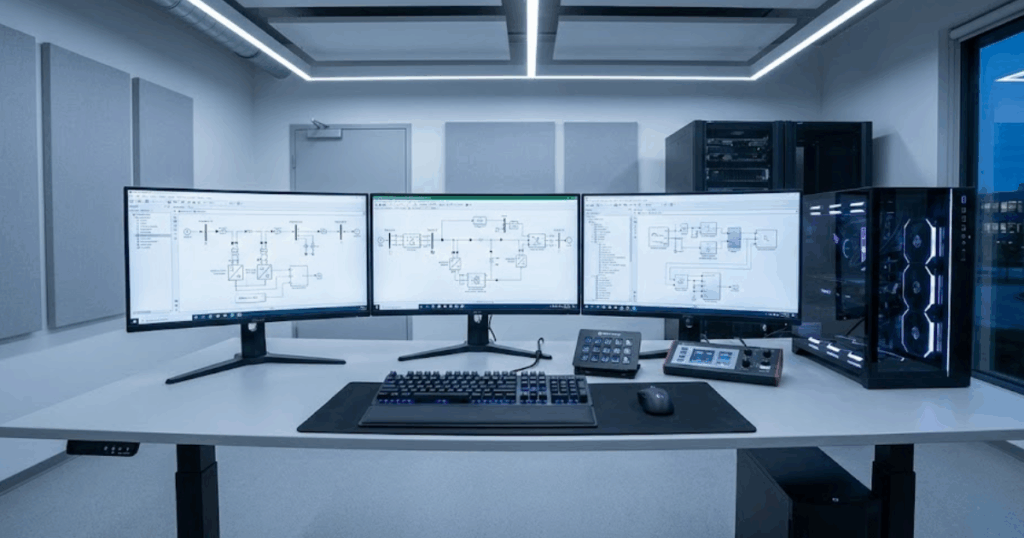
SPS SOFTWARE is designed as a modelling companion for courses that span circuits, power electronics, machines, and power systems. Students can start with small lab style circuits, then progress to converters, control structures, and feeders without having to change how they think about building models. The libraries focus on transparent, physics based components, so you can inspect parameters, equations, and measurement options instead of feeling blocked by black box behaviour. That clarity helps instructors align coursework with software workflows, reducing time spent on tool friction and leaving more space for engineering discussion. For students, this means less energy spent figuring out how to wire a diagram and more focus placed on what the system is teaching you.
Backed by OPAL-RT experience in electrical simulation, SPS SOFTWARE fits naturally into teaching labs that need reliable models for repeated use across semesters. Instructors can share template models, guided examples, and assessment configurations, while students adapt these foundations for projects, research starts, or honours work. Because the same platform scales from introductory exercises to more advanced system studies, departments avoid a split between simple teaching tools and separate research software. Teams also benefit from compatibility with model based design workflows, since models can be documented, versioned, and revisited as students progress. That combination of transparent physics, consistent workflows, and educational focus makes SPS SOFTWARE a dependable platform students and educators can trust.