

Key Takeaways
- Model consistency improves when shared parameters, data, and assumptions are explicitly documented.
- Parameter alignment stays stable when ownership, naming, units, and shared reference data are enforced early.
- A clean model handoff remains repeatable when assumptions and parameter changes are validated and recorded at every boundary.
Model consistency will improve when integration work treats models like interfaces, not just files. A single mismatch in units, defaults, or assumptions will turn into hours of rework. Defects follow. Clean handoffs will feel boring, and that’s the point.
Parameter alignment and data clarity come from making intent explicit before anyone starts “fixing” numbers. Integration teams sit between experts and owners. Your job is to standardize what gets owned, what gets checked, and what must be traceable. That discipline prevents surprises during model handoff.
Why model consistency breaks down during integration work
Model consistency breaks when teams exchange models without a shared contract for parameters, data, and assumptions. People patch mismatches locally, and those patches become silent forks. The model still runs, but outputs drift. Nobody knows which value is authoritative. Confusion spreads fast.
A model handoff from a controls group to a network group exposes this. One side assumes per-unit base values, the other uses absolute units, and the same conversion is applied twice. Plots look stable. Current limits and protection thresholds are now wrong, so debugging starts in the wrong place.
Fixing this takes more than asking for cleaner files. You need a set of practices that catch mismatches before they become local workarounds. We’ll get better results by policing interfaces and traceability, not by polishing every block. Rework drops when the contract is clear.
“The model still runs, but outputs drift.”
5 practices integration teams use to keep models consistent
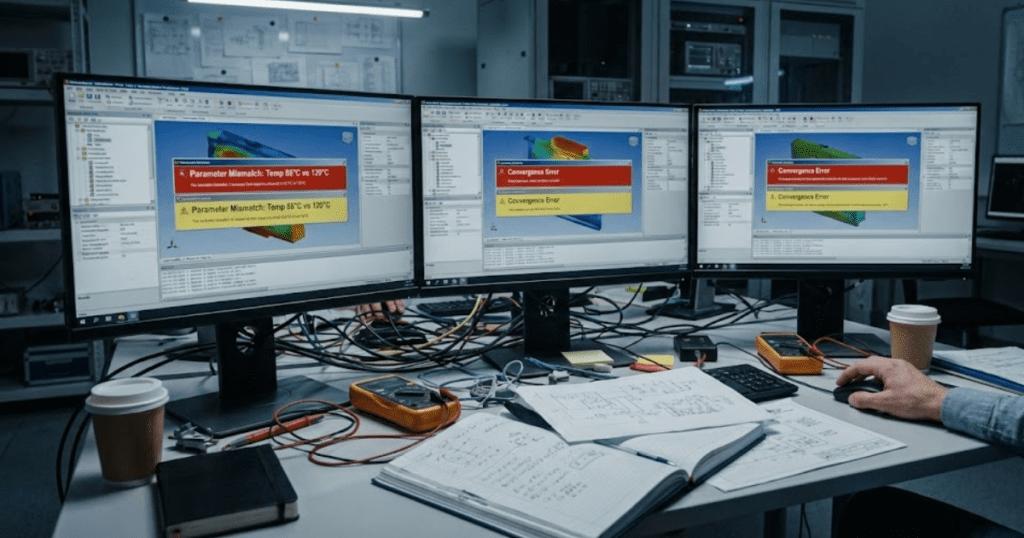
Model consistency comes from repeatable constraints that make mismatches visible early. Each practice targets a different failure mode: ownership gaps, unit drift, copied data, hidden assumptions, and unreviewed edits. When you apply all five parameters, parameter alignment becomes routine rather than late-stage firefighting.
Start with the practices that touch the most shared surfaces: ownership, naming, and units. Add central reference data and handoff validation next. Leave review checkpoints for last so they stay short.
1. Define shared parameter ownership before models move between teams
Shared parameters need an owner, a scope, and an edit rule, or they will drift the moment two teams touch them. Ownership is not about control; it sets who approves changes and who gets notified. One simple ownership map will prevent conflicting defaults and duplicate “master” copies. The owner also maintains default values and a short public change log.
A handoff often involves repeating settings such as base frequency, nominal voltage, or controller gains. One team tweaks a gain to pass a test, another team later “fixes” a different copy, and results split. Assigning a single owner ensures a single source and a clear review path for shared parameters. Keep ownership limited to values that cross boundaries or affect acceptance checks.
2. Lock naming conventions and units before integration begins
Naming and units are the quickest ways to lose data clarity, because small inconsistencies can hide in almost-the-same variables. A locked convention makes mismatches obvious and stops translation work that wastes expert time. Unit rules also prevent errors that look like physics problems when they’re really bookkeeping.
A common integration bug occurs when a parameter called Vbase in one model and V_nom in another has different units, like kV versus V. Someone connects the models, sees values that look reasonable, and moves on. A required unit tag and a naming pattern will flag the mismatch before you trust plots. Keep the convention small: name, unit, reference frame, and sign. If a value is unitless, it must be stated as such in writing.
3. Centralize reference data instead of copying parameters downstream
Copied reference data creates silent forks, because teams adjust copies to fit local tests. Centralizing shared data keeps parameter alignment stable and lets you track changes without chasing spreadsheets. Data clarity improves when every model points to the same dataset and the same version.
Store network base values, device ratings, and test profiles in a single editable reference that models read at build time. If a feeder impedance gets updated after a field review, the change lands once and dependent models update on the next run. Teams working in SPS SOFTWARE often keep that reference versioned and inspectable, so edits stay visible and reproducible. Keep engineering truth separate from temporary tuning, using a local override layer that never writes back.

4. Validate assumptions at every model handoff point
Assumptions will leak across teams unless you check them during the handoff itself. A handoff validation step confirms initial conditions, solver settings, saturation limits, and signal scaling before deeper tests begin. That keeps model consistency tied to intent, not just identical numbers.
One group might start from steady initial states, another starts from zero and ramps up. Both are valid, but mixing them creates false failures that burn days. A short checklist that includes start-up mode, sampling rate, and limiters will catch this early. Pair it with a small acceptance run that produces a known signature, like expected RMS values and expected protection triggers. Record these assumptions in a handoff note attached to the model package every time.
“A required unit tag and a naming pattern will flag the mismatch before you trust plots.”
5. Track parameter changes with lightweight review checkpoints
Parameter alignment is not a one-time task; it is a stream of edits across weeks of work. Lightweight review checkpoints stop silent drift without adding heavy gates. The goal is visible intent, so future handoffs don’t depend on someone’s memory. Shared means anything that affects interface signals, scaling, ratings, or acceptance plots.
Set a checkpoint any time shared parameters change: what changed, why it changed, and what tests were rerun. A short sign-off from the owning team prevents quick fixes that break later integration. The change note also answers “when did this start?” in minutes instead of hours. If you can’t explain the change in one sentence, the checkpoint blocks it until you can. Keep checkpoints asynchronous and focused solely on shared interfaces.
| Define shared parameter ownership before models move between teams | Assigning clear ownership prevents multiple teams from silently changing the same parameter in different ways. |
| Lock naming conventions and units before integration begins | Consistent names and units make mismatches visible early, rather than hiding errors within valid-looking values. |
| Centralize reference data instead of copying parameters downstream | Using a single shared source for reference data prevents forked values from drifting as teams tune models locally. |
| Validate assumptions at every model handoff point | Explicitly checking startup conditions, limits, and scaling ensures results reflect intent rather than setup differences. |
| Track parameter changes with lightweight review checkpoints | Simple change reviews keep shared parameters traceable so fixes do not introduce new integration problems later. |
Applying these practices across handoffs and integration stages

Clean model handoff is a workflow, not a template. Start with ownership and units, then central reference data, then handoff validation and reviews. You’ll know it’s working when discussions shift from “which number is right” to “which assumption is intended.” Results become predictable.
Roll this out one boundary at a time. Pick a shared interface, define shared parameters, and run the same acceptance check after every handoff for two weeks. Add the change checkpoint only after the basics stick, or reviews turn into arguments. The sequence matters because clarity has to come first.
Long-term consistency comes from keeping shared models teachable and inspectable. SPS SOFTWARE works best when the team treats parameters and assumptions as part of the model, rather than as hidden notes. That discipline makes the next integration calmer and easier to debug. New people join and ask hard questions.