Key Takeaways
- Link simulation in education with structured bench time to build prediction skills, safe practices, and clear reporting.
- Focus a power systems lab on measurable competencies, portable models, and repeatable assessments aligned to electrical engineering education.
- Use a unified workflow across models, HIL, and hardware to compare traces, manage latency, and standardize artefacts.
- Select platforms that support power systems lab growth with CPU and FPGA options, flexible I/O, FMI or FMU, and training resources.
- Treat feedback and outcomes as evidence, using scripts, logs, and rubrics to guide continuous improvement across terms.
Students learn best when labs mirror how modern grids and power electronics are built and tested. Clear outcomes, practical constraints, and iterative experiments give learners confidence before they touch high-energy rigs. Simulation, measurement, and control need to fit like puzzle pieces so that each session moves from idea to proof. You can shape that path with a plan that links course objectives to concrete lab time, model fidelity, and safe hardware access.
Faculty, lab managers, and technical leads ask for more than new equipment. They want reliable setups, repeatable exercises, and assessment data that shows where students grow. A modern lab balances software modeling, Hardware-in-the-loop (HIL), and hands-on wiring without stretching budgets. You can get there with practical steps, clear examples, and checklists that reduce rework and scale well across semesters.
Why modernizing your electrical engineering curriculum matters

Graduates now face systems that are software-defined, power-dense, and connected to advanced grids. Programs that treat labs as side notes miss critical skills like model validation, controller tuning, and test repeatability. Modern electrical engineering education centers on learning loops that go from design to verification, then back to refinement. Students build confidence when they can predict a response in simulation, reproduce it on hardware, and explain variances.
Safety, scheduling, and equipment availability also shape outcomes more than any single textbook. Faculty need options when classes are large, parts are back-ordered, or two teams need the same inverter rack. Mixing virtual experiments with structured bench time reduces idle minutes and builds professional habits around planning, logging, and peer review. Curricula that adopt these patterns deliver graduates who can contribute on day one in labs focused on renewable grids, electric drives, and power conversion.
Key competencies your lab curriculum should develop
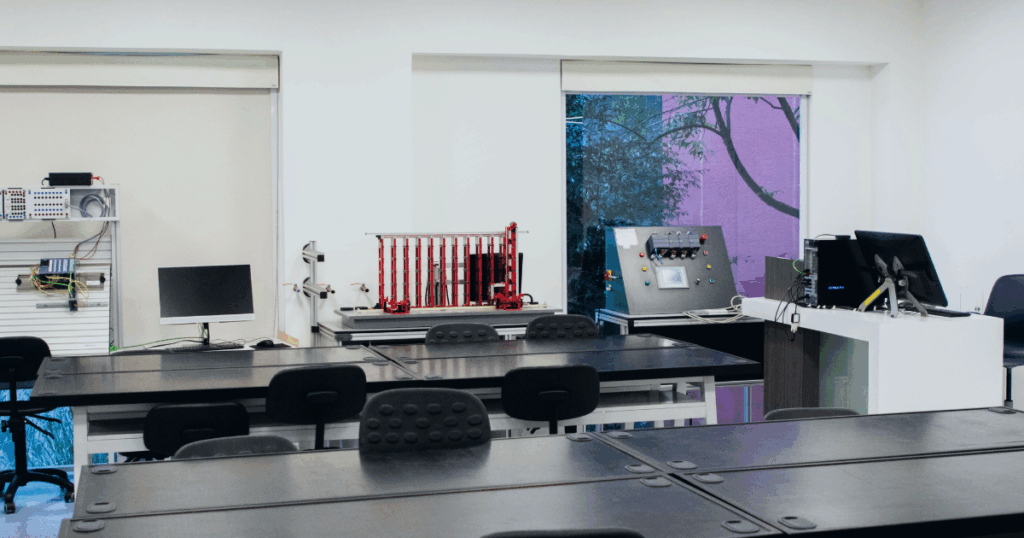
Start with outcomes that match capstone projects, internships, and lab assistant roles. Each competency should map to specific experiments, models, and measurements that are feasible within your facilities. Coverage must span the signal chain from sensing and actuation to control and protection. This scope also respects safety limits while giving students repeated practice with prediction, testing, and reflection.
- System modelling and verification: Students should translate specifications into plant and controller models, then compare predicted and measured responses. They learn to track assumptions, units, and tolerances throughout the model lifecycle.
- Control design and tuning: Learners design regulators, tune gains, and validate stability margins across operating points. They justify choices using plots, time-domain checks, and frequency-domain reasoning.
- Power electronics and conversion: Teams analyze switching behavior, thermal limits, and filter design for typical converters. They relate device parameters to efficiency, ripple, and electromagnetic interference.
- Protection, fault studies, and standards: Students examine protection settings, fault clearing, and device coordination under constrained scenarios. They connect test outcomes to applicable codes and lab safety practices.
- Hardware interfacing and protocols: Learners configure input and output (I/O), sensors, and communication links to close the loop with controllers. They practice wiring, calibration, and timing checks before energizing equipment.
- Software craftsmanship for engineers: Students write clear scripts, follow version control, and build small test benches for repeatable runs. They package models and data so another team can reproduce results.
- Data analysis, reporting, and reasoning: Learners process logs, compute key metrics, and argue conclusions with evidence. They present insights concisely with figures, tables, and a short discussion of limitations.
“Students learn best when labs mirror how modern grids and power electronics are built and tested.”
Competency-to-outcome map
| Competency | Lab outcomes students should demonstrate | Assessment signals |
| System modelling and verification | Build and validate plant models against measured step responses | Prediction error within a stated band, versioned model files |
| Control design and tuning | Tune regulators that meet rise time and overshoot targets | Gain rationale, stability margins, closed-loop plots |
| Power electronics and conversion | Size filters and components for a target ripple and efficiency | Calculations match measured ripple, thermal headroom shown |
| Protection and fault studies | Select settings that isolate faults with minimal service loss | Coordination plots, event logs, and post-fault analysis |
| Hardware interfacing and protocols | Commission sensors and I/O chains with verified timing | Calibration sheets, latency measurements, wiring diagrams |
| Software craftsmanship | Automate runs and data export with documented scripts | Reproducible logs, readable code, and commit history |
| Data analysis and reporting | Produce concise reports tied to objectives and evidence | Clear figures, traceable data, and limitation notes |
Clear competencies help you sequence labs, set expectations, and allocate scarce bench time effectively. Students see how skills stack from week to week, then carry those habits into the capstone and research. Faculty gain rubrics that tie marks to observable behavior and artifacts. Lab managers get a path to maintain quality across semesters and new cohorts.
How simulation complements hands-on learning
Simulation in education offers more than a fallback for limited bench time. It gives students a safe place to test assumptions, isolate variables, and check boundary cases that would take hours on hardware. Models also help faculty stage complexity, starting with low-order blocks and growing to detailed representations. A thoughtful plan links virtual runs, Hardware-in-the-loop (HIL) sessions, and measured reports so that each reinforces the next.
Bridging theory and lab readiness
Learners often meet equations before they meet instruments, and the gap can slow progress. Simulation closes that gap by turning equations into predictions that feel concrete. When a student adjusts a transfer function or a switching duty cycle and sees a waveform shift, the math becomes a tool they own. That sense of control carries into the lab when they meet the same behaviour on a scope.
Structured pre-lab models also foster careful reading of requirements. Students define inputs, limits, and sampling choices, then state expectations in plain language. The habit of predicting before measuring changes how teams use bench time. They arrive ready to test a claim, not to hunt for a starting point.
Scaling complexity without extra hardware
Faculty can present a base case, then extend it with components that would be expensive or unavailable in the lab. A microgrid model can add distributed generation, energy storage, and load profiles without purchasing new rigs. Students learn to run parametric sweeps and examine sensitivities across realistic ranges. These insights guide which cases deserve physical tests later.
This approach also helps students understand interactions. They can observe controller coupling, saturation effects, or converter limits without risking parts. Teams document the boundary between expected and out-of-bounds behaviour, which is a vital professional skill. Hardware sessions then focus on representative cases where the stakes are highest.
Shortening the feedback loop
Quick iteration builds momentum. Students can run dozens of trials, log metrics, and check against success criteria in minutes. Short cycles encourage better questions and leaner designs, which improves use of lab slots. The process also reduces anxiety because progress is visible, tracked, and shared.
Faculty benefit from consistent artefacts. Scripts, configuration files, and data logs make review efficient and fair. Automated checks highlight common issues and free instructors to coach higher-level reasoning. That time shift raises the value of each lab hour.
Improving safety for high-energy topics
Some topics require energy levels that justify a careful approach. Simulation lets learners explore fault energy, protection timing, and unstable modes without risk. They see consequences, think through mitigations, and plan safe test steps. The exercise builds the habit of pausing to evaluate hazards before touching equipment.
A safer plan results when teams can preview challenges. They set current limits, verify interlocks, and confirm sequencing against a checklist. Bench sessions then follow a script that reduces surprises. Students learn that safety is a technical skill, not an afterthought.
Preparing students for industry workflows
Modern teams treat models and data as first-class project assets. Students who commit changes, write short test scripts, and tag results learn practices that transfer to internships. They also learn to discuss model limits, assumptions, and calibration in clear terms. Those habits matter as much as formulas.
Communication improves when results are traceable. A well-labelled plot and a link to a script save time and avoid disputes. Faculty can ask sharper questions because evidence is easy to find. Students see how to support decisions with proof, not opinion.
Balanced use of models and benches teaches accurate prediction, careful measurement, and clear reporting. Students practise a repeatable process that splits complexity into steps, ties each step to evidence, and shows where to improve. Faculty keep lab time focused on the parts that truly require power hardware, test stands, and protective gear. This structure builds capacity without adding new rooms, while still raising the quality of hands-on work.
“The goal is a single learning thread that starts with a prediction, passes through controlled tests, and ends in a short report.”
Designing experiments for a power systems lab
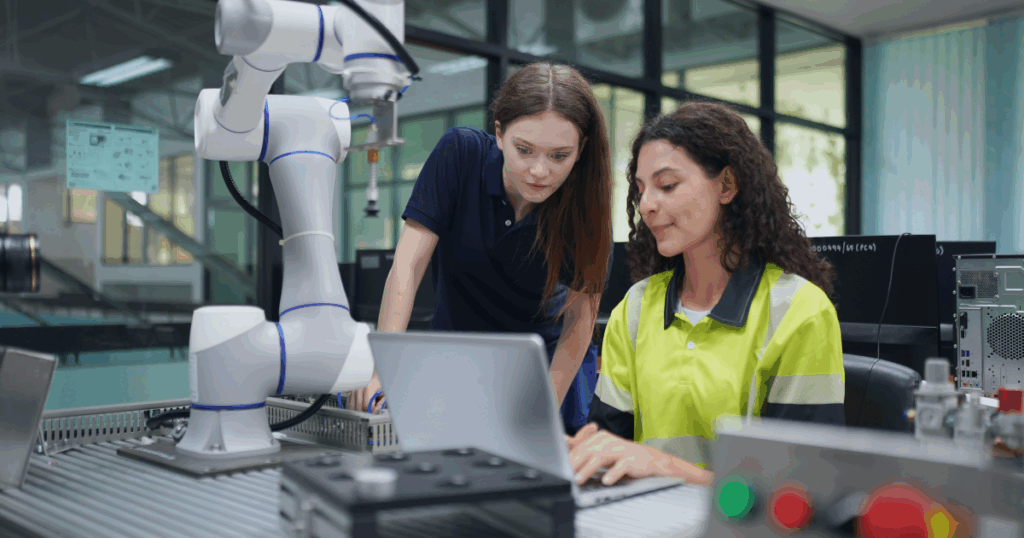
A power systems lab needs experiments that connect component behaviour to system effects. Start with clear learning goals, known input ranges, and expected responses that are easy to compare with models. Each activity should state required equipment, pre-lab modelling tasks, and safety notes that match your campus rules. This approach keeps teams progressing at similar speeds while giving space for stronger students to extend the task.
- Three-phase fault analysis and protection coordination: Students model and then test single-line-to-ground and three-phase faults with current-limited sources. They compare device curves, relay timing, and clearing sequences to validate settings.
- Inverter grid support under events: Teams implement voltage and frequency support modes, then evaluate recovery and stability. They examine how control choices affect power quality and compliance targets.
- Microgrid power sharing with droop control: Students tune droop coefficients and observe active and reactive sharing across sources. They measure the tradeoff between stiffness, stability margins, and bus regulation.
- Synchronous generator excitation and governor dynamics: Learners identify parameters, then test step responses for excitation and speed control. They relate overshoot, settling, and damping to equipment settings and constraints.
- Harmonics, filters, and power quality: Students model harmonics for typical converters, then size and test filters. They capture total harmonic distortion, thermal effects, and compliance against lab thresholds.
- State estimation with Phasor Measurement Unit (PMU) data: Teams fuse time-synchronized measurements with a simplified network model. They examine estimator residuals, bad data detection, and the impact of sensor placement.
- Energy storage control for ride-through: Students implement charge and discharge limits, then test transient events. They assess performance metrics like response time, state-of-charge tracking, and thermal headroom.
Experiments that align with modern grid challenges keep students engaged and build practical confidence. Clear links between pre-lab predictions and measured traces strengthen scientific reasoning. Your safety plan, tool availability, and assessment rubrics turn these activities into repeatable systems that scale. The phrase power systems lab should signal to students that this is a place for careful planning, structured tests, and strong teamwork.
Selecting tools and platforms to scale real-time simulation
Choosing platforms starts with performance and fidelity, then moves quickly to portability and total cost. Real-time targets should support central processing unit (CPU) and, where appropriate, field-programmable gate array (FPGA) execution so you can match solver requirements to timing needs. Interfaces for input and output (I/O) must be flexible enough to connect to student-built rigs and commercial controllers. Reliability, maintainability, and a clear upgrade path matter as much as benchmarks.
Ease of use influences adoption. Support for MATLAB and Simulink, Functional Mock-up Interface (FMI) and Functional Mock-up Unit (FMU), Python, and C gives students and faculty flexible ways to work. Licensing models should scale for undergraduate labs, project studios, and research teams without friction. Documentation, examples, and training resources reduce lead time for new instructors and teaching assistants.
| Selection factor | Why it matters | What to look for | Example indicator |
| Real-time performance | Meets fixed-step deadlines with margin | Deterministic scheduler, CPU plus FPGA options | Stable execution at target timestep with logged latency |
| Model portability | Reuse across courses and teams | FMI/FMU import, Simulink workflow, Python APIs | Same model runs on desktop and target with minor changes |
| I/O breadth | Connects to student rigs and controllers | Analogue, digital, encoder, serial, and Ethernet options | Quick reconfiguration per experiment without rewiring chassis |
| HIL readiness | Supports controller tests and rig protection | I/O fault insertion, safety interlocks, watchdogs | Safe stop and reset procedures verified in lab scripts |
| Scalability | Grows from one bench to many | Multi-user licensing, networked targets, cloud options | Multiple groups run identical setups during peak weeks |
| Usability and training | Lowers onboarding time | Tutorials, examples, and role-based guides | New teaching assistants productive within one week |
| Support and updates | Keeps labs current and secure | Versioned releases, clear deprecation policies | Predictable upgrade windows between terms |
Integrating simulation and hardware testing in one lab
Integrated labs let students move from models to measurements without changing tools or habits. The goal is a single learning thread that starts with a prediction, passes through controlled tests, and ends in a short report. Teams gain confidence when results match within a stated tolerance and discrepancies have clear causes. Faculty gain efficiency because artefacts are consistent, review is faster, and safety steps are embedded.
Choosing test points that bridge models and rigs
Plan measurement locations that appear in both the model and the bench setup. Voltage across a filter, current through an inductor, or controller internal states are typical choices that map well across both contexts. Students then compare predicted waveforms and logged data on a like-for-like basis. The comparison improves reasoning because evidence lines up clearly.
Test point selection also reduces setup time. Probes, wiring, and data capture tools can be standardised once the points are fixed. Students learn to document locations, sensor types, and calibration steps in a shared template. The habit improves repeatability across sections and semesters.
Synchronizing timing and latency across tools
Time alignment matters when you compare traces. Sampling rates, trigger logic, and timestamps must be coordinated so that overlays make sense. Students learn to compute and budget latency in the loop, which sets expectations for controller performance. These skills carry into projects that require tighter timing.
A small time shift can hide a control issue, so the lab should include a simple alignment exercise. Learners measure delays in the I/O chain and verify them against model assumptions. They document the path from sensor to controller to actuator with measured numbers. Those numbers then appear in reports as part of the evidence trail.
Version control and configuration management for labs
Models, scripts, and configuration files change often during a term. Version control gives teams a shared history, a way to propose changes, and a record that supports grading and feedback. Students practise small commits, descriptive messages, and tagged releases for checkpoints. Faculty can review diffs to understand decisions without lengthy meetings.
Configuration management also streamlines setup. Shared templates for solvers, I/O mappings, and logging prevent subtle errors. Teaching assistants can reset a bench to a known state fast and verify settings against a checklist. Downtime drops because recovery steps are clear and repeatable.
Hardware-in-the-loop (HIL) workflows for power electronics and drives
HIL lets teams test controllers against a simulated plant before connecting to energy sources. Students validate control logic, test abnormal cases, and refine gains with low risk. They then progress to hardware with a signed-off checklist that includes limits, interlocks, and pass conditions. The path builds judgment and reduces mishaps.
Faculty can structure the handoff from model-in-the-loop to HIL to bench using the same artefacts. Scripts, plots, and pass criteria stay constant, which keeps the focus on learning rather than setup. Students experience a professional workflow that maps to internships and research projects. Confidence grows because each step confirms the last.
Safety planning and reset procedures
A consistent safety plan is a teaching tool. Students review risk sources, confirm protective settings, and rehearse shutdown actions before energizing equipment. They also learn to log incidents and near misses in a simple format that respects privacy. The process frames safety as a skill to practise and improve.
Reset procedures matter when many teams share the same rigs. Clear steps to return a bench to a known state save time and prevent frustrating faults. Labels, interlock tests, and quick self-checks reduce surprises for the next group. The habit promotes respect for shared facilities and better results.
A unified approach links models, HIL, and bench tests without extra overhead. Students move through a consistent cycle that rewards prediction, evidence, and reflection. Faculty see stronger reports, fewer equipment issues, and safer labs. The lab becomes a place where good habits form, and those habits persist.
Evaluating student outcomes and curriculum feedback
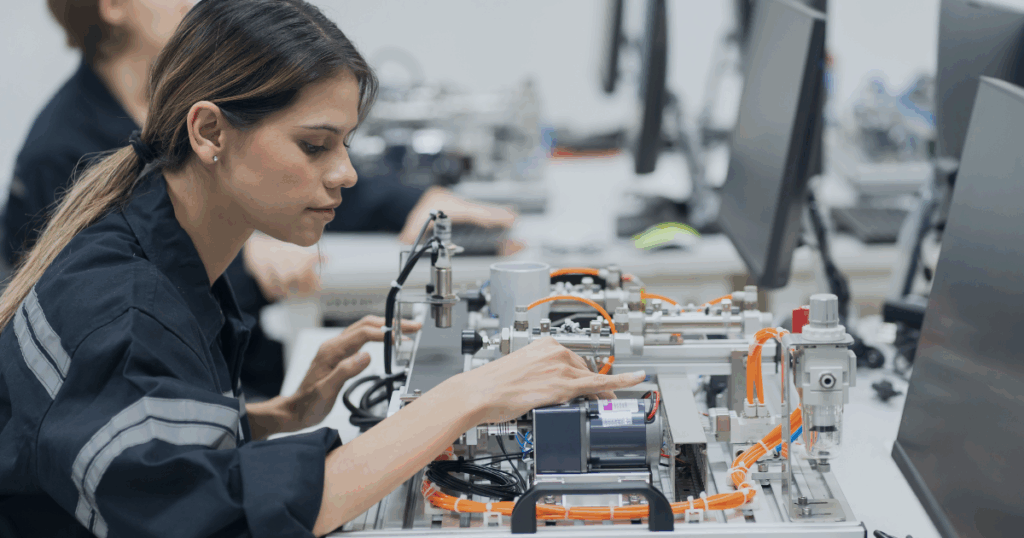
Assessment should show growth, not just grades. A strong system makes expectations clear, provides timely feedback, and drives improvements to labs and teaching. Evidence comes from scripts, plots, measured data, and short writeups, all tied to objectives. The process should be repeatable across cohorts and stable across staffing changes.
- Outcome-aligned rubrics: Use rubrics that mirror competencies such as modelling, control tuning, and data reasoning. Share exemplars so students can calibrate their efforts early.
- Portfolio of artefacts: Ask students to submit a compact set of files that prove claims. Include model snapshots, logs, and one-page summaries with clear links.
- Bench performance checks: Assess simple pass conditions on hardware such as timing margins or ripple limits. Keep checks objective, logged, and repeatable.
- Peer review and reflection: Short, structured peer comments help teams learn to explain choices and accept feedback. Individual reflections surface insights and next steps.
- Usage and reliability metrics: Track bench uptime, reset frequency, and time to first successful run. Patterns point to bottlenecks that merit fixes or redesigned instructions.
- External input where feasible: Invite technical leads or lab managers from partner programs to review capstone artifacts. Their comments help refine rubrics and expectations.
A feedback loop that uses clear evidence helps students and instructors improve together. Small gains each term compound into a programme that feels stable, supportive, and rigorous. The lab becomes a reliable place to practise technical judgement. Graduates leave with habits that make them productive from the first week on a new team.
Simulation modernizes curricula by moving prediction and evidence to the centre of every lab. Students test ideas quickly, document results, and arrive at the bench with a plan instead of guesswork. Faculty spread limited hardware across more learners while reserving benches for the cases that matter. The approach also builds professional habits around version control, scripting, and traceable results.
A modern power systems lab pairs accurate models with safe, well-instrumented benches. Experiments are staged, predictable, and tied to competencies such as protection, converter control, and system stability. Hardware is used where energy, timing, or measurement depth adds value, and simulation handles the rest. Assessment relies on evidence that any reviewer can repeat and verify.
Two or three students per bench usually keeps everyone engaged while leaving enough space for safe wiring. One student drives the instrument, one watches the model or script, and one records data and timing. Teams rotate roles across runs to keep skills balanced and assessment fair. Larger groups can still work, but time per person drops, and safety supervision becomes harder.
Comfort with complex numbers, differential equations, and basic linear algebra helps learners reason about models and stability. Coding skills in MATLAB or Python reduce friction during pre-lab work and data analysis. Familiarity with version control makes collaboration smoother and reduces lost work. Short primers at the start of term can close gaps without delaying lab progress.
Start with a pilot in one lab section, measure setup time, and refine instructions. Keep legacy rigs running while new benches prove their reliability and safety procedures. Share artifacts across courses so models, scripts, and rubrics stay consistent and reusable. Expand once the pilot shows clear gains in throughput, quality of reports, and student confidence.