
Key Takeaways
- Start with a clear study question and set model fidelity only where it changes the outcome, since extra detail in the wrong place will slow simulation without improving trust.
- Keep physics, controls, and numerics consistent across the full chain from device parasitics to PWM timing to EMT time step, because small mismatches will distort harmonics, losses, and fault response.
- Use validation as a gate, not a formality, with checks that separate electrical behaviour, control timing, and solver sensitivity so results stay stable across operating points and disturbances.
Accurate power converter and inverter models come from disciplined modelling choices.
Converter results go off the rails when fidelity, solver settings, and control timing do not match the question you need answered. Grid studies now lean heavily on inverter behaviour, and renewables supplied 30% of global electricity generation in 2023. That scale leaves little room for hand waving around switching, limits, and protection response.
“Accurate power electronics modelling is less about adding detail everywhere and more about placing detail where it changes the outcome.”
You will get better confidence when you treat converter modelling as a chain of choices that must stay consistent from devices to controls to electromagnetic transient simulation time steps. The sections below focus on those choices, the tradeoffs they create, and the checks that prevent false certainty.
Define modelling goals and required fidelity for converter studies

Start by locking down the study outcome, then set the minimum model detail needed to answer it. Converter modelling always trades speed for waveform detail, and the wrong trade creates convincing but wrong results. Fidelity must match the phenomena that matters, such as harmonics, protection triggers, or control stability. A clear goal also sets the acceptable time horizon and solver time step.
Good goal setting also forces boundary decisions that quietly dominate results, such as what sits outside the converter model and what is pulled inside it. Draw a line around what you will trust as a fixed network and what you will treat as a controlled power electronic system. Make the acceptance criteria explicit early, since you will use it later during validation and tuning.
- What measurable output will you trust, such as current ripple or voltage sag depth
- Which frequencies must be correct, from fundamental to switching sidebands
- Which events must be correct, such as faults, limit hits, and restarts
- What time window must be covered, from milliseconds to seconds
- What accuracy check will decide pass or fail against a benchmark
Choose switching averaged or hybrid converter model structures
Switching, averaged, and hybrid structures each answer different questions, and none is universally best. Switching models resolve commutation and PWM ripple but cost time step and runtime. Averaged models preserve control dynamics and power flow while discarding switching detail. Hybrid approaches keep switching where events matter and smooth the rest.
Pick the structure by asking which mechanism changes the decision you need to make. Harmonic compliance, dead time distortion, and semiconductor stress need switching detail. Controller tuning, weak grid stability, and active power setpoint response often fit averaged models if you represent limits and delays faithfully.
| Study focus | Model structure that fits | Main tradeoff you accept |
| Control loop tuning checks | Averaged converter with limits | Switching ripple is removed |
| Protection and fault clearing | Hybrid with switching near events | More setup and calibration work |
| Harmonics and dv or dt stress | Full switching with parasitics | Small time step and long runtimes |
| Energy yield and thermal trends | Averaged with loss models | Fast transients are simplified |
| EMI filter interactions | Switching with detailed passives | Parameter sensitivity increases |
Hybrid models only help when the handoff is clean. Keep state variables consistent and avoid hidden filters that shift phase, since that will mask instability and distort converter behaviour.
Build device and passive component models with correct parasitics
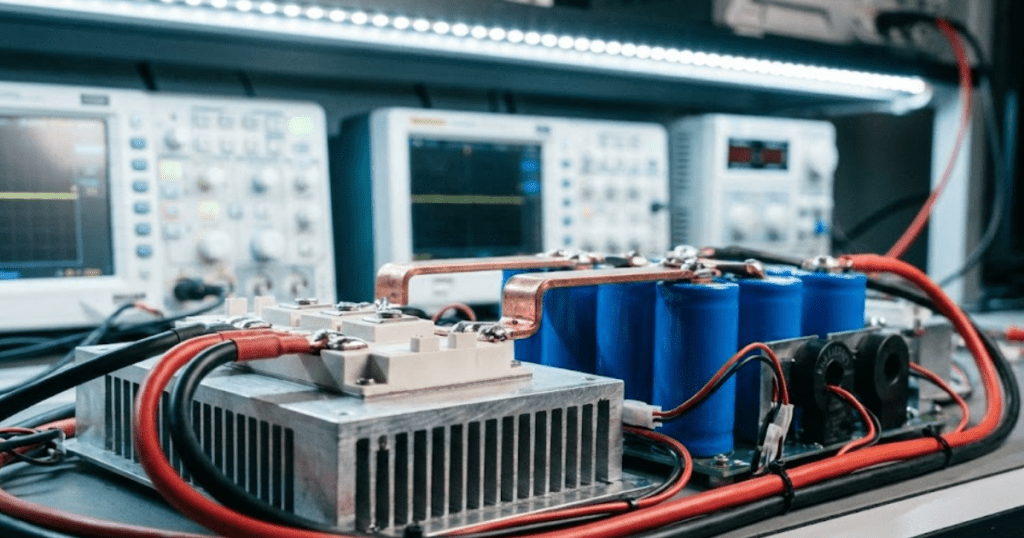
Device models and passive parasitics control switching loss, ringing, and harmonic content, so idealized parts will mislead you. Semiconductor on state voltage, reverse recovery, and nonlinear capacitances alter current and voltage edges. Inductor and capacitor ESR and ESL shift damping and resonance. Parasitics must also match the physical layout scale you intend to represent.
Start with the simplest non ideal set that changes your answer, then add detail only when the acceptance check fails. Snubbers, DC link capacitance, and stray inductance often dominate dv or dt and overshoot, so they deserve attention even when the control model is perfect. Thermal coupling can stay outside the EMT model for many studies, but you still need a loss representation that is consistent with your switching waveforms.
Parameter quality matters more than parameter count. Treat vendor curves, lab measurements, and extracted parasitics as data you version and review, not as values you type once and forget, since small errors in capacitance or stray inductance can shift resonance enough to change protection triggers.
Represent PWM modulation and dead time in inverter simulation
PWM and dead time decide the waveform your network actually sees, so modelling them carelessly will flatten harmonics and hide distortion. Carrier based modulation and space vector modulation differ in switching patterns and harmonic distribution. Dead time changes the effective phase voltage based on current direction, and that creates low order distortion. Modelling also must match sampling, update rate, and gate timing assumptions.
Consider a two level three phase inverter with an 800 V dc link, 10 kHz PWM, and a 3 microsecond dead time feeding an L filter and a stiff 400 V line to line grid. A switching model that includes dead time and current polarity logic will show a clear shift in the fundamental voltage and added low order harmonics, while an ideal switch model will not. That difference will also shift current controller effort and can change limit hits during voltage sags.
Dead time compensation belongs in the control model if the physical controller uses it. Keep the gate commands aligned to the simulator time step so dead time is not quantized into something much larger than intended, since that will create distortion that looks like a hardware issue when it is only a modelling artefact.
Implement control loops and digital delays for stable results
Control modelling must include sampling, computation delay, and saturation behaviour, since those features set stability margins. A continuous controller dropped into an EMT model without discretization will overestimate phase margin. Digital delay also interacts with the network impedance and can create oscillations that look like weak grid problems. Limits, anti-windup, and rate constraints shape fault response and recovery.
Start with a control timing budget that matches the intended platform. Represent sample and hold, PWM update timing, and any filtering used for measured voltage and current. Keep the controller time base consistent with the electrical time step so the loop does not see noisy derivatives or artificial phase lag.
Fault response deserves special care. Current limits, voltage ride through logic, and phase locked loop behaviour set the output during sags and phase jumps, so you will want those blocks to be explicit and inspectable rather than hidden inside black box elements.
Select EMT solver settings and time steps for converters
EMT simulation for converters lives or dies on solver stability, time step choice, and event handling. Switching edges, discontinuous conduction, and control updates introduce stiffness that can destabilize a loose solver. The time step must resolve the fastest event you care about, not the slowest behaviour you hope to study. Poor settings will quietly distort losses, harmonics, and peak currents.
Inverter simulation matters because inverter-based generation is no longer a niche case, and wind plus solar supplied 13.4% of global electricity in 2023. That level of penetration pushes planners and operators to trust EMT results during faults, energization, and control interactions. Solver choices become part of the engineering outcome, not just a numerical detail.
Pick a fixed step only if it resolves switching and control timing without excessive runtime. Variable step methods can work for averaged models, yet they still need guardrails around discontinuities and limit blocks so the solver does not step over the event that matters.
Set initial conditions and operating points to reduce transients
Initial conditions decide whether the first cycles of your simulation are physics or startup noise. A converter starting with empty DC link capacitors and zero controller integrators will create large artificial transients. A good operating point sets voltages, currents, and controller states close to steady operation before events occur. That keeps analysis focused on the disturbance you care about.
Use a staged startup that matches the intended sequence, such as network energization, DC link charge, phase lock, and current loop closure. If the study is a fault, start from a solved steady state so the fault is the first major change. If the study is a setpoint change, ramp references smoothly to avoid step commands that a physical controller would never issue.
Controller initial states deserve the same attention as electrical states. Integrators, filters, and phase locked loop states should reflect steady measurements, or you will misread the settling behaviour as a tuning problem.
Validate models against measurements and known converter benchmarks
Validation is the step that turns a model into something you can trust for choices that carry risk. Compare against measurements when you have them, and against published benchmarks when you do not. Start with steady state power balance and fundamental phasors, then move to harmonics and transients. Each validation layer should reduce uncertainty, not just confirm what already looked right.
Separate validation targets into electrical, control, and numerical checks. Electrical checks include dc link ripple, filter resonance, and harmonic spectra at key operating points. Control checks include step response, limit behaviour, and recovery after disturbances. Numerical checks include time step sensitivity and consistency across solvers when the physics is unchanged.
Transparent, editable models make this work practical because you can trace an error to an equation or parameter instead of guessing. SPS SOFTWARE is often used in teaching labs and research teams for this reason, since the component equations and parameters stay visible for review and adjustment.
Fix common modelling mistakes that distort losses and harmonics
Most modelling failures come from a few repeatable mistakes, and fixing them is a discipline, not a last minute patch. Ideal switches hide loss and ringing. Missing parasitics shift resonances and can erase harmonic peaks. Misaligned control timing can create artificial stability that disappears on hardware, so the model must be audited like a design.
“Good converter modelling is a habit of consistency across layers, not a hunt for the fanciest block.”
Start with a short checklist and apply it every time the model changes. Confirm that the switching frequency, PWM update rate, and dead time align to the simulation time step. Check that passive values include ESR and ESL where resonance matters, and confirm that device loss calculations use the same waveforms you simulate. Run a time step sensitivity check so you know the waveform is not a numerical artifact.
Teams that treat models as inspectable engineering objects get repeatable outcomes and fewer late surprises, and SPS SOFTWARE fits naturally into that workflow when you need physics based transparency you can review and teach from.