

Key Takeaways
- Grid forming controls must be modelled with clear physics based assumptions so stability evaluation reflects how inverter dominated networks actually behave during faults, load changes, and switching events.
- A structured approach that combines average, RMS, and detailed electromagnetic transient models helps engineers and students match model fidelity to each study while keeping control structures transparent and reusable.
- Grid support features such as voltage regulation, frequency droop, virtual inertia, and fault ride through need explicit representation and realistic limits to give credible results for grid support features and stability evaluation.
- Control tuning for droop gains, inner loops, and protection related logic directly shapes inverter response to disturbances, which means careful tuning in the model is essential before any settings reach hardware or the lab.
- Validation and clear documentation turn grid forming control models into trusted shared tools that support teaching, research, and project work, instead of isolated diagrams that are hard to reuse or justify.
Grid forming controls only feel mysterious until you sit down with a model that actually makes sense. When you work with inverter‑dominated networks, you see how quickly stability can slip if controls are not represented honestly. Assumptions that were fine for synchronous machines can hide issues once converter stations carry more of the system. Careful modelling turns those hidden behaviours into waveforms and numbers you can reason about.
Power systems engineers, researchers, and students all feel the pressure to represent grid forming controls accurately without getting lost in unnecessary detail. You need models that stay close to physics, highlight stability limits, and still run within practical simulation times. You also want a structure that supports repeatable studies, clear documentation, and open discussion in your team or classroom. A thoughtful approach to grid forming control modelling helps you answer tough questions with confidence instead of guesswork.
Why grid forming controls matter for stability evaluation
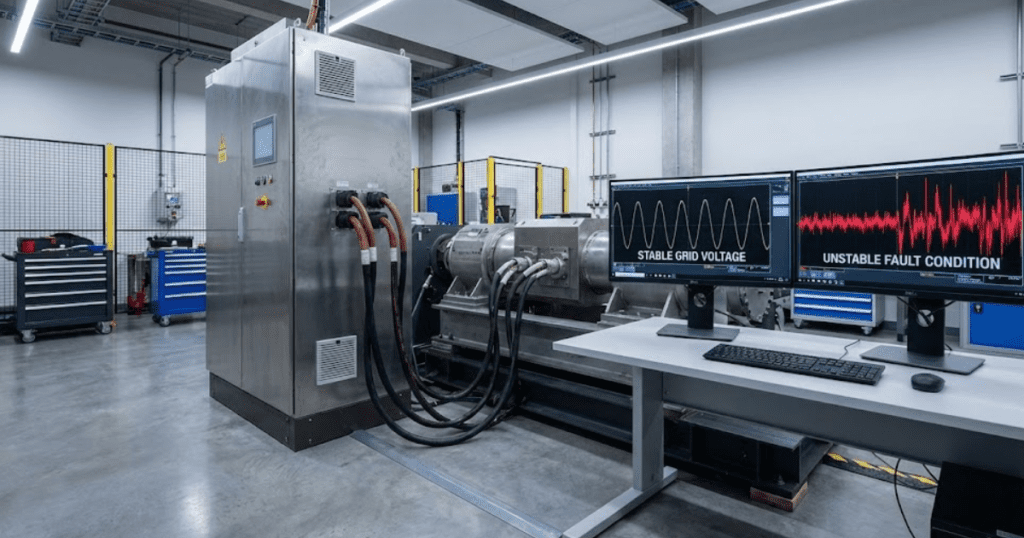
Grid forming controls set the voltage and frequency reference for converter‑based resources, so they sit directly at the centre of stability evaluation. When these controls are tuned well and modelled clearly, the inverter behaves like a stiff and predictable source that supports surrounding assets. When they are approximated or oversimplified, you can miss interactions that trigger oscillations, poor damping, or even loss of synchronism between converter clusters. A realistic model helps you see how grid forming controls actually respond to faults, load steps, and connection or disconnection of lines and resources.
Engineers use grid forming controls to provide functions that synchronous machines used to offer by default, such as inertia, damping, and voltage support. That shift makes the control loops themselves part of the stability story, not just auxiliary details around a main generator model. High renewable penetration, weaker interconnection points, and more converter‑connected loads all increase the sensitivity of stability evaluation to these control behaviours.
Careful modelling of grid forming controls turns stability studies from rough estimates into results you can argue for in project reviews and academic work.
How engineers model grid forming controls for detailed studies
Accurate models of grid forming controls grow out of a structured approach instead of ad‑hoc block diagrams. Engineers pick a modelling level that matches their study objectives, then shape control structures around that choice. Careful selection of reference frames, measurement filters, and switching representations helps keep numerical behaviour healthy. A consistent framework lets you reuse models across projects, compare different control strategies, and teach students with the same structures used in industry.
- Average converter models with detailed controls: Many teams start from an average model that neglects switching ripple while keeping the full control hierarchy. This format supports stability evaluation, protection interaction studies, and long time‑domain simulations without excessive runtime. You can include inner current loops, outer voltage loops, droop functions, and grid support logic explicitly. Students also find average models helpful because they can focus on control tuning without the distraction of carrier‑level waveforms.
- Phasor‑domain or RMS models with simplified dynamics: For long‑term studies, phasor‑domain representations capture slower dynamics while omitting fast control transients. Grid forming controls appear as algebraic or first‑order blocks that adjust voltage magnitude and angle based on power flow. This structure is helpful for planning investigations where you care more about post‑disturbance equilibria than detailed waveforms. You still retain enough behaviour to examine power sharing, frequency regulation, and voltage limits.
- Detailed electromagnetic transient models with switching: High‑fidelity studies require converter switching, filter dynamics, and possibly device parasitics. Engineers use these models to validate protection, study sub‑synchronous interactions, and confirm current limiting behaviour during faults. Grid forming controls in this context must be numerically robust and handle stiff equations without causing solver issues. Such models often serve as references that validate reduced‑order versions used later in routine studies.
- Modular control architectures with reusable subsystems: A clear hierarchy that separates measurement, inner loops, outer loops, and supervisory logic makes models easier to maintain. Each control block can be verified alone with unit tests before being combined into a full system. This modularity helps you compare droop‑based strategies, virtual synchronous generator structures, and other advanced algorithms without rebuilding the entire model. Teaching labs benefit from the same structure because students can focus on one part of the control chain at a time.
- Parameterised templates for different applications: Engineers frequently maintain parameter sets for battery storage, photovoltaic converters, and grid‑forming static compensators within a single model family. Templates let you adjust ratings, droop gains, and filter values while keeping the same core structure. This approach encourages consistency across projects and simplifies documentation for colleagues or students. Parameterised templates also make it easier to evaluate sensitivity to design choices without rewriting code.
A deliberate modelling approach saves time and improves trust in results. A mix of average, RMS, and switching‑level models lets you match effort to project needs while keeping a consistent control structure. Modular subsystems and parameter templates encourage reuse, which reduces errors and simplifies review. Over time, these habits build a library of grid forming control models that you and your peers can rely on.
Essential grid support features that strengthen control behavior

Grid forming controls really earn their keep when they provide robust grid support features that stay stable across a wide range of operating points. These capabilities bridge the gap between power electronics and the traditional expectations of system operators. Good implementations of these features let converters carry more of the network without sacrificing stability or power quality. Poor or incomplete implementations can leave your stability evaluation optimistic and your mitigation plans weak.
Each grid support function creates specific modelling needs and tuning questions. Engineers need to understand which states dominate the behaviour, which measurements drive the response, and which limits constrain it. Power system students also benefit from seeing these features as concrete control blocks rather than vague promises of support. Solid models of grid support features become a teaching aid, a design reference, and a verification tool at the same time.
Voltage regulation and reactive power support
Voltage regulation may look simple at first glance, yet it often decides how well a grid forming inverter behaves near limits. Engineers represent this feature with outer voltage control loops that adjust reactive power based on local bus measurements. Grid forming controls typically include droop relationships between voltage magnitude and reactive power, with limits that cap converter current. Careful parameterisation ensures that voltage support does not lead to unstable oscillations or conflict with other devices such as capacitor banks.
A strong representation of reactive power support also captures measurement filtering and saturation. Filters affect phase margins and can introduce lags that matter during fast changes such as line energisation or fault clearance. Saturation models for current and voltage keep simulations realistic, especially for weak grids where converter output is pushed near ratings. Engineers who include these details obtain waveforms that align more closely with field recordings and lab prototypes.
Frequency regulation and active power sharing
Frequency regulation in grid forming controls ties inverter active power to frequency deviations. Classical droop relationships adjust frequency based on measured active power output, helping multiple units share load without high‑bandwidth communication. Models must capture droop slopes, deadbands, and any secondary controllers that restore nominal frequency over longer timescales. Accurate frequency behaviour is essential for stability evaluation in low‑inertia systems.
Active power sharing depends on consistent droop parameters and network impedance between units. Engineers often represent feeder impedances explicitly so they can observe how line strength shapes power sharing. Additional controllers may correct steady‑state sharing errors or adjust droop gains based on operating conditions. Capturing these elements in the model helps you test multi‑inverter interactions instead of assuming ideal coordination.
Virtual inertia and damping behaviour
Virtual inertia and damping functions give converter‑dominated grids a response that resembles synchronous machines during disturbances. Grid forming controls can adjust frequency based on rate of change of active power, phase angle, or other signals chosen by the designer. Models need to capture these derivatives carefully, including any filtering or estimation used to reduce noise. Incorrect handling of these signals can produce unrealistic oscillations or overly smooth responses that hide real limits.
Engineers also model damping behaviour that counteracts oscillations between converters or between converters and remaining machines. This may appear as additional terms in droop equations or as separate damping controllers. Parameters often depend on grid strength and interconnection topology, so a transparent model helps you tune damping for each study case. Students gain intuition when they see how virtual inertia and damping change frequency traces during faults or load steps.
Fault ride through and voltage sag support
Fault ride through capability ensures that grid forming inverters stay connected during faults long enough to support system stability. Models represent ride through logic using voltage thresholds, timers, and current limiting blocks that control how much current the inverter can inject. Engineers often combine these blocks with reactive current priority, so the converter supports voltage recovery while protecting semiconductor devices. These details are vital for stability evaluation because fault behaviour sets the tone for the whole sequence.
Voltage sag support models also need to show how quickly the inverter reduces active power or reshapes current references. Measurement delays, digital control periods, and filter dynamics all influence the response during the first few cycles after a fault. Including those aspects in your model helps you check that protection relays interpret the current correctly and that post‑fault voltage remains acceptable. Realistic sag support representation gives grid planners more confidence when relying on converter‑dominated resources.
Black start and islanding support
Black start and islanding support push grid forming controls into their most demanding operating modes. Here the inverter must create voltage and frequency references without any external grid, then synchronise with new loads and other resources as they connect. Engineers model these behaviours with start‑up sequences, reference ramps, and synchronisation logic between islands. A robust model lets you test energisation sequences and load pick‑up without risking equipment.
Islanding support also involves detection and handling of unintentional islands. Grid forming inverters need logic that decides when to continue supplying local loads and when to trip. Models often include supervisory blocks that watch breaker status, power flows, and voltage quality indicators. Capturing these aspects allows you to test both planned island operation and edge cases where system topology changes unexpectedly.
Summary of grid support features in grid forming control models
| Grid support feature | Primary purpose for grid forming controls | Key modelling notes |
| Voltage regulation and reactive power support | Maintain acceptable bus voltage and reactive power balance | Include droop curves, filters, and current saturation limits |
| Frequency regulation and active power sharing | Share load among units and keep frequency near nominal | Represent droop gains, deadbands, and secondary control if present |
| Virtual inertia and damping behaviour | Improve frequency quality and damp oscillations | Model derivative signals, filters, and damping parameters explicitly |
| Fault ride through and voltage sag support | Keep converters connected and support voltage during faults | Capture thresholds, timers, current limiting, and reactive priority |
| Black start and islanding support | Create and maintain islands, then reconnect safely | Include start‑up sequences, ramping, and island detection logic |
Thoughtful representation of grid support features turns high‑level control diagrams into engineering tools that genuinely support design and teaching. Each feature adds a specific piece of behaviour that matters for stability studies and compliance assessments. When these features are correctly modelled, you can test not only steady‑state conditions but also demanding fault and islanding scenarios. That level of detail gives both practising engineers and students a clearer picture of how grid forming controls work in practice.
Careful attention to key modelling considerations helps your simulations mirror the real system more closely.
Key modelling considerations that shape accurate stability results
Accurate stability evaluation does not happen just because a model runs without numerical errors. The structure of your model, the way you capture measurements, and the choices you make around limits all affect results. Small simplifications in control blocks can hide poorly damped modes or unrealistic current peaks. Careful attention to key modelling considerations helps your simulations mirror the real system more closely.
Teachers and engineering leaders also care about repeatability and transparency. A model that depends on undocumented assumptions or hidden defaults is hard to trust and hard to teach from. Clear modelling choices support better communication between teams, between universities and industry, and between senior experts and early‑career engineers. As your grid forming projects grow, these shared standards save time and reduce rework.
- Selecting the right modelling domain and time resolution: Stability studies start with a decision about electromagnetic transient, RMS, or mixed‑domain representation. That choice sets expectations for which dynamics are visible and which are averaged out. Matching timestep, solver, and model order to your domain helps you avoid numerical artefacts. Engineers who document this choice can revisit it later when projects or study questions change.
- Representing converter, filter, and grid impedance accurately: Grid forming behaviour depends strongly on impedances around the converter. Models that approximate filters or feeders too aggressively can misrepresent voltage drops, fault currents, and power sharing. Including realistic impedances helps you observe interactions between grid support features and network strength. This level of detail is particularly important near weak buses and for multi‑inverter clusters.
- Capturing measurement filters, delays, and sampling effects: Real controllers do not see perfect instantaneous signals. Anti‑aliasing filters, digital sampling, and computation delays all influence phase margins and transient responses. Modelling these elements helps you explain why a lab prototype might oscillate even though a simplified simulation looked fine. Students gain a better feel for digital control when they can compare ideal and delayed responses side by side.
- Modelling protection and current limiting explicitly: Current limiting, overvoltage trips, and thermal limits strongly shape behaviour during faults and large disturbances. Simplified models that ignore these effects can overestimate support from grid forming inverters. Explicit limit blocks let you test fault ride through logic and confirm that protection sequences match grid codes and internal guidelines. Detailed limit modelling is also useful when explaining converter responses to operators and planners.
- Accounting for interactions between multiple inverters and machines: Individual inverter models may look well behaved, yet collections of them can interact in unexpected ways. Shared frequency and voltage references, line impedances, and protection coordination all play a role in overall stability. Including more than one inverter in your studies, even in simple test networks, reveals these interactions. Transparent parameter sets make it easier to compare different control strategies in multi‑unit scenarios.
- Managing numerical settings and solver choices: Power electronic models can stress simulation solvers, especially during stiff fault events or start‑up sequences. Choosing appropriate solvers, tolerances, and step sizes prevents numerical noise from appearing as false oscillations. Documented numerical settings also support reproducibility across teams and classrooms. Consistent solver choices can reduce the time needed to diagnose unexpected behaviour.
Paying attention to these modelling details leads to stability results that are both convincing and explainable. Engineers can defend their studies more easily when each modelling decision is traceable. Students learn faster because they see how specific choices affect waveforms and metrics. Over time, this disciplined approach to grid forming models raises the quality of stability evaluation across your projects and teaching labs.
How control tuning improves inverter response during disturbances

Control tuning decisions directly shape how a grid forming inverter responds when the system is stressed. Disturbances such as faults, line trips, or sudden load changes pass through each layer of the controller, from measurement filters to inner loops and outer droop functions. Parameters that look minor on a datasheet can make the difference between a well‑damped response and a sustained oscillation. Careful control tuning turns your model into a tool for understanding limits, not just checking boxes.
Engineers and students often approach control tuning with a mix of analytical methods and practical rules of thumb. Frequency and voltage droop slopes, current loop bandwidths, and damping terms all interact. Simulation models provide a safe place to test those interactions before changing settings on a lab bench or in the field. Clear documentation of control tuning parameters also simplifies handover between teams and helps you reuse successful settings.
Shaping frequency droop characteristics
Frequency droop parameters govern how active power output responds to frequency deviations and thus how converters share load. Control tuning here focuses on droop gain, deadband width, and any secondary restoration loops that slowly bring frequency back to nominal. A steep droop makes an inverter respond aggressively to load changes, which can help in weak networks but risks oscillations if several units behave the same way. Gentler droop improves damping yet may cause uneven power sharing between converters.
Engineers typically start from requirements on maximum frequency deviation and acceptable sharing error, then adjust control tuning parameters in simulation. Sensitivity sweeps across droop gains reveal where damping begins to degrade or where sharing becomes unbalanced. Including measurement filters and delays in your model keeps these sweeps realistic. Students who experiment with droop tuning in a simulation platform quickly see how strongly these parameters influence stability.
Adjusting voltage droop and reactive power limits
Voltage droop and reactive power limits decide how converters respond to voltage deviations at their point of connection. Control tuning for this feature balances voltage quality, reactive power sharing, and current constraints. Too aggressive voltage droop may push converters into current limits during faults or heavy load conditions. Too mild droop can leave bus voltage outside acceptable ranges for longer than grid codes allow.
Modelling voltage droop correctly lets you run studies that link control tuning to practical questions such as transformer tap settings or shunt device sizing. Engineers often run parametric studies where voltage droop gains and reactive limits are varied around nominal values. These studies reveal safe regions where both voltage quality and device stress remain acceptable. Students can use the same models to understand why reactive support settings from synchronous machines do not always carry over directly to grid forming controls.
Tuning inner current and voltage control loops
Inner control loops shape how quickly and accurately an inverter tracks its current and voltage references. Control tuning decisions here affect stability margins, harmonic content, and response to sudden reference changes coming from outer loops or protection logic. Bandwidth choices define how inner loops interact with line impedance and filters, especially in weak grids. Incorrect tuning can cause overshoot, oscillations, or slow settling that undermines grid support features.
Simulation models allow engineers to test a range of current and voltage loop bandwidths using step responses, Bode plots, or time‑domain disturbance cases. These studies should include realistic measurement noise, filter dynamics, and digital sampling effects to avoid overly optimistic results. Control tuning at this level benefits from a modular model structure where inner loops can be exercised alone. Teaching exercises that isolate these loops help students appreciate how low‑level control decisions influence system‑level behaviour.
Configuring synchronisation and reference generation
Even grid forming controls that act as voltage sources still need consistent internal references for phase and frequency. Control tuning for synchronisation or reference generation affects how quickly an inverter can align with other resources or restore nominal conditions. Parameters include gains in phase controllers, ramp rates for reference changes, and thresholds for declaring synchronism. Poor choices can lead to slow resynchronisation or sudden phase jumps that stress equipment.
Modelling these mechanisms accurately provides a safe space to test different synchronisation strategies, such as virtual oscillator approaches or enhanced droop schemes. Engineers can tune ramp rates and gains based on acceptable voltage and current transients during connection or reconnection events. Clear representation of this logic also supports studies that compare grid forming strategies to traditional grid‑following controls. Students benefit from seeing how synchronisation choices influence system start‑up and reconnection behaviour.
Configuring fault ride through and current limiting behaviour
Control tuning for fault ride through and current limiting directly impacts both device protection and system stability. Settings such as current limit thresholds, ramp‑down rates, and recovery delays determine how the converter behaves during and after faults. A conservative configuration protects hardware but may withdraw support too quickly, while aggressive settings provide stronger support at the expense of converter stress. Finding the right balance requires models that represent these controls faithfully.
Engineers usually perform fault studies across a range of fault types, durations, and locations while adjusting current limiting parameters. These studies show how control tuning influences voltage recovery, relay performance, and thermal stress indicators. Including realistic grid support features such as reactive current priority makes these simulations more meaningful. Students who interact with these models gain a practical understanding of why fault ride through settings are so carefully specified in project requirements.
Careful control tuning work pays off in fast, well‑damped responses that respect device ratings and grid code expectations. Models that represent tuning parameters transparently help you document your reasoning and revisit decisions as projects change. Engineers can build trust with operators and stakeholders by showing how tuning choices affect specific performance metrics. That confidence extends to teaching labs, where students can experiment safely with control tuning and immediately see the impact on inverter behaviour.
Practical validation steps engineers use before system integration
Model validation is where theory meets hardware and field practice. Grid forming control models that look elegant on paper still need to prove that they reflect what real converters do. Careful validation gives you confidence before connecting new controls to a lab setup, a teaching bench, or a live system. A structured sequence of validation steps helps you find problems early and correct them while changes are still affordable.
Validation also strengthens collaboration between control designers, system planners, and protection engineers. Shared test cases and common metrics make it easier to compare different strategies and agree on acceptable performance. Reusing validation procedures across projects improves consistency and creates a library of reference results. Students benefit too because they see how professional engineers compare models and experiments.
- Comparing against analytical small‑signal models: Engineers often begin validation by matching time‑domain responses to analytical transfer functions or small‑signal models. This step checks that key poles and zeros appear in the expected regions and that damping ratios match design targets. Consistency here suggests that the core control structure and parameter values are implemented correctly. Discrepancies point toward issues in measurement blocks, limits, or numerical settings.
- Testing standard disturbance scenarios in simulation: A set of repeatable test cases such as load steps, line trips, and three‑phase faults provides a baseline for comparison. Engineers run these scenarios under different operating points and record key metrics such as nadir frequency, voltage recovery time, and current peaks. These results become a reference for later hardware tests. Students can use the same cases in coursework, which prepares them for industry practices.
- Cross‑checking against simplified reference models: High‑fidelity models can be compared with reduced‑order versions to ensure consistent trends. If both models show similar stability margins and qualitative behaviour, you gain confidence that simplifications have not removed important dynamics. Differences highlight operating regions where only detailed models are trustworthy. This cross‑check also supports teaching, since students often start from simpler models.
- Correlating with hardware‑in‑the‑loop and lab measurements: Once simulations look consistent, many teams use hardware‑in‑the‑loop emulation or converter test benches. Measured waveforms from these setups reveal practical issues such as sensor noise, quantisation effects, and timing jitter. Engineers then adjust models to include these effects where necessary. This phase also offers a valuable training ground for students who want hands‑on experience with power electronics and controls.
- Documenting validation metrics and acceptance criteria: Validation gains value when criteria are documented and repeatable. Teams choose metrics such as overshoot limits, settling times, harmonic levels, and energy delivered during support events. These metrics become part of project requirements, procurement specifications, and teaching materials. Clear acceptance criteria make it easier to judge when a model is ready for system‑level studies.
Well‑planned validation turns grid forming control models into trustworthy tools rather than experimental sketches. A repeatable sequence of tests builds evidence that your models reflect both control theory and practical converter behaviour. Shared procedures help teams align on expectations and reduce surprises during commissioning. Over time, validated models become a knowledge asset that supports future projects, theses, and training sessions.
Typical challenges engineers face when modelling advanced control logic
Modelling advanced grid forming controls offers many chances to learn, but it also presents real frustrations. Engineers and students can struggle with numerical issues, missing data, or simply the complexity of modern control architectures. Acknowledging these challenges makes it easier to plan work, set expectations, and share good practices. Clear models do not remove every difficulty, yet they help you see problems more quickly and address them more calmly.
Project leaders and educators also need a realistic picture of where modelling can be time consuming. Planning for these pain points allows teams to schedule review time, allocate support, and build example models for teaching. Sharing common challenges among colleagues helps newer engineers avoid repeating known mistakes. Over time, this openness improves both engineering quality and classroom learning.
- Balancing model detail with runtime and maintainability: Very detailed models capture many dynamics but can be slow to run and hard to maintain. Simpler models run faster but may hide control interactions that matter for stability. Engineers often struggle to find a middle ground that suits both project timelines and technical rigour. Regular review of model purpose and audience helps reset this balance.
- Obtaining accurate parameters and internal control structures: Vendor documentation sometimes provides only partial information about control algorithms and parameter values. Modellers then face guesswork, parameter identification exercises, or iterative tuning to match observed behaviour. This process can consume significant time and introduces uncertainty into studies. Transparent and editable models reduce this problem by making assumptions explicit.
- Handling numerical stiffness and convergence problems: Grid forming control models that include switching, detailed filters, and nonlinear limits can cause solver issues. Engineers see symptoms such as tiny timesteps, slow simulations, or apparent oscillations that vanish when settings change. Diagnosing these issues requires experience with numerical methods as well as control theory. Clear separation between physical dynamics and numerical artefacts becomes an important skill.
- Keeping complex control logic understandable for teams and students: Advanced control features often involve nested state machines, mode‑dependent logic, and multiple fallback paths. Models that mirror this complexity without structure quickly become unreadable. Engineers must invest time in modular design, consistent naming, and documentation. Teaching activities also benefit when models present logic in a way that students can follow.
- Coordinating models across disciplines and tools: Grid forming studies often span protection, planning, controls, and hardware teams, each using different tools. Aligning assumptions across these models is harder than it looks. Small differences in control tuning, measurement placement, or network representation can lead to conflicting results. Shared modelling guidelines and open templates help reduce these mismatches.
Facing these challenges directly helps engineers and students build more robust modelling habits. Clear communication about limitations and assumptions keeps expectations realistic. Over time, organisations that document these pain points and share solutions find that grid forming control modelling becomes more predictable. That predictability supports both confident engineering decisions and more effective teaching.
How SPS SOFTWARE supports clear modelling of grid forming controls
SPS SOFTWARE focuses on giving engineers, educators, and students transparent models they can inspect, modify, and trust. Grid forming control blocks are built from open equations, so you see exactly how droop functions, current limits, and virtual inertia terms are implemented. That clarity helps you match models to your control specifications and adjust tuning without fighting hidden assumptions. Physics‑based libraries also make it easier to connect converters to realistic feeders, transformers, and loads for stability‑oriented studies.
The same models suit both classroom exercises and applied projects, which reduces duplication of effort inside your organisation. Teachers can use the platform to introduce grid forming concepts with simplified parameter sets, then gradually introduce more advanced options such as fault ride through and islanding control. Research teams can extend provided components with their own algorithms while keeping the broader system model intact. Engineers working on industrial projects gain a modelling companion that fits into existing workflows and provides a clear, auditable representation of grid forming controls.
SPS SOFTWARE also supports engineers who want to compare different control strategies using consistent system networks and test cases. You can keep network topology, loads, and protection logic fixed while swapping grid forming controllers or adjusting tuning in a controlled way. That workflow is helpful when preparing study reports, publishing academic work, or teaching advanced courses where repeatability matters. Many teams treat SPS SOFTWARE as a shared reference that underpins conversations between control designers, planners, and researchers.
A practical benefit of this approach is the reduction in time spent translating models between tools or rewriting control logic from scratch. Open component structures allow you to copy, adapt, and annotate models for new projects while preserving a common base. That makes it easier to document assumptions, reproduce results, and hand over work between team members or student cohorts. Engineers and educators who rely on SPS SOFTWARE gain a modelling partner that supports careful study of grid forming controls and the confidence that comes from transparent, physics‑based models.
Trust grows when models behave predictably, documentation stays clear, and teams can see what their tools are doing. SPS SOFTWARE is built around that principle, giving you a reliable platform for modelling grid forming controls with the depth and clarity your projects deserve.