

Key Takeaways
- Digital control of power converters should face a closed-loop plant model before any powered hardware session begins.
- Useful firmware validation depends on plant dynamics, timing, quantization, and fault logic that match what the controller will actually see.
- Bench work is most valuable after logic passes, when you are checking hardware-specific gaps instead of tracing preventable firmware bugs.
You can validate power converter control firmware before hardware energization, and you should treat simulation as the first place where control logic proves it belongs in the lab.
Digital control of power converters fails expensively when timing, limits, and plant response stay hidden until a powered bench session. A bug in duty clamping or a missed state transition can trip protection, stress parts, and leave you sorting through logs after the event. Software bugs cost the U.S. economy an estimated $59.5 billion each year. That same lesson applies to power converter control, where the better path is controller validation against a plant model before firmware meets hardware.
Closed-loop simulation is the first test bench for firmware
Closed-loop simulation should be your first firmware test bench because it checks commands against plant response before any power stage is at risk. You’re not just running code in isolation. You are testing how sampling, limits, and state transitions interact with converter physics. Early failures become visible, repeatable, and far easier to trace.
A current mode buck controller shows why this matters. A duty calculation can pass a unit test and still ring once it sees inductor current, output capacitance, ADC scaling, and PWM delay. The simulated run will show overshoot, integrator windup, and the instant protection asserts. You get the same logic path without a damaged switch or a blown fuse.
Power converter control problems rarely sit in one source file. The fault usually comes from interaction between the control law, the scheduler, signal scaling, and stored energy in the plant. That interaction is hard to isolate on a live bench because every rerun costs setup time and carries risk. Closed-loop simulation gives you repeatability first, which means bench time later is spent confirming behaviour instead of hunting for surprises.
The plant model should include the dynamics that move control
The plant model must include every dynamic that shifts loop gain, delay, or operating limits, because those details are what the controller actually reacts to. An ideal source and perfect switch model will not validate digital control of power converters. Your firmware needs plant behaviour that can move poles, clip actuation, and trigger protection. That level of fidelity is enough to test logic honestly.
A useful converter plant usually carries a short set of behaviours that bend control response in ways your code can feel. Skipping them creates false confidence. Most validation runs improve quickly when the model includes these points.
- PWM update delay should match the instant when a new duty value reaches the switches.
- ADC scaling should reflect offset, gain, and sample timing seen by the controller.
- Output capacitor ESR should shape the transient the voltage loop must regulate.
- Inductor current ripple should appear at the sample point used for feedback.
- Protection thresholds should share the same measured signals used by firmware states.
A voltage loop often passes against a lossless plant and fails once capacitor ESR and ADC scaling appear. Crossover shifts, the compensator pushes harder, and the duty command clips during a 50% load step. You don’t need a perfect plant to catch that case. You need a model detailed enough to move the same signals your firmware reads and writes.
Timing quantization should sit inside every controller validation run
Timing and quantization must live inside every validation run because digital controllers act on sampled values, delayed updates, and finite resolution. A stable continuous design can lose margin once firmware timing is included. Fixed-point scaling, interrupt order, and PWM latching each add delay or distortion. Those effects belong in the same loop as the plant.
A 100 kHz current loop offers a simple example. The ADC samples near a switching edge, the interrupt starts one cycle later, and the PWM register updates at the next period boundary. That sequence adds enough delay to cut phase margin even if the compensator looked clean in a continuous model. Quantization can then turn a small ripple into a repeated one count limit cycle.
You should model scheduler choices as firmly as control gains. A loop that works with ideal arithmetic can fail once scaling pushes the integrator into coarse steps or once an anti-windup path clears a cycle late. Firmware debug gets shorter when these details are visible before code ever touches the target. If timing is absent from validation, the first powered run becomes a timing experiment, and it shouldn’t be.
Reference steps reveal control loop limits before hardware debug begins
Reference steps are the quickest way to expose control loop limits because they force the controller to show settling time, overshoot, saturation, and recovery. A clean steady state trace says very little about robustness. Step tests make the loop answer a direct question. Can it move from one operating point to another without losing control authority?
A common check uses a 12 V output converter with a step from 20% load to 80% load, followed by an input sag and then a setpoint change. That sequence shows different weak points. The load step tests current loop action, the input sag tests duty headroom, and the setpoint change shows how the voltage loop handles accumulated error. You can see which limiter acts first and how long the loop stays there.
These traces are more useful than a single bandwidth estimate. They show the order of events, which is what firmware engineers need when a state machine or clamp interacts with the regulator. You will often find that the control law is acceptable while the transition logic still needs work. That’s a better finding to get from simulation than from a bench session with hot hardware waiting for the next run.
Fault cases expose state machine errors during safe model runs

Fault cases matter because many converter failures begin in state logic during events outside steady-state operation. You need to test startup, shutdown, retries, sensor faults, and limit events against the plant. These runs show how the controller behaves when assumptions break. Safe model runs let you inspect every branch without risking hardware stress.
Startup into a precharged output is a good case. The firmware might assume zero volts, command a large duty pulse, and then read an unexpected current spike on the first sample. A plant model will show if your soft start ramps correctly, if blanking windows are long enough, and if fault latches clear only when they should. The same setup can inject a stuck current sensor or a missing voltage sample without rewiring the lab.
State machine faults are expensive to trace on a live converter because the event sequence is brief and often nonrepeatable. You also learn very little from a failed run if one protection path masks another. Simulation gives you controlled fault injection and repeatable timing. That means you are checking logic discipline while protection keeps the hardware out of the fault path.
Pass criteria should reflect stability margins plus protection behaviour
Pass criteria should define what acceptable control behaviour looks like before the first bench session starts. A trace that looks calm is not a pass condition. You need limits for settling, overshoot, saturation time, recovery after faults, and protection reset behavior. Clear criteria keep validation from turning into opinion.
Better testing infrastructure could have removed about $22.2 billion, or 37%, of annual software defect cost in the U.S. economy. That same idea applies here because a converter team wastes time when every reviewer uses a different definition of acceptable loop response. A short checkpoint table keeps the standard visible.
| Checkpoint | What a pass looks like |
| Load step response | The output returns within your voltage band before the next operating change matters. |
| Duty saturation | The command leaves saturation cleanly and the integrator does not stay wound up. |
| Current limit event | The loop controls current without oscillation and clears the limit state as intended. |
| Sensor fault handling | The controller enters the correct safe state and does not restart on bad data. |
| Restart sequence | The firmware restarts only after valid conditions return and timing windows expire. |
Those checks should be agreed before anyone reviews waveforms. You’re judging firmware execution against a plant model after setting clear standards for the traces you review. That discipline makes simulation a true gate for release and keeps it from turning into a plotting exercise. The result is a test process that stays consistent from run to run.
The handoff to hardware should reuse the tested interfaces
The move from simulation to hardware should reuse the same interfaces that were validated in the loop. Signal names, scaling, limits, and update timing should stay aligned from model run to target code. When the interface changes at handoff, you are testing a new system. That breaks the value of earlier validation.
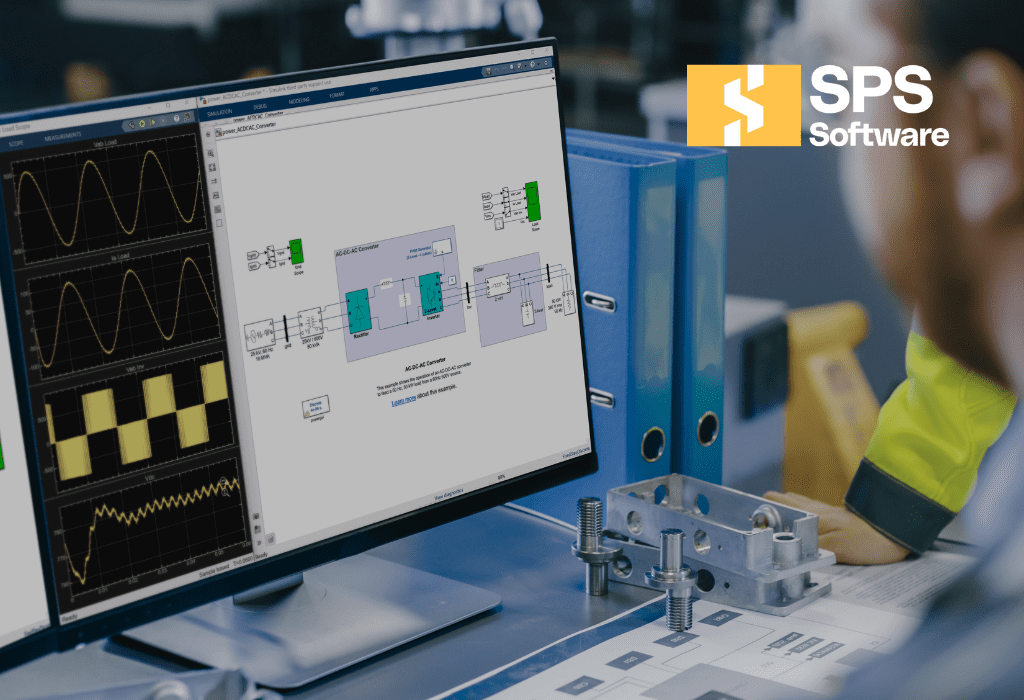
A practical handoff keeps duty commands, measured currents, measured voltages, fault flags, and state requests on the same signal contract used during model runs. If the firmware wrapper feeds per-unit values in simulation, the target wrapper should do the same unless there is a clear reason to change it. SPS SOFTWARE fits this step when teams need plant equations they can inspect while wiring firmware I/O to the same converter signals used later on the bench. That continuity keeps debugging focused on genuine hardware gaps.
You will still adapt drivers and peripheral setup for the target. What shouldn’t move is the meaning of the control interface. Teams lose days when an apparent control fault turns out to be a scale mismatch, swapped polarity, or a duty clamp applied in one wrapper but not the other. Reusing interfaces is simple discipline, and it pays back the moment hardware enters the loop.
Lab tests should confirm model gaps after logic passes
“Lab tests should confirm what the model left uncertain after logic has already passed against the plant.”
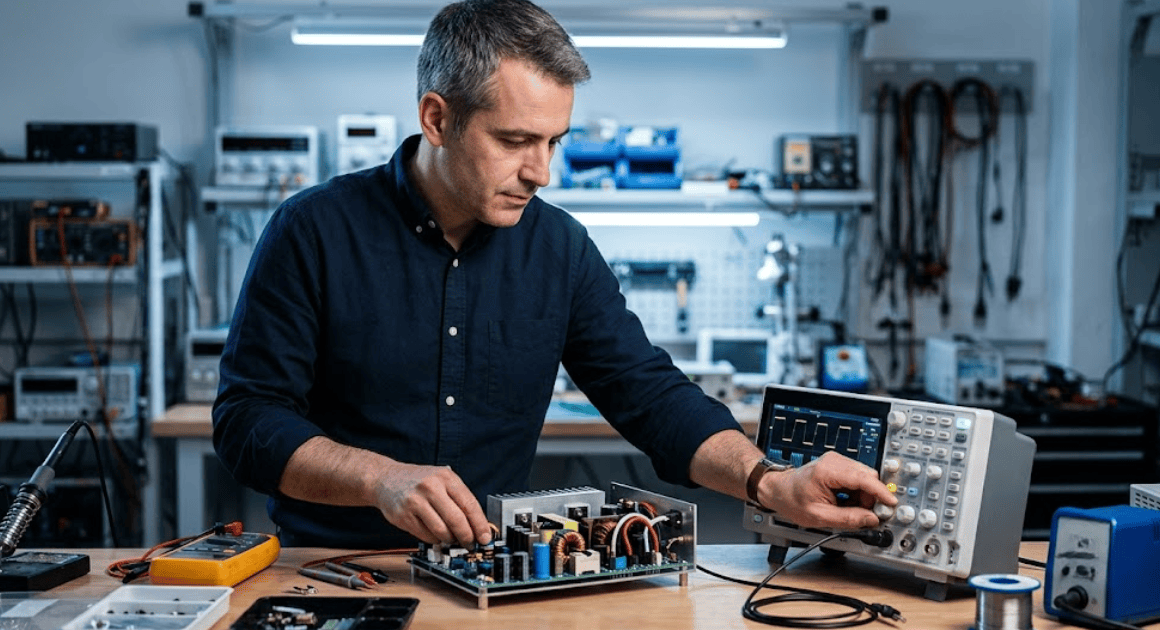
Bench time is best used to measure parasitics, thermal shifts, sensor noise, and hardware-specific delays that the model simplified. That order keeps the bench focused on physical gaps. It also keeps firmware debug from consuming the whole schedule.
A clean process looks modest and disciplined. You validate control logic in simulation, carry the same interface into hardware, and then use bench data to tighten the model where hardware disagrees. A converter that misses a target on the bench then becomes a modelling or implementation question with a narrow search area. You’re no longer guessing if the controller structure itself is sound, because that question was settled earlier.
SPS SOFTWARE belongs in that workflow because open, physics-based models help you see which mismatch comes from the plant and which comes from the code. That judgment matters more than a perfect first prototype. Teams that separate logic validation from hardware confirmation spend less time tracing avoidable firmware faults and more time refining the converter behaviour that truly depends on the bench.