Key Takeaways
- Real-time EMT reveals timing-sensitive phenomena that traditional phasor studies smooth out, improving protection, integration, and training decisions.
- Utility simulation supports grid fault analysis, transient control validation, inverter integration, operator readiness, and capital planning with repeatable evidence.
- Shared models and hardware-in-the-loop workflows align planning, operations, and training, which reduces misoperations, rework, and site risk.
- Metrics such as misoperations, investigation closure time, drill pass rates, and commissioning changes show clear returns from utility simulation.
- Open protocols, flexible I/O, and toolchain compatibility let teams adopt real-time EMT without replacing familiar workflows or data sources.
Real-time simulation turns grid uncertainty into measurable, testable scenarios. Protection, control, and planning teams can push models and hardware to their limits without waiting for a field event. Faster feedback on settings, firmware, and operating procedures helps reduce outages, misoperations, and rework. Teams that adopt this workflow gain a steady path to safer operations and better system performance.
Grid modernization introduces inverter-based assets, bidirectional flows, and higher sensitivity to fast transients. Utility simulation brings those behaviors into the lab with a timing-accurate view of currents, voltages, and control states. Hardware-in-the-loop (HIL) connects protection relays, controllers, and human interfaces to a digital twin that runs at the same time step as the grid. The result is hands-on learning, verifiable data, and a clear foundation for confident decisions.
Why real-time simulation matters for modern utility operations
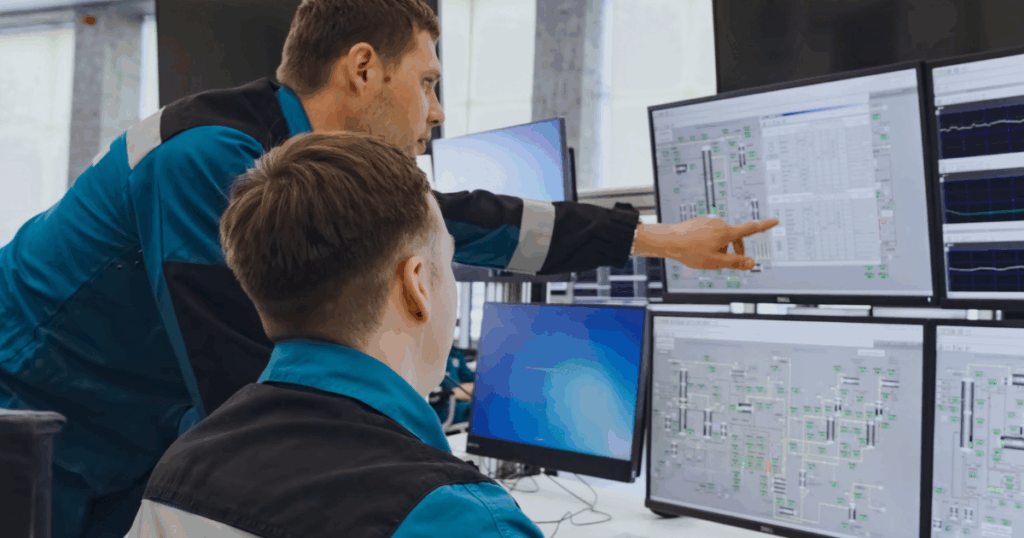
Electromagnetic transients (EMT) unfold over microseconds to milliseconds, and small timing errors can hide serious issues. Traditional studies based on phasor models can miss control interactions between relays, inverters, and converter-fed equipment, which is why utility simulation at real-time speed is now considered a core tool. Real-time execution exposes saturations, delays, and quantization that appear only when hardware interacts with high-fidelity waveforms. That level of detail helps explain nuisance trips, weak-grid voltage swings, and oscillations that traditional averages smooth out.
The same platform links operations, planning, and training around shared models, shared data, and shared tests. Hardware-in-the-loop (HIL) validation lets you evaluate a relay or controller under identical network conditions that planners and analysts are studying in software. Supervisory control and data acquisition (SCADA) and energy management system (EMS) interfaces can be wired to the simulator to exercise alarms, set points, and displays. The outcome is consistent learning across teams, fewer surprises in the field, and faster turnarounds on tough studies.
5 use cases for real-time simulation in utility operations
“Real-time simulation turns grid uncertainty into measurable, testable scenarios.”
Real-time platforms answer questions that are too risky, too expensive, or too rare to try on a live grid. High-rate waveform models expose how software logic, firmware, and field devices behave under tight timing. Teams can replicate bad days safely, then test fixes under identical conditions to prove they hold. The approach turns theories into measurements that you can trace, compare, and repeat.
1. Grid fault analysis and protection coordination
Accurate grid fault analysis requires voltage, current, and frequency dynamics that respond at sub-cycle resolution. Real-time electromagnetic transient models drive relays with realistic DC offsets, current transformer saturation, and arc resistance behavior. Misoperations caused by pickup delays or polarising logic become visible when the digital model feeds primary quantities into instrument transformers and relay inputs. You can iterate settings, logic equations, and coordination margins while recording waveforms just as a recorder would capture them in the field.
Protection coordination extends beyond a single feeder, so parallel and backup paths must be proven under varied clearing times, reclosing sequences, and stuck breaker cases. A real-time testbed helps you stress inverse-time curves, directional elements, and weak-source conditions without risking service. You can verify automation such as loop restoration, adaptive reclosing, and transfer trip before any truck rolls. Documented results from grid fault analysis in the lab give engineers clear evidence for settings, work instructions, and commissioning plans.
2. Testing and validating control schemes under transient events
Control schemes such as underfrequency load shedding, remedial action schemes, and microgrid transitions depend on precise timing. A real-time simulator lets you validate pickup thresholds, time delays, and logic paths against waveforms that match worst cases. Controller code running on programmable logic controllers, protective relays, or dedicated devices can be exercised through native input and output (I/O), sample streams, or communication protocols. Test sequences can include ride-through requirements, breaker failures, and concurrent faults to prove stability and recovery.
Supervisory paths often shape how controls behave, so you can link the simulator to the energy management system (EMS) or the distribution management system (DMS) front ends. Data historians capture each run to compare tuning changes, firmware updates, or topology tweaks over time. The result is repeatable evidence that a proposed control change satisfies criteria for speed, selectivity, and security. Field crews get concise acceptance scripts, and managers receive fact-based signoff packages.

3. Integrating renewable energy and inverter-based resources
Solar, wind, and storage plants interconnect through power electronics, which means grid-forming and grid following modes must be tested under stress. Real-time models capture pulse-width modulation, phase-locked loops, and controller saturation that shape current injection during faults and voltage sags. Studying these effects helps set ride-through windows, reactive support targets, and limits for ramp rates. Teams can verify how protections interact with inverter controls, then confirm that system voltage and frequency recover as planned.
Inverter-based resources (IBR) bring harmonic content, fast control loops, and dependency on network strength that cannot be approximated with coarse time steps. Real-time platforms expose interactions between feeders, collector systems, and point-of-interconnection equipment under outages or weak-grid conditions. You can test plant controller logic for curtailment, grid support, and black start sequences without contacting the live site. Insights flow directly into interconnection studies, commissioning plans, and operations playbooks.
4. Training operators for real-time system response
Operator training benefits when the simulator drives the same displays, alarms, and controls that staff use every day. A model can stream to supervisory control and data acquisition (SCADA), outage management, and call centre tools to rehearse procedures under pressure. Scenarios cover feeder switching, transformer energization, recloser coordination, and cold-load pickup with stress on timing and communications. Instructors can pause, rewind, and replay while capturing keystrokes and event lists for objective feedback.
Teams learn how to recognize precursor signs of trouble, ask for targeted measurements, and execute cross-team protocols. Exercises can practice storm response, substation commissioning, or black start across multiple desks with voice channels recorded. The same build can be used for new-hire onboarding, refresher cycles, and qualification on new equipment. Confidence grows because practice sessions mirror the cadence and constraints of a shift.
5. Planning system expansions and evaluating contingency scenarios
Planning studies benefit from a testbed that can run what-if cases with real protection and control hardware connected. You can screen conductor upgrades, new lines, or capacitor placements using the exact settings that will go to the field. Phasor measurement unit (PMU) data, feeder measurements, and substation event files can refine models so that stress tests reflect observed behavior. Results inform capital plans, outage windows, and temporary operating limits with less guesswork.
Contingency evaluations extend beyond N minus 1, so rare combinations, delayed clearing, and hidden failures can be practiced without risking service. System strength, inertia surrogates, and voltage support can be tested against new technology additions such as storage or flexible AC transmission. Planners and operators compare mitigation options side by side, then keep approved templates for future use. The effect is fewer last-minute changes during construction and smoother acceptance once the equipment is energized.
A single real-time platform creates a common source of truth for protection, controls, operations, and planning. Waveform accuracy shortens investigations, stabilizes settings, and reveals interactions that would otherwise stay hidden. Teams reduce risk because experiments happen under controlled conditions with field-grade equipment in the loop. That shared practice builds habits that pay off when conditions turn difficult.
How utilities benefit from adopting real-time EMT simulation
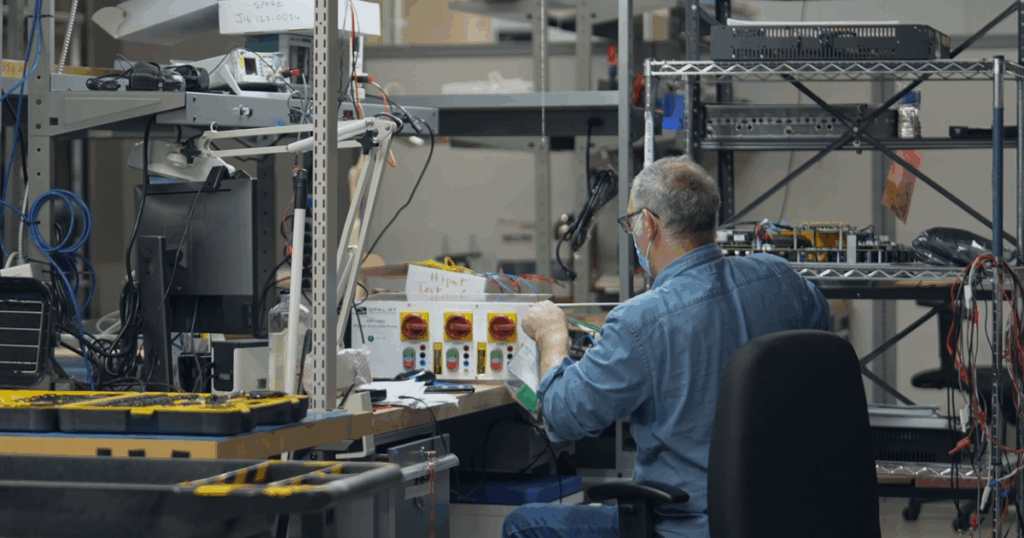
Real-time electromagnetic transient (EMT) simulation delivers waveform-level detail at the speed required for hardware tests. The approach makes inverter controls, converter switching, and instrument transformer dynamics visible to both engineers and operators. Adopting real-time EMT improves how you evaluate upgrades, set protections, and certify interconnections before crews roll. The benefits include reliability, safety, and cost control without forcing a restart of your toolchain.
- Higher protection confidence: Real-time EMT exposes CT saturation, DC offsets, and arc resistance effects that affect element pick-up and security. Settings can be tuned against worst-case waveforms, then locked with objective records.
- Clearer inverter interactions: High-resolution models show grid forming and grid following behavior under weak-grid conditions, sags, and frequency shifts. Engineers compare control revisions and filters side by side, then select parameters with evidence.
- Faster root cause analysis: Fault replays with field waveforms align models, devices, and logs to isolate the sequence of events. Teams close investigations sooner, and corrective actions reach the field faster.
- Reduced field risk and cost: Hardware-in-the-loop tests move hazardous trials into the lab, sparing staff and equipment. Crews receive proven settings and procedures, which trim site time and rework.
- Shorter cycle from model to acceptance: Shared models run across planning, protection, and training without conversion. New features can be trialed with firmware in the loop before a pilot goes live.
- Stronger operator readiness: Supervisory displays, alarms, and controls are exercised against the same EMT waveforms used in engineering tests. Staff practice rare scenarios and build muscle memory that holds under stress.
| Benefit | What it looks like in practice | Typical KPI | Utility outcome |
| Protection reliability | Fewer false trips and faster correct operations | Misoperations per 100 devices, clearing time variance | Fewer outages and fewer service minutes lost |
| Inverter integration success | Fewer setting changes during commissioning | Change requests per interconnection, voltage recovery time | Smoother energization and stable plant output |
| Engineering throughput | More test cases executed per week | Cases per week, lab utilization | Faster studies and decisions |
| Training effectiveness | More drills completed with objective scoring | Scored drills per operator, error rate | Higher readiness across shifts |
| Project risk | Fewer late-stage issues after equipment arrives | Issues found after Factory Acceptance Test (FAT), Site Acceptance Test (SAT) | Predictable schedules and budgets |
| Cyber-physical validation | Controller and network latencies measured under load | Round-trip latency, packet loss during events | Resilient controls and communications |
“When waveform fidelity meets hardware timing, your team sees the same phenomena that field devices see.”
The pattern is consistent across protection, integration, analysis, and training. When waveform fidelity meets hardware timing, your team sees the same phenomena that field devices see. That alignment trims uncertainty, reduces hands-on risk, and shortens cycles from study to approval. Real-time EMT turns complex interactions into repeatable tests that produce trusted decisions.
High-value starts include protection validation, inverter plant ride-through tests, and operator drills for storm response. These tasks benefit from waveform accuracy, repeatability, and the ability to connect relays, controllers, and SCADA systems. You can run fault replay studies for recent incidents, prove settings for reclosers and transfer schemes, and test new controls for storage or microgrids. The same builds support planning checks on new feeders, capacitor banks, and transformer energization with results that can be compared run to run.
A base setup includes a real-time simulator with CPU and FPGA resources, I/O modules that match your relay and controller interfaces, and a control workstation. Field data from phasor measurement unit (PMU) streams, microprocessor relay records, and SCADA historians help calibrate models. Most labs also add protocol interfaces such as International Electrotechnical Commission (IEC) 61850 and Distributed Network Protocol version 3 (DNP3) to exercise communications. Early projects often start with replaying a past event, then expand to hardware-in-the-loop (HIL) tests and operator drills as confidence grows.
Software-only studies simulate both the network and the control or protection device, which can mask latencies, sampling offsets, and I/O nonlinearities. Hardware-in-the-loop (HIL) connects the actual device under test to the simulator, so timing and quantization match field conditions. You capture firmware behavior under stress, including fault buffers, watchdogs, and communications retries. This approach improves trust in settings and logic before field crews apply them to equipment.
Measure reductions in misoperations, rework hours at sites, and time to close investigations after incidents. Track training throughput, pass rates on drills, and the number of controls or settings approved per quarter. Monitor commissioning change requests for inverter projects, then compare against previous years. Add qualitative feedback from operators and field staff to capture confidence gains that metrics do not fully show.