Key Takeaways
- Electromagnetic transient simulation helps you move from rough ideas to credible, repeatable studies that align with the expectations of peer review and thesis committees.
- Careful research modelling with EMT focuses on the right level of detail, linking device physics, control behaviour, and grid conditions to clear performance metrics.
- Structured EMT studies support paper ready simulation by producing clean, consistent waveforms and datasets that can be reused across several publications and projects.
- Well documented EMT models, with clear assumptions and parameter sets, strengthen academic workflows and make it easier for students and collaborators to contribute.
- Sharing EMT projects and data as part of research culture supports reproducible work, strengthens trust in results, and creates a foundation for future studies.
You spend weeks tuning a model, then still wonder if the waveforms will stand up in peer review. Electromagnetic transient (EMT) simulation gives you a way to test ideas, capture subtle behaviour, and build confidence before results ever reach a journal editor. Instead of relying on simplified assumptions, you can study switching detail, non linearities, and control interactions at the same time as you refine your research questions. Used well, EMT tools turn a rough concept into a repeatable study that supports clear, defensible conclusions.
For many researchers, the challenge is not access to software but structuring models so they lead naturally to publishable results. Questions arise about how detailed a feeder must be, how to document protection settings, and how to justify the chosen time step to reviewers. Careful EMT studies help you answer those questions while keeping a clear link between equations, parameters, and the story your paper needs to tell. When EMT workflows line up with academic expectations, you spend less time repairing models and more time interpreting what your system is actually doing.
How researchers use EMT simulation to prepare accurate studies
Accurate EMT studies start with a clear statement of what you want to measure and why that quantity matters for the paper. Instead of building a huge model first, many experienced researchers treat EMT simulation as an extension of their analytical work, checking assumptions step by step. That approach keeps the model focused on specific waveforms, time scales, and operating points that link directly to claims in the text. It also reduces the temptation to include every device and feeder section, which often makes simulation harder to explain and validate.
Once the study goal is clear, attention shifts to model fidelity and numerical choices. Device models must reflect the physics that influence the results you plan to publish, especially in converter dominated networks. Time step, solver settings, and switching schemes all affect whether the waveforms shown in the paper match what a peer could reproduce. When you treat EMT simulation as a way to design paper ready simulation campaigns instead of isolated runs, each study becomes easier to document, justify, and defend.
7 ways researchers use EMT simulation for published work
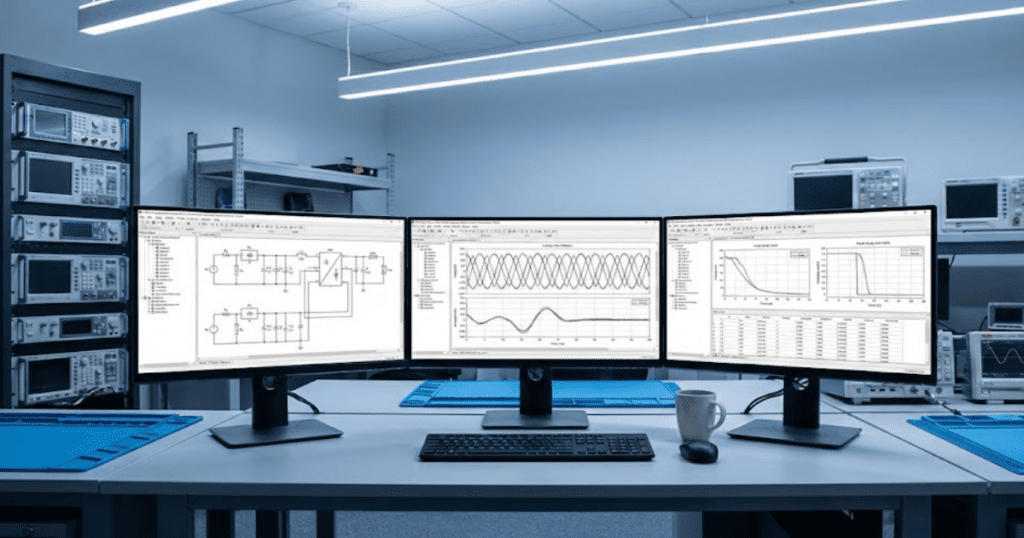
Careful EMT work links detailed waveform data to research questions about stability, power quality, and control performance. Researchers often rely on electromagnetic transient simulation when RMS tools cannot capture switching events, fast protection, or detailed converter behaviour. The same model may support several studies, for example by sweeping operating points or controller gains. Well planned EMT studies shorten the distance between a project idea and a set of figures that can stand up in review.
Summary of EMT use cases for published work
| # | EMT use case | Typical study goal | Example outputs for papers |
| 1 | Converter and inverter switching behaviour | Validate switching patterns and current stress | Phase currents, device voltages, switching transitions |
| 2 | Faults and protection coordination | Show protection timing, selectivity, and mis‑operation | Current and voltage during faults, relay signals, trip times |
| 3 | Renewable and microgrid interaction | Explain control interactions and grid impacts | Frequency, voltage, converter currents, point of common coupling waveforms |
| 4 | Control strategy and tuning assessment | Compare control variants and tuning choices | Step responses, harmonic content, stability margins |
| 5 | Parametric EMT studies | Map sensitivity to parameters and operating points | Families of waveforms, metrics versus parameter plots |
| 6 | Paper ready simulation figures | Produce clean figures and datasets for publication | High resolution plots, harmonics, statistical summaries |
| 7 | Reproducible research and sharing | Support replication and extension of studies | Model archives, configuration files, reference datasets |
Careful planning of these applications helps you create EMT studies that serve more than one purpose during a research project. A model built for one use case often becomes the foundation for several related publications. When you structure the model, data exports, and documentation with this reuse in mind, research modelling becomes far more efficient. This mindset also supports students in your group, who can build on existing EMT projects instead of starting from scratch each term.
“Electromagnetic transient (EMT) simulation gives you a way to test ideas, capture subtle behaviour, and build confidence before results ever reach a journal editor.”
1. Modelling converter and inverter switching behaviour
Converter and inverter projects often reach a limit with averaged models, especially when reviewers ask about device stress or switching induced distortion. An EMT model that includes detailed switching patterns, gate signals, and snubber networks lets you answer those questions directly. You can study how layout choices, modulation schemes, and dead time affect voltage overshoot or current ripple. That level of detail turns vague statements about “switching effects” into plots that quantify exactly what happens during each transition.
For published work, this type of model supports clear justification of design limits and safety margins. Current peaks at turn on and turn off can be compared with device ratings, and you can show how proposed changes reduce stress. High frequency details that would be invisible in RMS simulations now appear as precise, time aligned traces. When you base claims on these EMT waveforms, reviewers see a clear chain from modelling assumptions to measured quantities and final interpretation in the paper.
2. Studying faults and protection coordination in complex networks
Protection studies are a classic area where electromagnetic transient models shine. Short circuit events, high impedance faults, and breaker operations all involve fast transients and non linear conditions that simplified tools often smooth out. EMT studies let you trace how fault currents propagate through feeders, transformers, and converters, giving a clear picture of what each protection device actually sees. That level of insight helps you explain both successful operations and problematic cases in your publication.
Protection coordination research also benefits from direct access to relay logic and measurement paths inside the simulation. You can inject noise, CT saturation, and sampling effects to show how algorithms behave under stress. Trip times, mis operations, and security margins can then be quantified and linked to specific waveform segments. When you document these elements carefully, the protection section of your paper moves beyond settings tables and provides a convincing explanation of how the scheme behaves under challenging conditions.
3. Analysing renewable integration and microgrid behaviour
Converter dominated grids and microgrids bring questions about stability, power quality, and interaction between many local controllers. EMT simulation lets you observe how grid forming and grid following converters react to faults, load steps, and changes in renewable generation. You see not only average power flow but also oscillations, harmonics, and phase relationships that influence protection and control. This view is especially important when you want to explain incidents that simpler models cannot reproduce.
For published studies on microgrids and renewable integration, readers expect evidence that the proposed control or topology works under a range of operating conditions. EMT models support this by letting you test weak grids, unbalanced loads, and abrupt disconnection events with consistent numerical settings. You can show how droop settings, virtual impedances, or current limits affect recovery behaviour and service continuity. When those results appear in plots and tables, they give reviewers tangible evidence that the proposed approach can manage realistic scenarios.
4. Comparing control strategies and tuning methods
Researchers often propose new control schemes or tuning rules, then need to show clear benefits over established approaches. EMT simulation gives a strict test bench where control algorithms see the same plant, disturbances, and noise. This makes it easier to compare settling time, overshoot, harmonic content, and resilience to parameter variation. Each controller variant can be implemented with access to the same internal states, which helps align the discussion around measurable outcomes.
For example, you might compare two current control strategies for a grid connected converter using identical fault events and load steps. EMT results then show how quickly each scheme stabilizes currents, restores voltage, or respects limits. Those waveforms can be condensed into error norms or quality indices that fit well in a research paper. When readers see that every control variant faced the same EMT scenarios, they are more likely to trust the conclusions you draw.
5. Running parametric EMT studies for sensitivity and robustness
Many projects need evidence that a design holds up across a range of parameters instead of just one operating point. EMT studies support this by letting you automate sweeps of controller gains, line impedances, filter values, and load levels. For each case, you can track metrics such as harmonic distortion, overshoot, settling time, or energy through key components. This creates a structured picture of sensitivity that is hard to obtain from the laboratory alone.
Such parametric research modelling, when planned early, lines up closely with the tables and plots needed for journal or conference publications. Instead of hand picking a few “good looking” cases, you work from a pre-defined grid of scenarios. The resulting datasets can be post processed into surfaces, contour plots, or summary statistics that directly support your main arguments. Reviewers then see that the proposed design or method maintains performance across the tested range, which adds weight to claims about robustness.
6. Producing paper ready simulation figures and datasets
Even the strongest concept can struggle in review if the figures are noisy, inconsistent, or poorly labelled. EMT tools can act as a source of paper ready simulation data when you configure output channels, sampling rates, and naming conventions with publication in mind. You can align axes across all figures, keep fonts and units consistent, and extract only the time windows that illustrate the effect you care about. This preparation turns raw waveforms into clean visuals that support your narrative instead of distracting from it.
Beyond figures, EMT projects can output data in formats suited for sharing and further analysis. Time series can be exported for statistical work, spectral analysis, or comparison with measurement campaigns. When you attach these datasets as supplementary material, other researchers gain a stronger basis for replication or extension. That attention to detail signals that the study is not only correct but also carefully prepared for academic scrutiny.
7. Supporting reproducible research and open model sharing
Reproducible research depends on more than just equations in the text. EMT models, configuration files, and test scripts often contain the practical details that allow another group to regenerate your results. When these elements are organised and shared, peers can validate study claims, explore new parameter ranges, or adapt the model to different systems. This practice strengthens the impact of your work and reduces the chance that important insights stay locked in a single lab.
EMT projects are well suited to this style of research because they gather topology, parameters, control code, and measurement points in one workspace. You can store model versions alongside predefined test cases that match the figures and tables in your paper. Clear naming, documented assumptions, and simple instructions lower the barrier for others who want to reuse the model. Over time, this approach builds a body of EMT work that supports collaboration across institutions and successive cohorts of students.
Well scoped EMT applications help you move smoothly from concept, to simulation, to publishable evidence. Each use case adds a layer of confidence, from device physics and protection timing to control performance and long term reliability. When those layers connect through clear modelling and documentation, peer reviewers can follow your reasoning without guessing about hidden assumptions. This structure also makes it easier for your future self, and for students in your group, to extend the project into new studies.
How EMT models support clear documentation for academic workflows
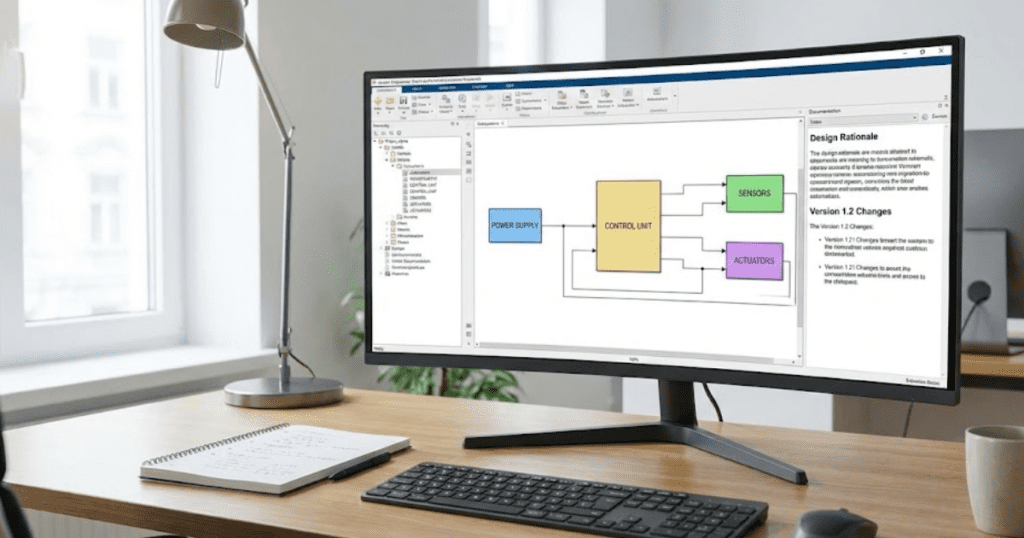
Clear documentation matters as much as numerical accuracy when EMT work feeds into academic workflows. Reviewers want to see not only waveforms but also how models were built, tuned, and validated. Students and collaborators need a way to understand your choices without hours of one to one explanation. Good documentation habits inside the EMT model itself make these expectations easier to meet.
- Structured project hierarchy: A consistent folder and subsystem structure lets readers see where feeders, controllers, and protection elements live. When each major function has a clear place, new users can trace signal flow and add their own components without confusion.
- Documented model assumptions: Text blocks, notes, or attached documents that explain simplifications and modelling boundaries save time during review. Readers can see which parasitics, thermal effects, or control delays were ignored and why that choice made sense for the study.
- Parameter sets linked to test cases: Storing parameter files or masks for specific scenarios avoids guessing later about which values produced which figures. This practice helps you match model states to particular EMT studies and supports quick regeneration of plots if a reviewer asks for clarifications.
- Clear naming for signals and scopes: Using descriptive names for measured quantities and scopes reduces errors when preparing figures. A consistent naming scheme also helps students avoid mixing up phases, reference frames, or control variables when they export data.
- Embedded references and cross links: Notes that point to equations in your paper, or to earlier reports that justified certain parameters, connect the simulation to a broader research context. These links guide readers who want to understand not only how the EMT model runs but also why it has its present form.
- Version information and change logs: A short log of changes, with dates and reasons, makes it easier to track which version matches which submission. That history becomes invaluable when you revise a paper months later and need to confirm the exact model that produced a specific waveform.
When EMT models carry this kind of documentation, they shift from private working files to shared academic assets. Supervisors can review work more efficiently, since they can inspect assumptions and parameters without rebuilding the model. Students gain confidence that their projects will still make sense to them at the end of a degree or thesis. Reviewers see a level of care that builds trust in both the methods and the published results.
“Well scoped EMT applications help you move smoothly from concept, to simulation, to publishable evidence.”
How SPS SOFTWARE supports research modelling and academic publication

SPS SOFTWARE is designed to help engineers and researchers move from concept to publishable EMT studies with less friction. Open, physics based component models give you a clear view of equations and parameters, which is essential when reviewers ask for justification. You can build detailed converter, feeder, or microgrid models while keeping structures readable for future collaborators. This supports research modelling that feels like an extension of your analytical work instead of a separate, opaque step.
SPS SOFTWARE also aligns with teaching and lab workflows where several people share and adapt the same EMT projects. Project files, component libraries, and example templates give students and colleagues a consistent starting point that still allows deep customisation. Data export options help you create clean figures, tables, and supplementary datasets suited to journal and conference expectations, so paper ready simulation becomes a normal outcome of modelling rather than a last minute scramble. The platform gives you practical tools to connect day to day modelling with reliable, trustworthy academic results.