Key takeaways
- Simulation-first validation reduces late-stage surprises and speeds commissioning while improving grid reliability and grid code compliance.
- Real-time simulation stresses systems with fault and abnormal scenarios safely, producing traceable evidence for regulators and operators.
- Electromagnetic transient modeling captures fast inverter dynamics, revealing control interactions and fleet effects that steady state tools miss.
- Hardware-in-the-loop connects real devices to a digital grid, exposing configuration issues before deployment and reducing on-site rework.
- Treating simulation as a core practice leads to smoother renewable integration, fewer outages, and more predictable project outcomes.
Modern power grids run on complex software controls as much as physical wires, and relying on yesterday’s testing methods has become a risky bet. We believe that every new grid control scheme or device should prove its worth in a high-fidelity real-time simulation before ever touching live equipment. This simulation-first mindset stems from hard lessons: legacy testing often misses fast transients and control glitches, only for them to emerge later when the stakes are highest. The consequence is not just technical trouble. It’s project delays, reliability threats, and compliance headaches. Power disruptions already cost businesses around $150 billion annually, with storm-related outages alone accounting for $20–$55 billion per year. As electric generation becomes dominated by inverter-based sources and regulators tighten performance standards, the only sure path forward is to embed rigorous simulation into every stage of grid innovation. By doing so, operators can embrace new technology with confidence that reliability and regulatory standards will never be compromised.
Traditional testing fails to ensure reliability in today’s complex grid

Grid engineers must manage an unprecedented influx of inverter-based generation, which challenges traditional planning and test methods. Modern power systems are evolving rapidly, with renewable and inverter-based resources forming the bulk of new capacity. In one region, fully 95% of new generation is inverter-based, reflecting a seismic shift in grid dynamics. Unlike the steady behavior of older coal or gas plants, inverter-based sources run on software logic, and their interactions can be hard to predict with conventional studies. Grid planners who rely on simplified models or isolated field tests often miss critical fast transients and control instabilities lurking in these digital power plants. As a North American reliability report observed, inadequate modeling of new inverter plants has already led to unexpected outages during grid disturbances. Each solar farm or battery added brings unique software behavior that legacy testing approaches struggle to anticipate.
The fallout from these blind spots is felt in both project timelines and system reliability. Problems that were invisible in traditional tests tend to surface only during commissioning or early operation, forcing last-minute fixes that can derail deployment schedules. Today’s grid codes are also far stricter, requiring proof that equipment can ride through faults and meet performance standards under dozens of scenarios, but old testing regimes seldom provide this assurance. The rising complexity of reliability studies is one reason new energy projects now face drawn-out cycles; for instance, U.S. projects built in 2023 waited an average of five years from interconnection request to commercial operation. Such delays and late-stage surprises indicate a troubling gap: using conventional methods, teams lack a safe way to fully vet how new devices and control software will behave in worst-case grid events.
“Modern power grids run on complex software controls as much as physical wires, and relying on yesterday’s testing methods has become a risky bet.”
Real-time simulation offers a safer path to grid reliability and compliance

Real-time digital simulation is emerging as the grid engineer’s high-fidelity proving ground. It provides a risk-free setting to validate power systems under any conceivable condition. Instead of gambling on untested equipment or controls, teams can now model an entire grid (or plug actual devices into a simulator) and observe exactly how they behave during faults, surges, and abnormal events. When a problem is found in simulation, it means time to fix it early, not a costly surprise later. This simulation-first approach yields several critical advantages.
- Stress any scenario without danger: Advanced simulators allow engineers to recreate lightning strikes, sudden outages, load spikes, and other extreme events without risking customer outages. For example, a hardware-in-the-loop testbed can impose severe voltage dips or frequency swings on a prototype inverter safely in the lab. This means grids are prepared for events that physical testing would never dare to induce on real infrastructure.
- Catch hidden design flaws early: By linking real control hardware or protection devices into a real-time simulated grid, engineers expose their equipment to a wide range of conditions long before field deployment. Issues like unstable controller oscillations or protection settings that misbehave under certain transients can be identified and corrected upfront. Industry research indicates that a well-structured virtual testing process can uncover up to 50% of system issues before integration. This early insight is a huge win for project stability.
- Provide proof of grid code compliance: Simulation delivers more than insight; it produces hard evidence. Every test scenario yields detailed waveforms and performance data, which can be archived to demonstrate adherence to standards. Utilities can show regulators that a new wind farm’s controls will ride through a 0.5-second voltage sag or meet frequency response requirements on paper, because they’ve already done it under simulated conditions identical to the real grid. This traceability streamlines the compliance process, turning grid code tests into a routine validation step rather than a leap of faith.
- Accelerate project timelines with rapid iteration: In a simulator, making a change doesn’t require rewiring a substation or waiting for a weather event; it might be as simple as tweaking a parameter and re-running the scenario. This agility slashes development time. Grid integration studies that once took months can be compressed into days of intensive simulation. Engineers can iterate through controller settings or converter designs quickly, confident that if the simulation passes, the real system will likely follow suit. The result is faster commissioning and fewer on-site headaches.
- Ensure reliable performance when going live: Perhaps the greatest benefit is the confidence that comes from thorough testing. When a system has survived every worst-case scenario in a high-fidelity digital twin, grid operators can proceed to deployment knowing there will be no unpleasant surprises. Real-time simulation bridges the gap between lab and field. If a solution works in the simulator under the same conditions, it will work on the grid. This leads to smoother integrations of renewables and new technologies, with reliability reinforced rather than jeopardized.
By making simulation a core part of planning and validation, utilities and developers shift from reacting to problems toward preventing them entirely. Investing in comprehensive real-time simulation may require effort up front, but it consistently pays off in avoided outages, met compliance benchmarks, and projects that stay on schedule. In practice, this is especially evident in renewable energy integration. This challenge is tailor-made for rigorous electromagnetic transient (EMT) simulation.
EMT simulation validates renewable integration under real conditions
Integrating renewable energy sources into the grid presents unique challenges that real-time EMT simulation is ideally suited to tackle. Using electromagnetic transient models, engineers can recreate the fast, intricate electrical phenomena associated with inverter-based generation and low-inertia systems. The following examples highlight how this approach ensures renewable projects operate smoothly and meet strict requirements from day one:
Capturing high-speed transients and faults
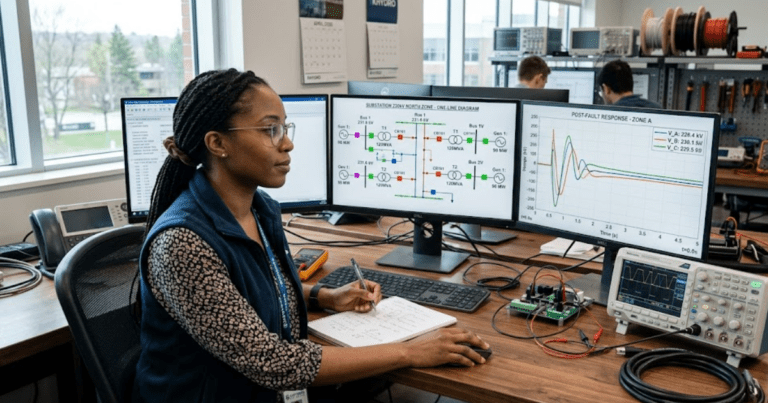
Renewable-heavy grids experience rapid fluctuations that traditional analysis tools often overlook. Inverter-based plants can disconnect in milliseconds during voltage spikes or frequency dips if their controls aren’t tuned perfectly. By using EMT simulation, utilities can simulate sub-cycle transients and fault events to see exactly how solar and wind inverters respond. For instance, industry investigators have replayed real disturbance events in simulation to pinpoint why certain photovoltaic farms tripped offline. NERC, the North American grid regulator, studied two major solar inverter disturbances in Texas where control software misbehaved amid grid fluctuations, risking the loss of hundreds of megawatts of generation. With a real-time simulator, engineers can replicate those precise conditions in a lab setting and adjust inverter control parameters or protection settings to prevent such incidents. This level of insight into microsecond-by-microsecond behavior is only possible with EMT tools, enabling more robust and fault-tolerant renewable integration.
Testing inverter control interactions at scale
It’s not just individual devices; the collective behavior of many distributed energy resources can create stability issues if not coordinated. High-fidelity simulation lets grid engineers model dozens or even hundreds of inverter-based resources operating together on a virtual grid. They can introduce fluctuations or control actions and observe how the entire fleet reacts. Using power hardware-in-the-loop techniques, researchers have connected actual solar inverter units to a simulated network to verify their performance in concert with many virtual ones. One such real-time simulation study demonstrated that coordinating the controls of numerous PV and battery inverters could provide valuable grid support, smoothing feeder voltages and reducing wear on equipment. By iterating different control strategies in the simulator, operators can discover the optimal settings that ensure stability even with high renewable penetration. This system-wide view is crucial. It reveals emergent oscillations or power quality problems that would be impossible to detect by testing components in isolation.
Validating new equipment with hardware-in-the-loop
When a manufacturer develops a new wind turbine controller or a utility invests in a novel battery inverter system, hardware-in-the-loop testing offers a critical final check before field deployment. Here, the physical controller or power electronic device is plugged into a real-time digital simulation of the grid. This setup drives the equipment through myriad operating scenarios (from normal conditions to extreme faults and grid disturbances), all while the device “believes” it is connected to a live network. Because the simulation runs in real time, the hardware reacts exactly as it would on an actual grid, allowing engineers to assess its performance and compliance. At facilities like the National Renewable Energy Laboratory, multi-megawatt grid simulators are used to subject full-size hardware to realistic grid waveforms and transients. This ensures that a new component meets interconnection standards and reliability expectations before it ever goes on the grid. Any tendencies to malfunction (for example, dropping out during a voltage sag or causing harmonics) are revealed and resolved in advance. HIL validation builds confidence for all stakeholders, equipment vendors, utilities, and regulators alike, that a renewable integration project will work as intended and satisfy grid codes from day one.
Real-time simulation is now indispensable for ensuring grid reliability and compliance

The modern grid has become far too complex to trust its reliability to guesswork or after-the-fact fixes. Real-time simulation is no longer a luxury; it is a necessity at the core of grid planning and operations. By integrating high-fidelity models and hardware-in-the-loop testing early and often, engineers move proactively instead of reactively. Issues that could cause outages or regulatory violations are identified and resolved in the virtual realm before they ever threaten the live system. The result is more than just fewer surprises; it’s a fundamental shift in how grid projects are executed. New technologies can be deployed with greater speed and confidence, backed by data that proves they will perform safely and in full compliance. In short, real-time simulation has become the indispensable bridge between bold grid innovation and the unyielding need for stability. It is what makes a resilient, regulation-ready power network possible.
“Real-time simulation is no longer a luxury; it is a necessity at the core of grid planning and operations.”