
Key Takeaways
- Hardware in the loop testing works best when you treat timing, scaling, and input/output limits as primary design constraints rather than setup details.
- Controller HIL and protection-focused HIL answer different engineering questions, so your bench architecture should follow the hardware you need to validate.
- Repeatable fault sequences give you stronger engineering judgement than traditional bench tests alone because they expose logic errors before full power hardware is energized.
Hardware in the loop testing is the safest way to prove control and protection logic before high-energy hardware reaches the bench.
Power systems teams use hardware-in-the-loop testing to close the gap between simulation and equipment response without risking converters, relays, feeders, or test staff. Renewables supplied more than 30% of global electricity generation in 2023. That shift places more converter control, grid support logic, and protection interaction between your model and the network. You’ll need a method that exposes timing faults, scaling mistakes, and edge cases before copper, silicon, and fault current turn a modelling error into damaged hardware.
Hardware in the loop testing links simulation to hardware behaviour
Hardware in the loop testing connects a simulated plant to physical hardware so the device under test reacts to a modelled grid, converter, or machine as if it were installed. The loop is closed. Signals move both ways. You can validate behaviour before full-power equipment is built.
A feeder relay can receive modelled voltage and current from a faulted line, issue a trip, and force the simulated breaker to open within the same test sequence. An inverter controller can see a direct current link sag, respond with its programmed current limit, and reveal unstable code without energizing a power stage. That matters because bench hardware on its own only shows the cases you can safely build. Hardware in the loop testing exposes rare faults, weak grid conditions, and recovery sequences that are expensive or unsafe to reproduce with physical plant hardware. It also shows sequence dependencies, such as a trip command arriving before a controller exits its start-up state. Those timing interactions are hard to see in isolated subsystem tests.
Power system HIL setups depend on deterministic time steps
Power system HIL depends on fixed execution timing between the model, input/output exchange, and hardware under test. Stable timing makes the result believable. If that schedule slips, the bench will show false behaviour. Trips can appear late and switching events can smear across samples.
A distance relay bench shows this clearly when the line model runs at one step, the analogue output updates at another, and the relay input filter expects a third. That mismatch distorts phase angle and apparent impedance, so the relay seems wrong even when the logic is sound. Power electronics benches face the same problem, because dead time, pulse width modulation edges, and current limiting react to very small timing errors. It’s better to use a simpler model with disciplined timing than a huge model whose step size hides the behaviour you need to verify. You should set timestep from the fastest electrical event that matters, then confirm every input/output path follows that budget.
A useful HIL bench starts with interface limits
A useful HIL bench starts with interface limits because signals fail long before the plant model fails. Voltage range, current range, resolution, and input/output update rules set the credibility of every test. If those limits are loose, the bench will lie. You need defined boundaries before model tuning begins.
A controller that expects plus or minus 10 V analogue inputs will react badly if the interface clips at 8 V or if a 12 bit output turns a small current oscillation into a staircase. The same bench can miss a digital trip pulse if pulse width, debounce, and input thresholds were never defined. Those checks are mundane, but they’re where many benches fail. Clear interface limits also protect your hardware from bad assumptions during early commissioning.
- Set analogue voltage and current ranges to match the hardware terminals.
- Confirm sensor scaling so engineering units stay consistent across model and input/output paths.
- Check converter resolution so small oscillations are not rounded away.
- Define digital pulse width and threshold rules before trip testing starts.
- Limit fault injection cases to what the amplifiers and hardware can reproduce safely.
Controller HIL supports power electronics before full power tests
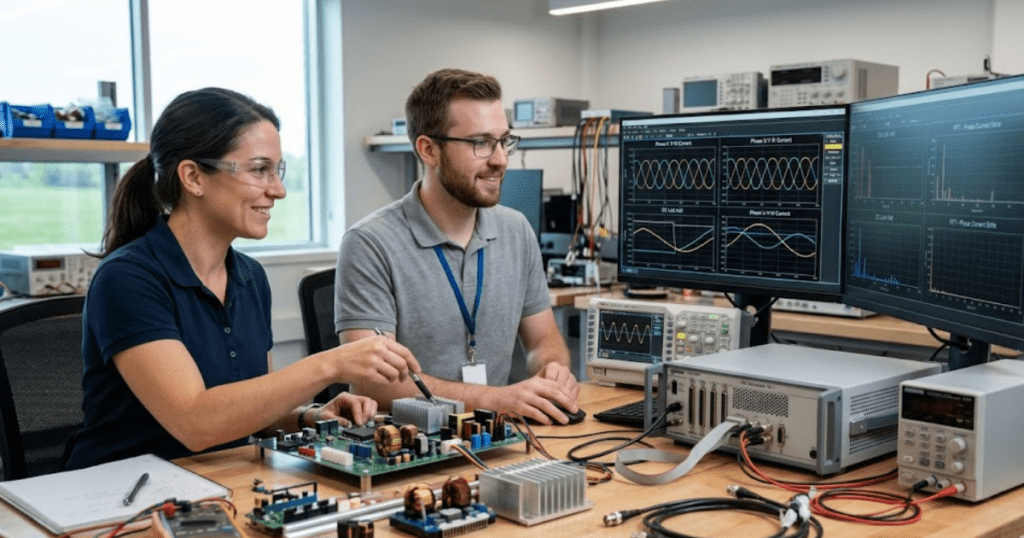
Controller HIL is the best starting point for power electronics because it keeps the control board physical while the power stage stays simulated. You test code, input/output mapping, and fault response early. Risk stays low. You keep the hardest hardware exposure out of the lab.
“Good HIL work is disciplined signal engineering from start to finish.”
A grid tied inverter controller can be wired to a simulated direct current bus, alternating current filter, and weak feeder, then pushed through start-up, current saturation, and ride-through sequences before any high voltage cabinet is energized. Planned United States utility scale capacity additions for 2024 were 81% solar and battery storage. That share means more power system assets depend on control boards, firmware states, and gate timing that you can check at the controller stage. A missed sign on a reactive power reference will show up here before it reaches a power cabinet. You’ll still need power stage tests later, but controller HIL catches unstable tuning, sign errors, and protection conflicts when fixes are still cheap.
Power hardware HIL supports protection relay validation
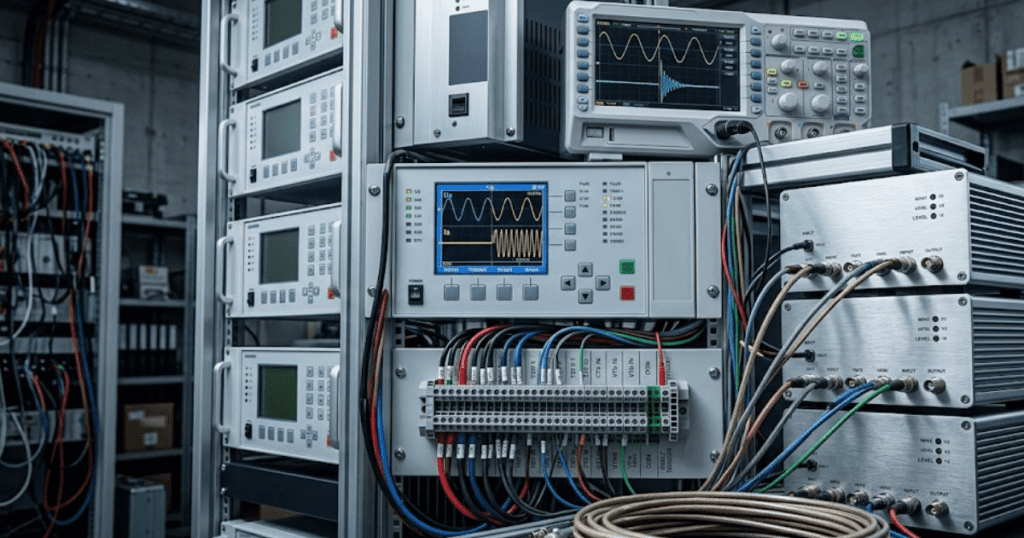
Power hardware HIL is useful when the device under test is a relay, recorder, or protection controller that must see credible electrical quantities at its terminals. The simulated network produces faulted voltages and currents. The hardware acts on them. The loop then feeds that action back into the network model.
A feeder relay validation bench can apply a single line to ground fault at several distances, include source impedance changes, and let the relay trip a simulated breaker so you can inspect zone reach and clearing sequence. That setup is much richer than a static secondary injection test because the relay sees pre-fault load, fault inception angle, and post-trip recovery in one sequence. Accuracy still depends on the amplifier path, signal conditioning, and the relay’s own filtering. If the analogue outputs saturate or phase shift, you will misread relay performance and spend hours chasing a model problem that started in the interface rack. That closed-loop view is why relay timing and reach checks are more credible here.
Software choice depends on timestep limits in your model
Software choice should follow the smallest timestep and the hardest interface on your bench. A relay model, a switching converter, and a feeder stability study do not ask for the same solver behaviour. Model transparency matters too. If you can’t inspect assumptions, you won’t trust the test result.
You should sort tools by model class, switching detail, control integration, and export path to the HIL target. SPS SOFTWARE fits early model development when you need editable power system and power electronics models that make equations and parameters visible before bench reduction begins. That visibility helps you trim a plant model without losing the behaviour the hardware must see. Those software questions matter most before bench build.
| When your bench needs | Your software should provide | Why that choice matters |
|---|---|---|
| Electromagnetic switching detail in a converter plant. | The solver should keep a small fixed step and preserve switching states without hidden averaging. | Controller faults and current spikes disappear when the model smooths them away. |
| Protection studies with changing fault conditions. | The model should reproduce voltage and current waveforms that remain stable through events and topology changes. | Relay reach and trip timing only make sense when the electrical quantities stay credible during the whole sequence. |
| Large feeder or microgrid representation. | The software should let you reduce the plant to the parts the hardware must actually see. | A reduced model keeps the bench manageable without hiding the interactions that matter for validation. |
| Heavy use of controller inputs and outputs. | The workflow should map analogue and digital channels clearly and keep scaling visible to the test team. | Hidden channel rules create more bench errors than weak plant equations. |
| Academic or research use with frequent model edits. | The platform should expose equations and parameters so users can inspect and modify assumptions quickly. | Transparent models make it easier to explain results, reproduce studies, and catch errors before hardware testing starts. |
Traditional testing misses faults that HIL can repeat
“It’s better to use a simpler model with disciplined timing than a huge model whose step size hides the behaviour you need to verify.”
Traditional bench testing is still important, but it cannot repeat enough abnormal cases to prove complex power system logic on its own. HIL fills that gap with controlled faults and repeatable sequences. Each run starts from the same conditions. That repeatability makes debugging much faster.
A lab team can replay the same weak grid voltage sag, frequency excursion, and breaker failure case dozens of times while tuning a converter controller or relay setting group. Physical plant tests rarely offer that consistency because component temperature, supply conditions, and manual setup drift from run to run. HIL also lowers risk during early validation, since you can push hardware into bad states without exposing a full power stage or a live feeder. You can isolate one variable at a time instead of rebuilding a full test rig. You still need final hardware tests for thermal performance, insulation, and power quality, but those tests work better after HIL has already removed logic errors and sequence faults.
Most HIL failures start with poor signal scaling
Most HIL programmes fail at the signal layer before they fail in the plant model. Wrong units, poor scaling, clipped outputs, and hidden filtering will corrupt every result on the bench. Engineers then lose trust in the setup. Good HIL work is disciplined signal engineering from start to finish.
A current loop that looks unstable can turn out to be a swapped sign on an analogue channel, and a relay that appears slow can be reacting exactly as designed to a mis scaled current transformer input. Teams using SPS SOFTWARE often catch those unit and parameter mistakes earlier because open equations make assumptions visible before they reach the HIL rack. That habit matters more than any single tool choice, because reliable hardware in the loop testing comes from clear models, strict interfaces, and repeated checks that keep the bench honest. It’s the difference between a trusted lab tool and a confusing rack of cables. When you build HIL around that discipline, the test system becomes a place to verify engineering judgement instead of a place to guess.