


Key Takeaways
- The right software choice starts with the studies your team must run and defend.
- Transparent models and good workflow fit often matter more than long feature lists.
- Total value depends on solver fit, usable libraries, tool links, and practical access over time.
Choose power system simulation software by matching solver fidelity, model transparency, workflow fit, library depth, tool links, and total cost to the studies your team actually runs.
Most poor software choices happen when teams buy breadth instead of fit. A student lab needs clear models that can be opened and edited, while a utility study group needs dependable fault, protection, or stability results under repeatable settings. If you score a power system simulation software list against the work you already do, your short list gets smaller and stronger.
The 6 factors to evaluate in power system simulation software
The best power system simulation software matches your study type, your team skill, and your model workflow. Feature count won’t rescue a poor fit. A short list gets stronger when you test how a tool handles the work you already run. These 6 factors keep that review grounded.
“A disciplined review usually points to a narrower and more defensible choice.”
1. Solver fidelity must match the studies you run
Solver choice sets the ceiling on what your results will mean. If you run electromagnetic transients, switching studies, converter interactions, or detailed fault events, you need a solver that captures those effects without hiding them behind coarse assumptions. A planning team running steady-state load flow needs something different. A tool can look impressive and still miss your study target if its numerical approach does not match the physics you care about. A feeder model that looks stable under an averaged method can show very different current spikes when inverter switching or capacitor energization is represented in more detail. You’re not buying “accuracy” in the abstract. You’re checking if the solver can reproduce the kind of behaviour your team must explain, defend, and reuse later.
2. Model transparency affects trust teaching and research reuse
Transparent models are easier to verify, teach, and modify. If you can inspect equations, parameters, and block behaviour, you’ll spend less time guessing what a packaged component is doing. That matters in research and education, where model assumptions must stay visible. A graduate student studying converter control will lose time if a closed component masks current limits or filter equations, while an editable model lets the same student test assumptions and document them cleanly. This is also where platforms such as SPS SOFTWARE fit well, because open model structure supports review and reuse instead of locking key details away. Teams usually feel this benefit months later, when someone new inherits a study and has to understand why the original model behaved the way it did.
“Transparent models are easier to verify, teach, and modify.”
3. Workflow fit matters more than raw feature count

Software earns its place when it fits the way your team already works. Setup time, case management, parameter updates, plotting, and export steps will shape daily use more than a long feature sheet. A protection engineer comparing relay settings across several feeder cases needs quick duplication, clean naming, and consistent reporting, not twenty extra modules that never get touched. The same pattern shows up in teaching labs, where a clear interface keeps students focused on system behaviour instead of menu hunting. Friction compounds across a term or a project. If routine actions take six clicks in one tool and one step in another, the better workflow will save hours, reduce setup mistakes, and make peer review much easier.
4. Library depth should match your system scope
Component libraries matter when they reflect the systems you actually build. You need enough depth to model generators, lines, transformers, relays, inverters, converters, machines, loads, and controls at the level your work requires. A rich library is helpful only if it covers your scope without pushing you into constant custom work. A microgrid team, for instance, might need battery storage, grid-forming controls, feeder protection, and renewable source models in one study chain. If one of those pieces is missing, engineers start patching together substitutes, and model confidence drops. Too much unused library depth also creates noise. The right choice gives you broad coverage for your domain, plus room to refine models, without turning every new study into a manual component build exercise.
5. MATLAB and control tool links reduce manual work
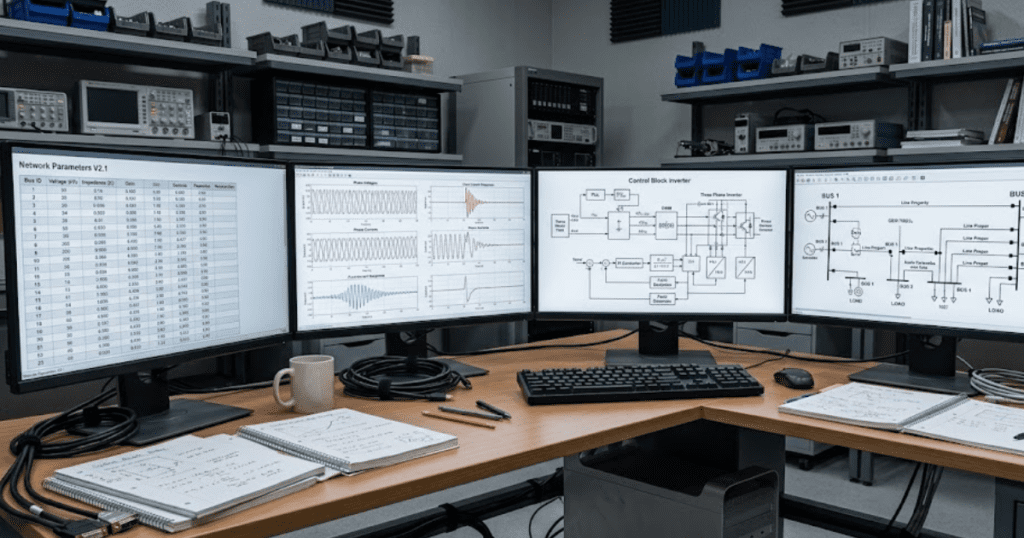
Strong tool links matter when control design and power network studies happen in separate steps. If your team builds algorithms in MATLAB/Simulink and validates plant behaviour in a power system model, poor exchange between those stages will create avoidable hand edits. That slows testing and raises mismatch risk. A converter team sees this quickly when controller gains, sampling settings, or signal paths have to be copied manually after each revision. Clean import, export, or co-modelling support keeps control logic aligned with the plant representation used for network studies. You’ll also get more reliable handoff across teams, because the same assumptions move through the workflow. Good integration is less about convenience and more about protecting consistency across repeated model updates.
6. Licensing support and compute costs shape total value
Total value comes from what your team can actually use over time, not from the sticker price alone. Licence limits, user access, training effort, support quality, and hardware load all affect whether a tool becomes part of normal work or sits underused. A teaching lab with thirty students will feel licence friction very differently from a research group with two specialists, and a consulting team will care about repeatable support during tight study schedules. Compute cost matters too. If a detailed model takes too long to solve on standard machines, people will simplify cases just to keep moving. That tradeoff often weakens the original purpose of the study. A sound software choice balances technical fit with access, support, and practical runtime on the systems you already have.
| Factor to compare | Main point to keep in view |
|---|---|
| 1. Solver fidelity must match the studies you run | Your solver has to represent the electrical effects your study needs, or the results will answer the wrong question. |
| 2. Model transparency affects trust teaching and research reuse | Editable and readable models make review, teaching, and long-term reuse much easier. |
| 3. Workflow fit matters more than raw feature count | A tool that matches daily tasks will save more time than a tool packed with unused options. |
| 4. Library depth should match your system scope | The best library covers your actual systems well enough that you do not keep building substitutes. |
| 5. MATLAB and control tool links reduce manual work | Good links between control design and network models keep revisions aligned and reduce copy errors. |
| 6. Licensing support and compute costs shape total value | Access rules, support quality, and runtime on normal hardware will decide how useful the software stays. |
How to match software choices to your team goals
Match software to the job before you compare price sheets or product claims. Teaching labs need clarity. Research groups need editable models and repeatable studies. Engineering teams need dependable workflows that save rework, support review, and keep results understandable months later.
Your first filter should be the study outcome you can’t compromise on. If students must see equations and signal flow, place transparency first. If your group studies converter switching, place solver fidelity first. If multiple engineers share models across projects, place workflow and licence fit near the top. This simple scoring habit keeps a power system simulation software list tied to your work instead of to marketing language.
- Choose solver fidelity first when study accuracy is the main risk.
- Choose transparency first when teaching or publication reuse matters most.
- Choose workflow fit first when several people will touch the same models.
- Choose library scope first when your systems span networks and power electronics.
- Choose total cost first when licences or hardware limits will restrict use.
A disciplined review usually points to a narrower and more defensible choice. Teams that value open models, physics-based behaviour, and clean teaching or research workflows often find SPS SOFTWARE easier to justify because the selection criteria stay visible from the first pilot model to later reuse. That kind of fit will matter long after the trial period ends.