
Key Takeaways
-
- Simulation saves the most time when it removes early uncertainty about topology, stress, control stability, and operating corners before hardware exists.
-
- Prototype count drops only when models include the physics that shape pass or fail on the bench, including switching detail, thermal behaviour, and control timing.
-
- Free tools work well for concept screening, while later stages still need disciplined hardware proof for compliance, assembly effects, and final validation.
Simulation cuts power electronics prototype cycles by moving most failure discovery onto the screen.
Hardware still matters, but it belongs later in the process, after you’ve settled topology, control ranges, stress limits, and likely fault paths. Power electronics now touch at least 80% of the electricity generated before it reaches end use, which makes slow design loops and repeated bench rework expensive. Teams that use power electronics simulation software well don’t skip hardware. They narrow the first build to confirmation work and keep bench time for issues that only physical testing will expose.
“A model that ignores parasitics, thermal coupling, or digital control timing will look calm on screen and turn messy on the bench.”
Simulation removes most prototype spins before release
Simulation removes most prototype spins because it answers the first round of engineering questions before a board exists. You can settle topology choice, device stress, control stability, and thermal margins in software, then reserve physical builds for confirmation instead of basic discovery. That shift is what trims iterations.
A converter team choosing between a phase-shifted full bridge and a resonant stage doesn’t need two early boards to compare current stress, soft switching range, and transformer utilization. A well-built model will show where conduction loss rises, where control gets sensitive, and where magnetics sizing starts to hurt efficiency. That comparison often removes one hardware path before purchasing starts.
Prototype savings come from removing uncertainty in the order it appears. First, you answer, “Will this topology meet the target?” Next you answer, “What values and limits keep it stable?” Physical builds still check workmanship, noise coupling, and thermal assembly details, but those checks come after the design direction is set. You’re not paying for boards that exist only to show a concept was weak.
Early switching studies expose failures before hardware exists
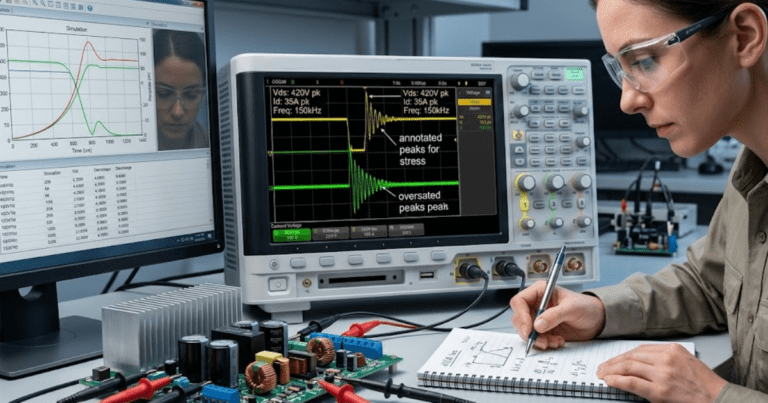
Early switching studies expose the failure modes that cost the most time on the bench. You can see overshoot, ringing, reverse recovery stress, dead time sensitivity, and current spikes long before a layout is ready. That gives you a chance to fix device selection and gate strategy before parts are ordered.
A 1 kW boost stage can look fine in averaged calculations and still fail once parasitic inductance and diode recovery are included. The model can show a drain voltage spike above device margin during turn off. It can also show that a small gate resistor change trades a little switching loss for a large drop in stress. That fix is cheap on screen and slow on a bench.
Switching studies also keep you from blaming the wrong thing later. Teams often chase firmware, layout, or sensors when the actual problem started with a poor commutation path or dead time choice. Hardware can’t tell you what would have happened under ten other timing settings without ten more test runs. Simulation can, which saves days before first power up.
Parameter sweeps shrink test time across operating ranges
Parameter sweeps cut test time because they check far more operating points than a bench session can cover in the same week. You can vary input voltage, load, temperature, component tolerance, and control gains in a structured way, then focus hardware work on the corners that still look risky. That is where simulation earns its keep.
A battery charger has to behave well at low line, high line, light load, full load, and during current limit transitions. Running those cases physically takes setup time, safe power handling, and repeated measurement cleanup. A simulation sweep can flag the exact corners where current ripple spikes or loop phase margin drops. Electric motor systems use more than 40% of global electricity, so inverter and drive operating ranges matter well beyond a single lab setup.
Teams often ask how many prototype iterations this saves. The number depends on model quality and product risk, but one skipped board spin is common when sweeps expose bad corners early. Two or more saved spins is realistic for converters with wide input range, thermal limits, and tight protection timing. Bench time gets shorter because you arrive with a short list of questions instead of surprises.
Model accuracy sets the ceiling on prototype savings
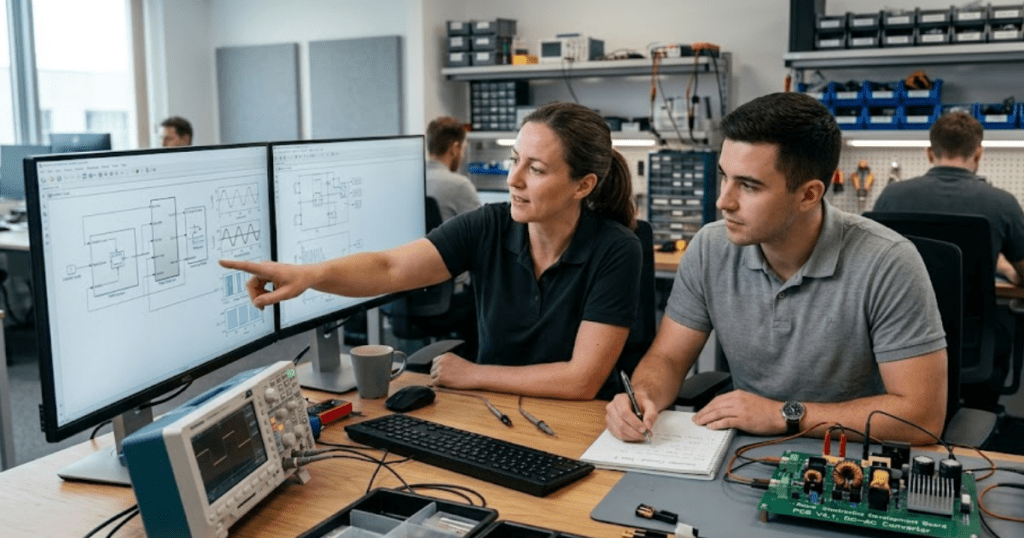
Model accuracy sets the ceiling on prototype savings because a weak model only moves mistakes earlier without removing them. Useful power electronics simulation software has to capture the physics that decide pass or fail for your design. If those effects are missing, the nice plots won’t mean much when hardware arrives.
A model for a half bridge inverter that ignores dead time, winding resistance rise with heat, and control sampling delay will report cleaner waveforms than the board will ever produce. That gap matters because design choices will follow the model. Tools such as SPS SOFTWARE matter here because transparent component models let you inspect equations, losses, and control assumptions before you trust the output. You’re not forced to accept a hidden black box.
Trust grows when a model includes the same details that will shape hardware results:
-
- Device switching loss reflects the actual gate path and parasitics.
-
- Magnetic parts include saturation and copper loss across temperature.
-
- Thermal paths link semiconductor loss to junction temperature.
-
- Control loops use the sampling and limits planned for firmware.
-
- Fault cases cover startup, overload, and abrupt load steps.
Each missing piece lowers the value of every screen result that follows. Accurate modelling doesn’t remove all uncertainty, but it will keep you from mistaking a neat waveform for a safe design.
Hardware still matters for compliance tests near release
Hardware still matters because some questions can only be answered with physical parts, wiring, sensors, and thermal assembly in place. Compliance work, electromagnetic interference checks, insulation spacing, and manufacturability all depend on the built product. Simulation reduces prototype count, but it won’t replace final proof.
A grid tied inverter can meet harmonic targets in a model and still miss limits after cable routing, grounding, and enclosure details are added. A current sensor can saturate, a heatsink interface can underperform, and connectors can add resistance you did not expect. Those effects show up only when the hardware exists as a physical object with all of its imperfections.
| Project stage | What simulation should answer | What hardware should confirm |
|---|---|---|
| During concept selection, the model should show which topology has enough efficiency and stress margin. | The model should rank options before any board is ordered. | The bench should confirm only the chosen path rather than compare weak options. |
| During control design, the model should show loop stability across planned operating corners. | The model should expose where gains or limits become unstable. | The bench should verify margins with actual sensors and timing delays. |
| During thermal planning, the model should estimate losses and hot spots under worst case load. | The model should identify parts that need cooling changes before layout is fixed. | The bench should confirm measured temperatures with the chosen assembly. |
| During protection design, the model should test startup, overload, and short fault timing. | The model should show which thresholds trip too early or too late. | The bench should confirm trip behaviour with actual wiring and noise present. |
| Near release, the model should act as a final sense check for expected waveform trends. | The model should help target the highest risk test conditions first. | The bench should complete compliance and production readiness checks. |
Physical testing works best when it arrives late enough to answer the questions only hardware can answer. If you ask the bench to choose topology, tune controls, and expose switching faults all at once, your schedule will stretch and your prototype count will climb.
Free power electronics simulation software fits early concept work
“Simulation removes most prototype spins because it answers the first round of engineering questions before a board exists.”
Free power electronics simulation software fits early concept work when your goal is to compare ideas, inspect waveforms, and estimate first order stresses before the design is mature. It is useful for teaching, feasibility work, and trade studies. It becomes less useful when the project depends on deeper device, thermal, and workflow detail.
A student team or small research group can use a free tool to test a buck converter control idea, compare switching frequency choices, or estimate capacitor ripple current before spending on hardware. That is often enough to reject poor options and settle target values. It’s a sensible first step when the question is broad and the cost of a rough answer is still low.
Limits appear once the model needs stronger fidelity, reusable component libraries, or a clean handoff into a wider engineering process. Free tools often work best at the concept stage, while later stages need editable models, clearer parameter control, and easier validation against measured data. You’ll save the most when you treat free software as a filter for early ideas, not as a substitute for full engineering checks.
Weak models create false confidence before bench bring-up
Weak models create false confidence when they hide the very effects that break the first board. A model that ignores parasitics, thermal coupling, or digital control timing will look calm on screen and turn messy on the bench. That gap wastes time because you’ll trust the wrong evidence at the wrong stage.
A designer can simulate a clean startup sequence for a bidirectional converter, only to find that the physical unit trips protection at turn on because capacitor precharge, sensor offset, and timing quantization were left out. The screen result was not useless, but it answered a smaller question than the team thought it answered. That is how simulation gets blamed for failures that actually came from shallow modelling.
Warning signs are easy to spot. Waveforms that stay perfect across every corner, losses that barely move with temperature, and control loops that never show saturation usually point to missing detail. You’re better off with an honest rough model than a polished one that hides risk. Honest models tell you what still needs hardware proof, and that honesty protects the schedule.
A staged workflow cuts cost before the first build
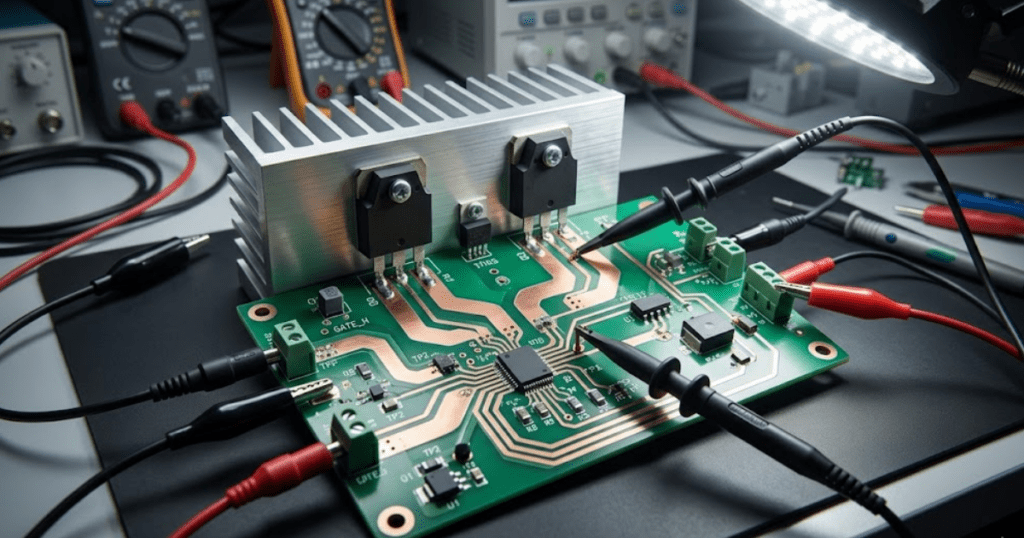
A staged workflow cuts cost before the first build because it assigns each question to the cheapest test method that can answer it well. Simulation should handle concept screening, stress checks, parameter sweeps, and fault rehearsal first. Hardware should arrive only after the design has earned the right to be built.
A disciplined flow starts with simple models to reject weak concepts, then moves into detailed switching and thermal studies, then uses a focused prototype to confirm the remaining unknowns. That sequence keeps procurement, layout, firmware, and lab time aligned around a design that already has evidence behind it. Teams that skip those stages usually spend the same engineering effort anyway, just later and at higher cost.
Good engineering judgment shows up in what you refuse to build too early. That is why power electronics simulation software matters most when it makes the first hardware build count. A platform such as SPS SOFTWARE fits that discipline when you need transparent models that support understanding as well as results. You’ll still prototype, but you won’t prototype to ask questions that software should have answered already.