A practical guide to choosing EMT simulation software and power system analysis software for transients based on solver visibility, model openness, timestep control, initialization, data access, and workflow fit.

A practical guide to choosing EMT simulation software and power system analysis software for transients based on solver visibility, model openness, timestep control, initialization, data access, and workflow fit.
You will judge model quality faster and more fairly when you score it against clear criteria, not a gut feel. Formative feedback cycles show measurable gains; one synthesis reported a mean effect size of 0.32. The same pattern shows up in engineering labs, since repeated checks beat one big grade. Consistent evaluation will turn modelling from guesswork into a habit you can defend.
Model quality is not about packing the most blocks into a diagram. Quality means your model will answer the question it claims to answer, with results you can explain and repeat. Students improve faster when evaluation looks like a small test plan with logged evidence. Educators grade with less noise when the same evidence is visible to everyone.
Students evaluate model quality when deciding whether a model is fit for its stated purpose. The check includes correctness, clarity, and repeatability, not just a clean plot. A model is high-quality when another person can run it and get the same result. A model is considered low-quality when its results depend on hidden tweaks or missing context.
A microgrid lab model exposes this fast. One student tunes a voltage sag response until the waveform looks right, then forgets to state the source impedance used. A lab partner runs the same file and sees a different sag depth, but cannot reconcile the mismatch. Quality drops because the model’s story is not repeatable.
Good evaluation starts with a plain question: what will this model support, and what will it not support. “Runs without errors” is a low bar for engineering work. A model that runs can still violate units, sign conventions, or energy balance. Evaluation shifts the focus from “did it run” to “did it prove anything.”
Most student reviews map to a small set of review criteria that work across courses. Accuracy matters, but it must tie to a reference you can defend. Consistency checks matter because they catch mistakes without extra data. Transparency matters because a hidden assumption will break peer review and grading.
An RLC step response assignment makes the criteria concrete. A strong model matches the expected damping ratio, maintains unit consistency, and shows the source of initial conditions. A weak model matches the plot only after random parameter edits, then hides those edits inside subsystems. The same criteria still apply to feeders, converters, and protection logic models.
We trust a model when we can trace each result back to evidence. Accuracy without traceability will not earn trust, since no one can see why the match occurred. Traceability without accuracy also fails, since the model will not answer the task. Quality stays strong when you balance criteria and match the grader’s focus.
“Evaluation shifts the focus from “did it run” to “did it prove anything.”
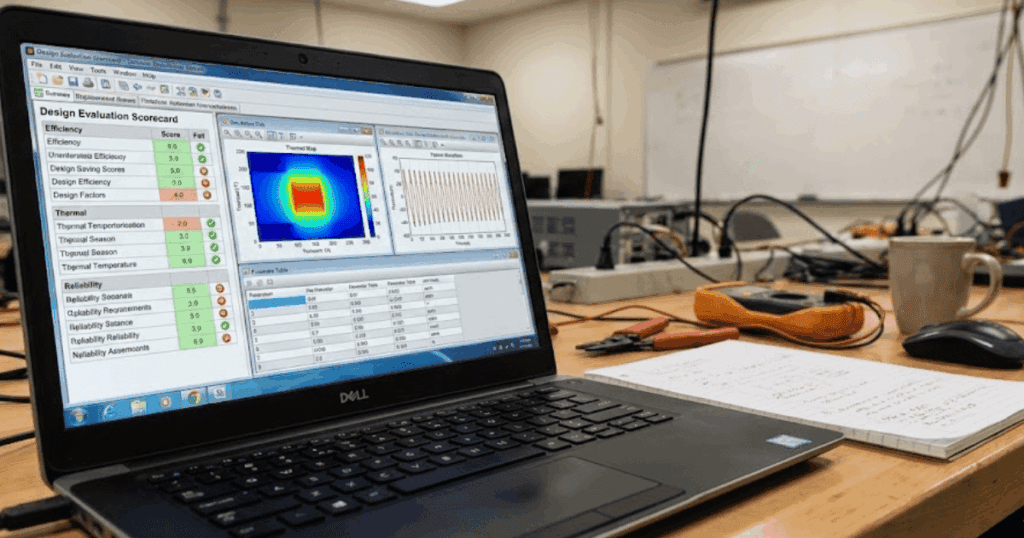
An evaluation scorecard turns model review into repeatable scoring. You define criteria, tie each to evidence, and score the same way each time. Consistency beats clever weighting, since graders trust repeatable checks. Self checks speed up when evidence is clear.
Disagreement drops when the scorecard requires evidence. One published study reported an overall inter rater reliability ICC of 0.7 when evaluators scored the same work with a shared rubric. Students can mirror this by anchoring each score level to an artifact, not a feeling.
| Aspect being checked | What strong model quality looks like | What weak model quality looks like |
| Purpose alignment | The model answers a clearly stated question and stays focused on that task from start to finish. | The model includes extra behavior that does not support the stated task or distracts from it. |
| Assumptions visibility | All simplifying assumptions are written down and their impact on results is explained. | Assumptions are implied or hidden, making results hard to interpret or trust. |
| Evidence for correctness | Results are supported by reference checks, sanity tests, or expected physical behavior. | Results rely only on visual agreement or tuning without justification. |
| Repeatability of results | Another person can run the model and reproduce the same outputs using the same inputs. | Results change when someone else runs the model or when files are reopened. |
| Transparency of parameters | Key parameters, units, and initial conditions are easy to locate and understand. | Important values are buried in subsystems or lack units and context. |
| Review readiness | The model includes notes or artifacts that support grading and peer review. | The model requires verbal explanation because supporting evidence is missing. |
Transparent models make scorecards easier to apply, since you can point to equations and parameters. SPS SOFTWARE supports this style when labs need inspectable models for review. Clarity cuts debate and regrading. Feedback gets sharper because each gap maps to one row.

A good review order saves time because early checks catch the biggest errors. Start with purpose and scope, then check the structure and run simple sanity tests, then judge the results. The order stops you from tuning a broken model. Notes become easier to follow for peers and educators.
A lab partner reviewing a converter model can apply these steps in minutes. The reviewer confirms the switching frequency and control targets, then checks the power-stage wiring. A no load run should keep current near zero and voltages in range. Only then should the reviewer judge efficiency or waveform shape.
Later tests assume earlier checks are correct. Controller tuning before sensor scaling checks will waste hours and still result in a failing grade. The sequence reduces bias in peer assessment, since everyone follows the same path. Educators grade faster when the student assessment steps align with the grader’s workflow.
Assumptions and scope define what “correct” will mean for your model. A model can be excellent inside its scope and useless outside it. Students who write scope clearly avoid unfair criticism, since reviewers know what was intentionally left out. Educators reward clear scope because it shows engineering judgment.
A power electronics task that targets control-loop stability illustrates the trade-off. An averaged converter model will cleanly answer the stability question, while a switching model will bury it under ripple and step-size noise. The averaging assumption is valid when you state frequency separation and explain why ripple is not the metric. Quality rises because the model matches the task.
Scope also changes what tests you should run. An EMT level network study will need checks on time step, solver limits, and numerical stability, while a steady state RMS study will need checks on balance and phasor assumptions. Students lose points when they test the wrong thing, then claim the model is “validated.” Clear scope keeps tests aligned with what the model claims to represent.
Students often score models based on output shape rather than evidence. That habit rewards tuned models and punishes models that document their work. Another error is mixing critique of the idea with critique of the implementation. Quality scoring should focus on what the model proves, not what you wish it proved.
A classic failure occurs when a single nominal waveform match ends the review. The model passes the nominal case but fails under a small change, such as a load step or a shift in fault impedance. Another failure shows up when time steps are chosen for speed, which distorts dynamics and hides instabilities. Review criteria that include repeatability and sensitivity checks will catch both issues.
Self assessment also fails when documentation gets skipped because the model is “obvious.” Missing units, initial states, or parameter sources will block grading and peer review. Students also lose points when a value changes without a note, so the final model has no audit trail. A scorecard forces discipline, since each row needs a specific artifact.
“The closing judgment is simple: disciplined evaluation is part of engineering, not extra paperwork.”

Educators grade student models best when feedback points to the same evidence students used for scoring. Clear criteria reduce arguments about style and focus attention on what the model will support. Alignment also means educators will show what “good” looks like in the same format used for grading. Students learn faster when feedback turns into the next test you should run.
Calibration before grading keeps scores consistent across sections. Two graders score the same sample model, compare notes, and adjust scorecard wording until scores match. Students can mirror this during peer review by swapping models and scoring them independently, then discussing one mismatch at a time. The result is fairer grading and stronger habits.
The closing judgment is simple: disciplined evaluation is part of engineering, not extra paperwork. Students who treat review criteria as a test plan will build models that teach as they run. Educators who align comments with the scorecard will spend less time defending grades and more time coaching. SPS SOFTWARE supports this approach when labs want transparent, inspectable models that make evidence easy to show.

Modern modelling will make your labs teach understanding, not button clicks. Digital labs let students change parameters and explain waveforms. You’ll grade exercises with checks, not guesswork. Lab reports will improve.
Engineering teaching uses models on paper, so simulation models fit. The update treats a model like an instrument to verify and stress. Teaching support needs an update because students learn faster with one workflow. That shift modernizes modelling labs without turning class time into tool training.
Modern modelling belongs in engineering teaching because it links theory to visible behaviour. Students will see how parameters, controls, and disturbances alter voltages and currents. That clarity will reduce copying and raise the quality of explanations. Labs get easier to repeat across semesters.
A useful lab pattern starts with a claim, then asks students to prove it with the model. A fault study can require a predicted first-cycle current, a simulated result, and a short explanation of the gap. Students can pinpoint the cause by checking source impedance and measurement points. That habit builds skepticism and engineering judgment.
These six changes modernize modelling activities without adding weekly hours. Each item ties an exercise to visible response and a check. Pick two items next lab cycle, then expand once grading feels stable. Stronger explanations will show up fast.
“A useful lab pattern starts with a claim, then asks students to prove it with the model.”
| Replace static lab manuals with interactive digital lab workflows | Students learn more when labs require them to test changes, capture results, and explain outcomes instead of following fixed instructions. |
| Use open, inspectable models to teach system behavior step by step | Allowing students to see inside models helps them trace cause and effect and build debugging skills rather than guessing. |
| Design modelling activities that connect equations to system response | Linking calculations to simulated waveforms teaches students to validate theory and question mismatches instead of accepting plots at face value. |
| Scale student exercises from simple blocks to full system studies | Gradually expanding a single model across labs builds confidence and reinforces how small subsystems combine into larger systems. |
| Blend offline simulation with controller and system validation tasks | Treating models as test benches trains students to think in test cases and limits, not just nominal operation. |
| Support instructors with reusable templates and assessment-ready models | Standardized templates reduce grading effort and keep modelling labs consistent across sections and semesters. |

Static manuals push copy steps, while a digital lab workflow forces evidence at each stage. A simple structure works well: run a baseline, change one variable, then explain the delta using plots and values. A workflow can live as a versioned model folder with a checklist and a results file. Students will submit the model plus labeled plots with units and captions, not screenshots.
A motor start lab can ask three runs: rated voltage, 90% voltage, and higher inertia. The checklist can require the same axes, the same time window, and one metric such as peak current. Setup time is the tradeoff because file naming and storage must be consistent. That effort pays back when grading speeds up and disputes drop.
Students learn faster when they can open a model, see assumptions, and trace cause to effect. Inspectable models teach debugging because students can follow signals and states instead of guessing during lab time. A good lab starts with a small readable model and adds one feature per step. Each step should include one check that proves nothing else changed.
A converter lab can begin with an averaged switch, then add a switching bridge, then add a filter, and finally add control. Each step can require a power balance check or a ripple measurement. SPS SOFTWARE works well when students inspect structure and parameters instead of treating blocks as magic. Cognitive load is the constraint, so optional detail should stay hidden.
Modelling works best when students carry one equation from paper to plot, then explain the gap. The model becomes a test bench for assumptions about linearity, saturation, and time constants. Students will stop treating plots as truth and start asking what the model implies. That practice shows up later in design and fault finding.
An RL step response is a clean example: students compute the time constant, predict the 63% rise time, then measure it from the simulated waveform. A second run can add a sensor filter and ask for a revised calculation and plot. Scope control matters, so keep the math short and the measurement method explicit. Grading gets easier because the explanation matters more than a perfect value.
Students build confidence when exercises scale in a planned sequence instead of big jumps. A scalable sequence reuses the same base model and grows it in layers, so students practice refactoring. Each lab should add one new concept and one new failure mode to diagnose. That structure also helps you pinpoint where a cohort gets stuck.
A protection sequence can start with a source and load, then add a line, then add a fault, and finally add relay logic. Measurements can stay constant, while each week adds one plot such as trip time or negative-sequence current. Planning is the tradeoff, because you’ll need the end state defined early. Students still struggle, but the struggle stays focused and teachable.

A modern lab treats the model as a place to validate control logic and system limits, not just to get waveforms. Students will think in test cases: nominal operation, disturbance, fault, and recovery. The controller can be simple, but timing and saturation need to be modeled. Students learn to ask what breaks first and why.
A grid-tied inverter exercise can ask students to tune a current controller, then test a voltage sag and a phase jump. A second pass can add measurement noise and a slower sampling rate, then require a justified retune. More variables are the tradeoff, so defaults must be fixed and changes must be limited. That discipline produces cleaner comparisons and better reasoning during grading week.
Teaching support keeps modelling labs teachable at scale. Templates make grading consistent, protect lab time, and help new instructors run the same lab with fewer surprises. Assessment-ready models also support integrity because student edits are visible and checkable. You’ll spend less time hunting files and more time reading explanations.
A template can include standard measurements, a plot generator, and a results page that pulls key metrics. A check script can flag missing labels, unit errors, and unsaved runs on submission. A starter model can keep the test bench fixed while students edit parameters and logic blocks in marked areas. Maintenance is the tradeoff, since templates need updates when objectives shift.
“Students will think in test cases: nominal operation, disturbance, fault, and recovery.”

The right mix depends on what you want students to do without you nearby. Start with one outcome you can grade cleanly, such as explaining a waveform change using model evidence. Then pick the lab pattern that fits that outcome and keep everything else fixed for the first run. Students trust labs when the rules stay stable.
Class size and lab access matter. Large groups need templates and checks, while small groups can spend more time debugging. A one-page lab contract helps: allowed edits, required plots, one pass or fail check. A modelling platform only helps if your course rewards clarity and verification, and SPS SOFTWARE works best as the shared workspace that keeps labs consistent.

Power engineering students often face a daunting gap between classroom theory and real-world practice. Complex topics like electromagnetic transients (EMT) and power converter basics can remain abstract, leaving students unsure how to apply formulas or design principles in practice. Building true confidence with EMT and converter models requires more than lectures and equations – it calls for hands-on exploration in a safe, intuitive simulation environment. This thought leadership piece examines why intuitive simulation is a key driver of learning, how it addresses common pain points in power engineering education, and ways it empowers both students and instructors.
“Simulation helps make the abstract become concrete, turning what might seem like dry, boring calculations into visual and interactive phenomena.”
Relying on theory alone to teach EMT and converter fundamentals can leave students with a fragile understanding. Many undergraduates struggle to connect textbook formulas to the behavior of actual circuits – for example, picturing how a converter’s current waveforms respond to a control signal, or how a transient surge propagates through a power system. Studies have shown that while students retain only about 10% of what they read or hear, they remember up to 90% of what they actively do (even if it’s done via simulation)t. In other words, working through a problem hands-on – such as building a simple rectifier model or simulating a short-circuit transient – cements learning far better than passive study.
Crucially, theory by itself doesn’t instill the confidence to tackle real equipment. A student might ace an exam on converter topologies yet feel hesitant to design or experiment with one in the lab. This is because abstract knowledge hasn’t been translated into intuitive understanding or practical skill. Educational researchers note that computer simulations can bridge this gap by allowing students to put theories into practice in a realistic context. By interacting with EMT and converter models on screen, students begin to see how the equations play out in dynamic behaviour. For example, they can adjust the firing angle of a thyristor in a converter simulation and immediately observe the effect on voltages and currents – linking theory to tangible results. Without such experiences, theory remains an “on paper” concept, and students often lack confidence that they can predict or control what will happen in a real circuit.
Engineering educators have long emphasized the importance of moving from abstract to concrete learning. Simulation helps make the abstract become concrete, turning what might seem like dry, boring calculations into visual and interactive phenomena. In one study, introducing a simulation tool in a power electronics course “improve[d] the quality of teaching by making the abstract concrete [and] the boring interesting,” which in turn stimulated greater student interest. When students see a converter model come alive – with waveforms oscillating and responding to parameter tweaks – the subject matter clicks in a way that pure theory can’t achieve. This builds a much deeper understanding of EMT basics and converter operation, laying the groundwork for genuine confidence.

Even when students know what they are supposed to do, fear of failure can hold them back from trying it. In traditional high-voltage or power electronics labs, a simple wiring mistake can lead to blown components or safety hazards. It’s no surprise that fear of failure presents a notable barrier to learning and innovation, especially among engineering students. Students might hesitate to experiment or may follow lab recipes blindly, worried that a wrong move could damage expensive equipment or embarrass them in front of peers.
Virtual laboratories remove these worries by creating a risk-free space for exploration. Research on simulation-based learning finds that students often develop anxiety about performing experiments due to the perceived negative consequences of mistakes, but in a virtual lab “they can safely perform experiments… without any fear of damage to the equipment or injury to themselves.” In other words, simulations let students fail safely. No blown fuses, no public mistakes – just feedback and the chance to try again. This freedom to experiment, without the usual stakes, is transformative for learning.
Consider a few key benefits of safe, virtual lab environments for EMT and converter education:
By removing the real-world consequences, safe simulation spaces drastically reduce learning anxiety. Students no longer fear looking “inadequate” for a misstep, and they gain confidence with each hands-on attempt. In fact, educators have observed that this confidence carries over to real labs once students have honed their skills virtually. After all, if you’ve successfully navigated dozens of fault scenarios on a virtual microgrid model, you approach the physical equipment with much less trepidation. The result is a student who doesn’t just know the theory but feels ready to apply it.

A major advantage of modern EMT and converter simulators is their transparency – students can literally see what’s happening inside a system. Unlike a physical circuit, where many processes are invisible, a simulation model exposes every voltage, current, and field variable for inspection. This transparency turns abstract concepts into something almost tangible.
For example, think of the concept of transient stability in a power system, or the switching behavior inside a PWM inverter. On paper, these are described by differential equations and abstract waveforms. In a transparent simulation, students can watch the system’s response unfold step-by-step: they might plot the rotor angle of a machine during a fault, or zoom in on the current spike when a transistor switches on. Complex equations transform into intuitive visuals. As one educational study noted, certain theoretical relationships “can be better understood by comparing simulation graphs” side by side. By overlaying the simulated current and voltage waveforms of a converter with the expected theoretical waveforms, students quickly grasp how the theory translates to reality – and where there are nuances that pure theory might gloss over.
Another aspect of transparency is that simulation models are grounded in real physics, yet are user-friendly to interact with. Many widely used power engineering simulation packages (such as those built on MATLAB/Simulink) provide intuitive, graphical interfaces. Students build circuits by dragging and dropping components, much like drawing a schematic. They can double-click on any element to inspect or change its parameters. Since the underlying calculations are based on established EMT algorithms and converter equations, the outcomes remain faithful to what physics predicts – but the process of model-building and observation is accessible even to beginners. In effect, the simulator becomes a sandbox version of a power lab, where everything is visible and adjustable.
Transparency also means students can trace cause and effect through a system. If an EMT simulation shows oscillations after a circuit breaker operation, a student can pause and probe the model to find the root cause (perhaps a resonant LC path). If a DC-DC converter output is not as expected, they can inspect internal variables (inductor current, diode state, etc.) to diagnose why. This practice of opening the black box leads to deeper understanding. Instead of treating converters or transient phenomena as magical or inscrutable, students come to intuitively understand how each part of the system contributes to overall behaviour. One educator observed that using a visual simulation environment enabled instructors to demonstrate dynamic system behavior easily by changing inputs and showing students what happens in real-time, which “stimulates students’ interest” and engagement in learning power electronics. In short, transparent simulation models turn theoretical EMT and converter concepts into living, interactive lessons – building a strong intuitive foundation that pure theory teaching often lacks.

“Guided exercises ensure that the first time a student encounters complex equipment, it is not truly the first time.”
While open-ended exploration is valuable, students benefit greatly from a structured path when first learning EMT and converter basics. Guided exercises – such as step-by-step simulation labs or progressive problem sets – provide scaffolding that helps beginners practise EMT fundamentals in a logical sequence. Starting with simple models and gradually increasing complexity prevents overwhelming novice learners, all while building their skill and confidence incrementally.
For instance, a guided exercise might begin with a basic RC circuit to illustrate a transient response, then add complexity: first a single-phase rectifier, then a full bridge converter with control, and eventually a grid-tied inverter system. At each stage, the exercise can prompt students to predict outcomes, run the simulation, and reflect on any differences. This approach ensures learners grasp core principles (like time constants or PWM effects) before piling on more layers. By the time they reach advanced scenarios, they have a toolkit of understanding developed through practice. Research supports this scaffolded approach – one study found that combining interactive simulations with guided problem-solving significantly improved students’ systematic problem-solving abilities in engineering courses (InSiDE simulations for dynamics education).
Moreover, guided simulation labs serve as a bridge to working with real hardware. They familiarize students with procedures and troubleshooting in a low-stakes setting. When the time comes to use physical equipment, students who have completed virtual exercises often perform far better. In one case, 94% of students reported gaining domain knowledge and confidence in their lab skills – and felt better prepared for in-person labs – after using virtual lab simulations as a practice tool. This is a striking validation that well-designed simulation activities can bolster real-world readiness. Students walk into the hardware lab having essentially done it before in the virtual world: they have seen the correct waveforms, made and corrected mistakes, and learned the workflow of an experiment.
Confidence grows hand-in-hand with competence. By practising EMT basics and converter operation through guided simulations, beginners steadily build both their understanding and their self-assurance. Instead of facing a high-power converter demo for the first time with uncertainty, they approach it like a familiar exercise. An illustrative example comes from a biology context where students first learned microscope operation in a virtual lab; instructors found those students were noticeably more adept and confident when handling the real microscopes later on. The same principle applies in power engineering: a student who has virtually debugged a faulty inverter model will feel far more confident troubleshooting a physical inverter in the lab. Guided exercises ensure that the first time a student encounters complex equipment, it’s not truly the first time – they have done it virtually, reflected on it, and are ready to succeed for real.
Building confidence with EMT and converter models begins with a learning space that feels approachable, structured, and safe, which is the same spirit carried into how OPAL-RT SPS SOFTWARE supports education. Students often advance more consistently when a modelling tool lets them start small and build knowledge layer by layer, and this is where clear, physics grounded behaviour matters. The platform offers an intuitive way to test ideas, review internal signals, and practise guided steps without fear of mistakes. This style of progression helps students connect theory to practical insight in ways that feel achievable at each stage. The result is a stronger sense of readiness when students eventually work with hardware in the lab.
Educators also benefit from having a modelling system that grows with the learner rather than limiting their curiosity. SPS SOFTWARE supports transparent component models, straightforward simulation workflows, and structured exercises that align naturally with the teaching of EMT basics and converter basics. Instructors can use these tools to reinforce lessons, demonstrate system behaviour visually, and create opportunities for independent exploration. As students gain confidence, they can move from simple circuits to advanced system studies using the same familiar environment. This cultivates a long term path for mastery while supporting the instructional goals of modern power engineering programs.