
Key Takeaways
-
- SIL should lead your workflow when controller logic and plant assumptions are still unsettled.
-
- HIL earns its cost when timing, scaling, and protection behaviour on physical hardware become the main risk.
-
- Consistent models, tests, and pass limits are what make SIL and HIL work as one validation path.
SIL should come first for power electronics control work, and HIL should follow when timing and input/output fidelity start to matter.
Power electronics process and control more than 80% of electricity in the United States, which shows how much rides on stable control behaviour and sound validation choices. You’ll get better results when you treat software-in-the-loop as the place to stress control logic early and hardware-in-the-loop as the place to prove implementation details against physical interfaces. That sequence keeps faults visible while your models are still easy to edit. It also cuts the risk of late surprises once code reaches sensors, PWM outputs, and protection signals.
“The best transition from SIL to HIL keeps the same test intent, pass limits, and core plant assumptions across both stages.”
SIL versus HIL sets the test boundary
The main difference between SIL and HIL testing is the location of the controller and plant during the test. Software-in-the-loop keeps the controller code and plant model inside simulation, while hardware-in-the-loop testing means the controller hardware is physical and the plant stays simulated. That boundary decides which faults you can trust the setup to expose.
A digital current loop for a boost converter makes the distinction clear. SIL will show if PI gains, limits, and fault states behave across operating points. HIL will show if ADC scaling, PWM timing, and fault pin wiring still behave once the controller board runs the code. Each method answers a different test question.
| Comparison point | What SIL tells you | What HIL tells you |
| Controller execution | The controller runs as software, so you can inspect states, tune logic, and repeat tests quickly. | The controller runs on physical hardware, so you can check processor timing, I/O paths, and code integration. |
| Plant representation | The plant stays simulated, which makes parameter sweeps and fault injection simple. | The plant also stays simulated, but it must interact through physical signals and interface limits. |
| Main fault class | This setup is strongest for control logic errors, state machine mistakes, and poor tuning choices. | This setup is strongest for sampling delays, interrupt clashes, scaling problems, and interface timing faults. |
| Project timing | You can start before controller hardware is ready, which keeps early design work moving. | You need enough hardware maturity to test the actual controller board and its connections. |
| Confidence limit | A pass means the control concept is sound under the assumptions in the simulation. | A pass means the implemented controller behaves correctly against the simulated plant through physical I/O. |
SIL finds controller logic faults before hardware exists
SIL is the right place to validate embedded control logic before hardware is available because it makes control states visible and cheap to test. You can run the compiled controller code or an equivalent software representation against a plant model and catch errors while the cost of change is still low.
A three-phase inverter controller shows why this matters. You can test current regulation, DC-link supervision, anti-windup, and transition rules between startup, run, and fault states without waiting for a control board. If the modulator saturates during a voltage sag, you’ll see the sequence that caused it. That clarity helps you fix logic instead of guessing from a failed bench test.
Poor software quality cost the United States economy at least $2.41 trillion in 2022. That figure covers far more than power electronics, yet the lesson still holds. Late faults are expensive because they mix software errors with hardware uncertainty. SIL separates those issues early, so you won’t burn time chasing a control bug through an oscilloscope trace.
HIL proves timing behaviour against physical interfaces
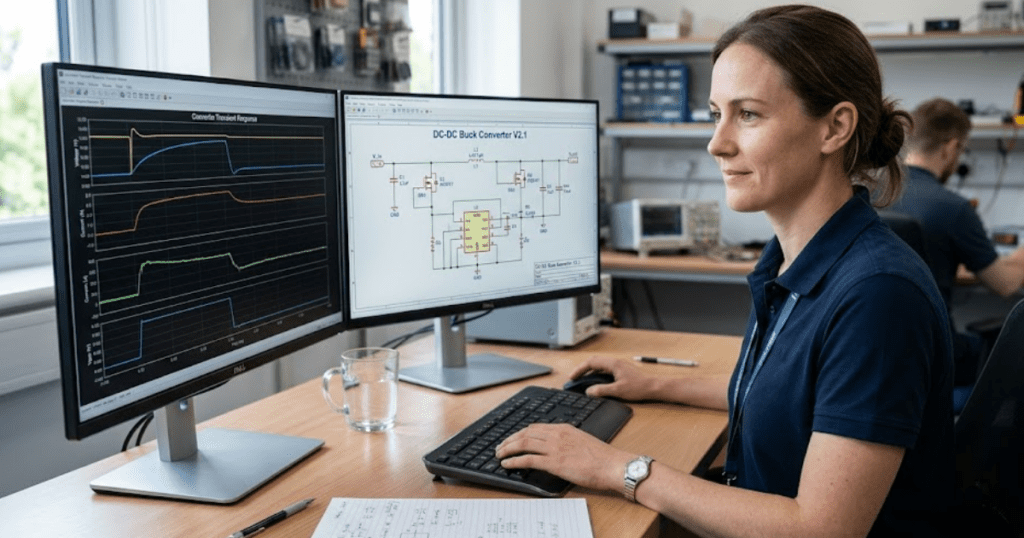
HIL matters when you need proof that the implemented controller behaves correctly with actual hardware timing and actual I/O paths. It exposes issues that simulation alone won’t show clearly, such as sample jitter, interrupt latency, ADC quantization effects, PWM update timing, and hardware fault input handling.
A bidirectional DC/DC converter offers a common case. The control law can look perfect in SIL, yet the physical controller might sample current too close to a switching edge and feed noisy values into the loop. That problem will show up as limit cycling, unstable duty commands, or nuisance trips. HIL puts the controller board into the test, so those interface details stop hiding.
You should treat HIL as proof of implementation behaviour, not as a substitute for plant modelling discipline. A weak plant model will still mislead you, and a good controller can still fail if scaling, timing, or protection logic is off by a small amount. HIL earns its place when physical execution details carry the remaining risk.
Use SIL first when plant risk is still high
Use SIL first when you’re still settling plant assumptions, operating modes, and controller structure. Early power electronics work usually carries large uncertainty around parasitics, operating limits, and fault scenarios, so a flexible simulated boundary gives you more value than immediate hardware connection.
A grid-tied inverter with an LCL filter is a good example. Filter resonance, grid impedance spread, PLL tuning, and current limiter behaviour all need attention before hardware timing becomes the main concern. You can sweep line conditions, DC-link levels, and fault cases quickly in SIL. That lets you see which control choices are robust and which ones only work under narrow assumptions.
You’ll also get a better plant model from this stage. Dead time, sensor lag, saturation, and switching ripple can be added in steps instead of all at once. That staged approach keeps cause and effect visible. Once the plant risk drops and the controller logic stops moving every week, HIL becomes the next sensible step.
Move to HIL when input output timing becomes critical
Move to HIL when the remaining questions are about execution timing, I/O fidelity, and fault response on the actual controller hardware. That point arrives after control logic has settled enough that new failures are more likely to come from implementation details than from missing equations or poor state logic.
Several signs usually show that you’re ready for that move:
-
- The control law has stopped shifting every few days.
-
- Pass or fail now depends on interrupt timing.
-
- Protection trips must be checked through physical pins.
-
- Sensor scaling errors can alter loop stability.
-
- Startup and shutdown sequencing needs hardware proof.
A motor drive controller often reaches this point after basic speed and current loops are stable in SIL. Startup contactor sequencing, desaturation input handling, and encoder capture timing then become the hard parts. HIL gives you a safe way to test those paths without risking a full-power stage. That’s when the move pays off.
A staged workflow links SIL results to HIL results
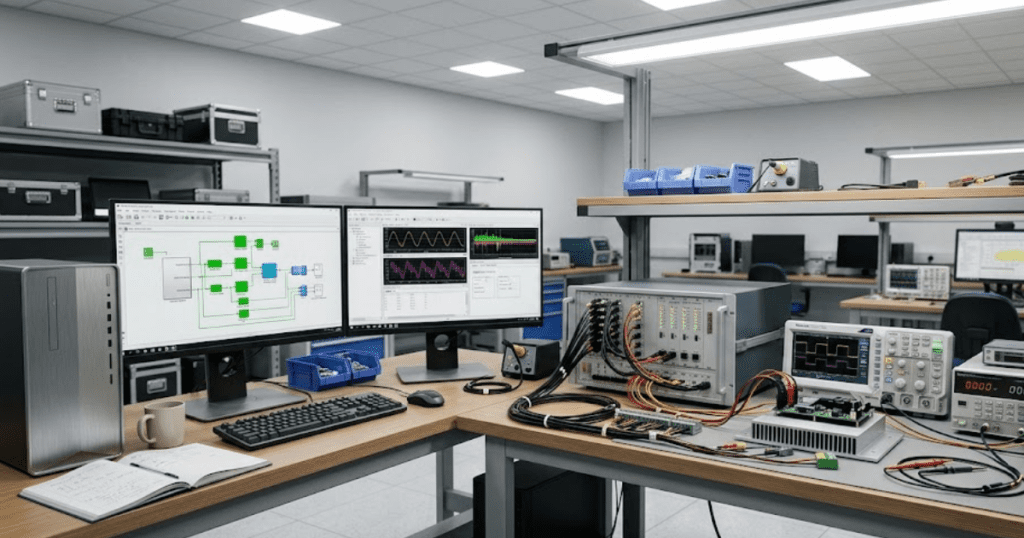
The best transition from SIL to HIL keeps the same test intent, pass limits, and core plant assumptions across both stages. You should not treat HIL as a fresh start. It works best when it inherits the scenarios that already proved useful in SIL and then adds implementation checks around them.
A practical workflow for a charger controller starts with plant validation and control tuning in SIL. The same test set then moves forward with defined limits for overshoot, settling time, fault recovery, and mode transitions. HIL adds checks for ADC mapping, discrete input timing, PWM scaling, and watchdog handling. That continuity makes result comparison much easier.
Teams lose time when names, signals, or test thresholds shift between stages. You’ll want the same operating points, the same fault cases, and the same expected responses carried through the workflow. If a pass in SIL turns into a failure in HIL, the source of the mismatch becomes far easier to locate. That’s how a staged workflow saves effort instead of adding ceremony.
Model-based design gains trust from matched assumptions
SIL and HIL fit model-based design only when the assumptions stay aligned across plant, controller, and test logic. If model fidelity, signal scaling, or interface definitions drift between stages, trust falls quickly because each pass result refers to a different system picture.
A transparent modelling setup helps here. SPS SOFTWARE fits this work when you need plant models that engineers can inspect, edit, and connect to a controller validation flow without hiding the equations. A converter study in an academic lab or an R&D team can use the same plant structure for early SIL runs and later HIL preparation. That continuity keeps engineering discussion focused on behaviour instead of tool opacity.
Matched assumptions don’t mean frozen models. You should refine loss terms, sensor limits, and switching details as evidence improves. The key is that each refinement stays traceable and visible to the team. Model-based design earns trust when the model lineage is clear and the test boundary stays intentional.
“Software-in-the-loop keeps the controller code and plant model inside simulation, while hardware-in-the-loop testing means the controller hardware is physical and the plant stays simulated.”
Weak test boundaries create misleading pass results
Pass results become misleading when the chosen test boundary hides the failure mechanism you actually need to expose. SIL can look clean while physical timing is broken, and HIL can look stable while the plant model is too simple to stress the controller properly. Good validation comes from matching the boundary to the active risk.
A converter that passes every SIL case can still trip on hardware if the overcurrent input arrives a few microseconds later than the logic assumed. A controller that passes HIL can still fail on a power stage if the simulated plant ignored saturation or resonance that dominates operation. Those are not small misses. They come from asking the wrong setup to answer the wrong question.
You’ll get stronger engineering judgement when each stage has a narrow job and a clear handoff. SIL should break logic early. HIL should prove execution details before full system exposure. That discipline is more useful than chasing one test rig, and it’s the mindset SPS SOFTWARE supports when teams want physics-based models that stay understandable from first concept to final validation.