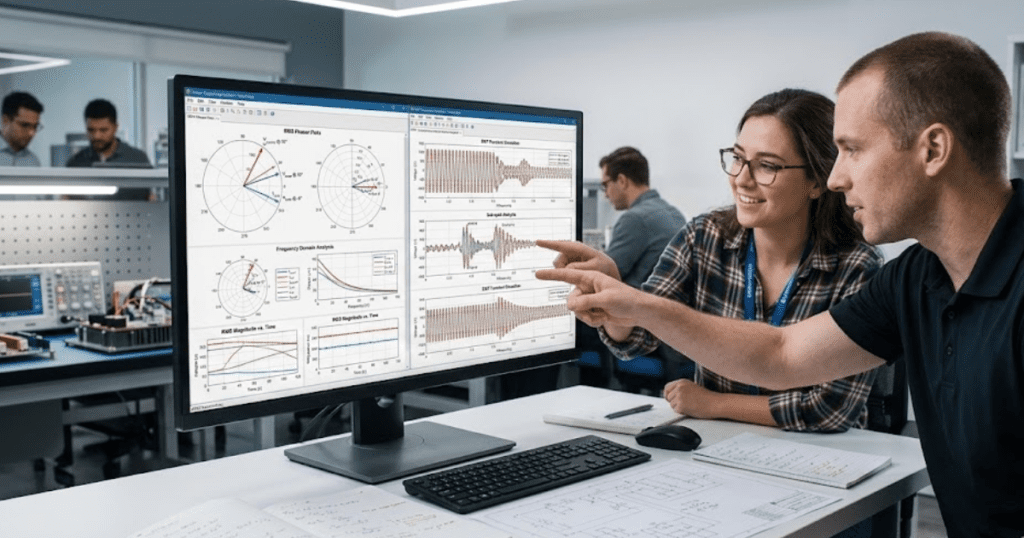
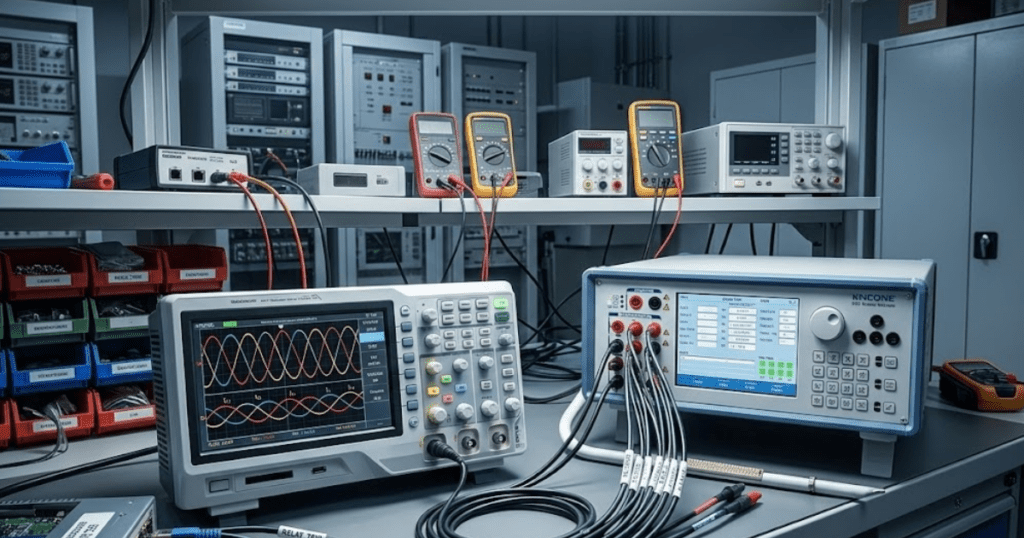
Choosing the right solver is how you get power system results you can trust.
Solver choice is not a software preference, it is a modelling choice that decides what physics your simulation can and cannot represent. A clean plot can still be wrong if the method cannot resolve the time scales that matter, or if numerical damping hides the behaviour you actually need to study. A standard lightning impulse used for insulation testing is 1.2/50 µs, and that single fact should settle one point early: some electrical questions live in microseconds, not seconds.
“Good solver selection starts with your study objective, then works backward to the model detail, the time step, and the numerical method that will hold accuracy where it counts.”
Speed matters, but it comes after correctness, because a faster wrong answer still costs you time when tests do not match, protections misoperate on paper, or controls look stable only because the solver blurred the dynamics. Treat the solver and its settings as part of your model, document them, and you will get results that hold up under review.

Power system solvers fall into a few families that each simplify the physics differently. Algebraic solvers handle steady state power flow and short circuit calculations without time stepping. Phasor and RMS time domain solvers step electromechanical dynamics using averaged network behaviour. EMT solvers step the full electrical waveforms, so switching, saturation, and fast protection effects show up directly.
Those families also differ in how they solve equations at each time step. Power flow typically uses Newton style iteration on algebraic equations, while EMT and RMS solvers integrate differential algebraic equations that combine network constraints with device dynamics. Fixed time step EMT focuses on repeatable waveform accuracy, while variable time step RMS often focuses on long runs with acceptable dynamic error. Solver terms like “explicit,” “implicit,” “trapezoidal,” and “backward Euler” describe how the integrator behaves when the system has fast and slow dynamics mixed together.
A practical way to keep this straight is to ask what your model states really represent. RMS and phasor models usually represent fundamental frequency magnitudes and angles, so they will not show PWM ripple or subcycle peaks that drive some protections. EMT models represent instantaneous voltages and currents, which is why they catch commutation overlap, diode recovery effects, and wave propagation effects when line detail matters. Once you pick the solver family, the rest of the setup is not “tuning,” it is matching the numerics to the physics you chose to represent.
EMT simulation is the right fit when the answer depends on waveform detail, fast switching, or subcycle interactions between the network and devices. Phasor and RMS simulation is the right fit when the answer depends on slower dynamics, steady state limits, or system level behaviour over many cycles. The method you choose sets a ceiling on the fastest phenomenon you can trust. That ceiling matters more than the run time.
A concrete way to choose is to frame your question as “what must be time resolved to answer this.” Consider a 13.8 kV industrial feeder with a VFD front end, a capacitor bank, and an overcurrent relay set near a sensitive process load. If you need to see capacitor inrush peaks, diode bridge commutation notches, and relay pickup on a distorted current, EMT will be the only method that shows those details without heavy assumptions. If you only need the post-event voltage recovery trend across tens of seconds after a motor restart, a phasor or RMS study will answer faster with less model detail.
| What you need to learn | Method that usually fits | What will decide accuracy most |
| Steady state voltages, losses, and equipment loading | Power flow with an algebraic network solver | Model data quality and consistent base values will matter more than solver settings |
| Generator angle and frequency response over seconds | Phasor or RMS electromechanical simulation | Machine, governor, and exciter models plus event timing will dominate results |
| Converter control interactions and switching related distortions | EMT time domain simulation | Time step, switch model detail, and control sampling will set what you can trust |
| Protection pickup that depends on subcycle peaks or distortion | EMT or waveform based protection modelling | Anti alias filtering, measurement windows, and integration method stability will matter |
| Long feeder voltage profiles across many load changes | Quasi static time series using steady state solves | Load models, tap logic, and event sequencing will dominate, not microsecond detail |
| Travelling waves and surge propagation along long conductors | EMT with distributed line representation | Propagation effects scale with the speed of light at 299,792,458 m/s, so time resolution must respect those delays |
Once the objective is clear, mixed workflows become easier to manage. Start with a simpler method to set initial conditions and sanity check operating points, then move to EMT only where the physics needs it. A solver does not fix missing model detail, and extra detail does not rescue a solver that cannot represent the behaviour your question depends on. Pick the method that matches the question, then set the numerics to protect that choice.
Time step and integration method control numerical error, numerical damping, and stability, so they directly shape what you will believe from a plot. A time step that is too large will smooth peaks and distort phase, even if the simulation “runs fine.” A method that is too aggressive on damping will hide oscillations that matter for control or protection. The right settings come from the fastest dynamics you must resolve, not from defaults.
Fixed step EMT usually works best when you set the step from switching frequency, the smallest L and C time constants, and the fastest control sampling in the model. A common engineering check is to keep enough points per switching period that switching edges do not collapse into one or two samples, then confirm key quantities do not change much if you halve the time step. Trapezoidal integration will preserve waveform detail well, but it can show numerical ringing if discontinuities are harsh. Backward Euler will damp high frequency content, which can help stability but can also hide the very ripple you needed to see.
Accuracy problems often look like “weird physics,” but the cause is numerical. Spikes at switching instants can be time step artefacts, while missing overshoot can be numerical damping. Event handling also matters, since breaker operations and limiter activations can create discontinuities that stress the integrator. When you treat the time step as a modelling parameter and not a performance knob, you will avoid long loops of trial and error.
Stiff systems mix very fast and much slower dynamics, and that mix can cause explicit methods to become unstable or force impractically small steps. Nonlinear devices add iterative solves inside each step, so convergence settings become part of accuracy and not just a way to stop warnings. Ideal switches, saturating magnetics, and hard limits create discontinuities that make iterations struggle. Stable results come from a solver that matches stiffness and a model that avoids impossible idealizations.
Practical fixes usually start with the device models. Parasitic resistances, snubbers, and realistic source impedance remove infinite di or dv demands that no numerical method can satisfy. Smoother limiter functions often behave better than hard clipping, since they reduce sudden Jacobian changes during Newton iterations. Consistent initial conditions also matter, because a solver that starts far from a feasible operating point will waste iterations and can land in nonphysical states.
Tool transparency helps here because you can see what equation is actually failing when convergence breaks. SPS SOFTWARE is often used in teaching and research settings for this reason, since editable component models make it easier to spot where an “ideal” assumption created stiffness or where a limiter created an algebraic loop. Once the model is physically reasonable, implicit integration and sensible tolerances will do their job.
“Convergence success is not luck, it is the result of model realism and numerical alignment.”

Validation is the step that proves your solver choice did not hide a modelling error. Initial conditions must match the steady state you intend, or the simulation will spend its first cycles correcting a mismatch you never meant to study. Physical limits must hold, such as capacitor voltage continuity and inductor current continuity across switching events. Basic sanity checks will catch unit errors, sign mistakes, and impossible setpoints before you trust any deeper insight.
Start with the simplest checks that do not require another tool. Confirm voltages and currents match expected magnitudes at steady state, confirm power balances are sensible, and confirm device states align with control logic. Check that protection elements see the same measurements you think you modelled, including any filtering and measurement windows. A short run with a reduced time step is also a strong check, because large differences signal numerical sensitivity that you must address before you interpret fine detail.
Limits and invariants provide another layer of confidence. Saturation should clip flux or current where the model says it should, not where the integrator can tolerate it. Energy stored in inductors and capacitors should not grow without a source, and damping should not appear from nowhere. When validation is disciplined, solver choice becomes a controlled engineering variable instead of a hidden source of uncertainty.
Most solver mistakes come from asking a waveform question with a non-waveform method, or from using an EMT method with settings that cannot resolve the behaviour you care about. Converter models amplify this problem because switching, control sampling, and nonlinear limits all sit close together in time. Protection models amplify it again because pickup and timing can depend on peaks, distortion, and measurement windows. You will get better outcomes when you treat solver settings as part of the protection or converter design, not as an afterthought.
Phasor studies often fail for converter and protection work when key triggers depend on distortion, DC offsets, or subcycle features. EMT studies fail when the time step is too large, when the integrator adds damping that hides ripple, or when ideal device models create discontinuities that force convergence shortcuts. Another common issue is mixing discrete logic with a variable time step without checking event timing, since timing drift can shift relay operations or control state changes. Clear alignment between sampling, switching, and integration timing keeps those errors from creeping in.
The best long term habit is to write down what must be resolved, then pick the simplest method that still resolves it cleanly. A short pilot run that checks convergence, time step sensitivity, and measurement behaviour will save more time than chasing “weird” plots late in a project. Teams that work in SPS SOFTWARE often formalize this as part of their model setup, since transparent equations and editable models make solver assumptions visible and reviewable. That discipline, more than any single solver setting, is what turns simulation from a nice picture into engineering evidence.
You’ll learn faster when you limit power system models to one concept at a time.
Students often struggle because they mix too many modelling choices at once, then can’t tell which assumption caused which result. A simpler approach works better: choose a narrow model, predict the result, run the numbers, then check the prediction. Average exam scores rise about 6% with active learning, and failure rates drop by about 55% when learners practise instead of only listening.
“Simple models are not “toy” models if they preserve the physics tied to your learning goal.”
The discipline is picking what to ignore, stating it plainly, and validating that the model still answers the question you care about. Once you can do that, moving up to larger networks becomes an extension of the same habits, not a fresh restart.

A simple power system model keeps only the components and equations needed to answer one question with confidence. It includes explicit assumptions about frequency, balance, and linearity. It excludes details that add parameters but do not change the answer you’re checking. It produces a small set of outputs you can sanity-check quickly.
Start each model with three choices that you write down before you calculate anything: the time scale, the variables you will observe, and the error you will tolerate. Time scale drives everything else. Phasor and per-unit work fits steady-state studies, while switching and fast controls require electromagnetic transient detail. Observable variables should be few and meaningful, like bus voltage magnitude, current, and complex power flow on one branch.
Keep the “simple” label honest by testing it against a short checklist. If you can’t explain why a feature is present, it probably should not be.
A single-phase source and one load is the fastest way to practise voltage, current, impedance, and power factor without distractions. You will see how phase angle changes current, how that alters real and reactive power, and how small sign errors show up immediately. The model is small enough that you can compute the answer two ways and compare.
Take a 240 V RMS source at 60 Hz feeding a series 10 Ω resistor and 15 mH inductor. The inductive reactance is about 5.7 Ω, so the impedance magnitude is about 11.5 Ω with a positive angle near 29 degrees. Current is roughly 20.9 A and lags the voltage, so real power is about 4.4 kW while reactive power is about 2.4 kVAr. Those numbers give you a compact target you can verify again using complex power, \(S = VI^*\), and the power triangle.
This one model teaches two habits that carry into every larger network. First, you learn to predict the direction of change before computing, such as current dropping when reactance rises. Second, you learn to validate with units and bounds, since power factor must sit between 0 and 1 in magnitude for passive loads. If you can’t reconcile the phasors and the power results here, bigger systems will only hide the same confusion.
Per unit and phasors reduce the arithmetic burden while keeping electrical meaning intact. Per unit rescales voltages, currents, impedances, and power to chosen base values, so components at different voltage levels become comparable. Phasors replace time-varying sinusoids with complex numbers, so steady-state network calculations become algebra. Both methods push you toward consistency and away from memorized shortcuts.
Per unit works best when you select base power and base voltage once, then convert every element without exceptions. That forces you to track where turns ratios belong and prevents “hidden” unit mistakes. Phasors work best when you treat angle as a first-class quantity, not a decoration at the end. When you keep the reference direction fixed, the signs of reactive power and voltage drop stop feeling arbitrary and start feeling mechanical.
Tooling matters because beginners need transparency, not mystery numbers. SPS SOFTWARE is useful here because you can inspect component equations and parameter meanings directly, then match your hand calculations to the same assumptions. That feedback loop helps you learn what a model is doing, not just what it outputs.
| Model focus | What you should be able to answer from it | Fast check that catches common mistakes |
| Single-phase source and passive load | Current magnitude and angle, plus real and reactive power | Power factor stays within physical bounds for a passive impedance |
| Phasor network with a few buses | Voltage profile and branch power flow under steady-state conditions | Power balance closes when you include losses with a consistent sign |
| Per-unit network across voltage levels | Comparable impedances and voltage drops across transformers | Converted impedances scale correctly when base voltage changes |
| Transformer equivalent circuit | Voltage regulation trends and how impedance affects load voltage | Secondary voltage decreases as load current rises with positive series impedance |
| Thevenin source plus fault impedance | Fault current magnitude and what reduces it | Fault current increases when source impedance decreases |
A transformer and line model lets you study voltage drop and losses with just a few parameters. You include series resistance and reactance, a turns ratio, and a clear reference direction for current. You exclude saturation, frequency dependence, and detailed capacitance unless the question demands them. You will be able to explain why load voltage moves when current changes.
The key is to separate what is physically happening from what is being approximated. Series impedance produces drop and losses, while shunt elements matter more for long lines and higher voltages. If the goal is teaching fundamentals, a short-line series model often gives the cleanest connection between current, impedance angle, and receiving-end voltage. Keep the transformer model consistent with your per-unit base so you do not mix secondary and primary quantities accidentally.
Losses are not an academic footnote, and a simple model can make that visible without extra complexity. Electricity transmission and distribution losses in the United States are about 5% of the electricity transmitted each year. A beginner model that includes resistance shows exactly where that 5% comes from and what design levers, like conductor resistance and current level, control it.
“Discipline matters more than tool choice, but the right tool reduces friction in practice.”

Fault and protection models should start with the simplest fault-current calculation that still matches your learning goal. You include a source equivalent, the impedance up to the fault, and the fault type you intend to study. You exclude detailed breaker dynamics and relay filtering until you can predict fault current direction, magnitude, and sensitivity to impedance. You will gain confidence faster when each model answers one protection question.
A good progression is to compute three-phase bolted fault current using a Thevenin equivalent, then add fault impedance, then address unbalanced faults using symmetrical components. Each step adds one idea and one new failure mode, which is exactly what beginners need. When you keep the network small, you can also check your result against physical constraints, like fault current rising when system impedance falls, and voltage collapsing closest to the fault.
Protection logic can stay simple and still teach the right instincts. Focus on pickup, time delay, and coordination margin, and treat measurements as ideal at first. That keeps attention on selectivity and sensitivity, not on a long list of settings. Once the fundamentals are stable, more detail becomes meaningful instead of overwhelming.
Entry level exercises should repeat the same core checks until they feel automatic. You practise setting bases, keeping consistent signs, and validating results with limits and conservation. You avoid jumping to large networks until you can explain each number in a small network. Confidence comes from repeatable habits, not from completing the biggest model you can open.
Choose exercises that force the same three questions every time: what stays constant, what changes, and what must be true physically. That structure catches the common beginner errors, like mixing line-to-line and line-to-neutral voltage, flipping the reference direction on complex power, or converting per-unit values with mismatched bases. When you fix those issues early, your later studies stop feeling like guesswork, and your results become easy to defend in a lab or design review.
Discipline matters more than tool choice, but the right tool reduces friction in practice. SPS SOFTWARE fits teaching and learning when you want physics-based models that stay readable, so students can connect equations to outputs without extra layers hiding assumptions. Keep the focus on choosing the smallest model that answers the question, then checking it hard, and you’ll build skills that hold up when systems get larger and stakes get higher.
The first teaching models you choose in power engineering can either confuse students or make everything finally click. Early circuits, sources, and machines set the tone for how students picture voltage, current, and power. When those introductory models are concrete, visual, and grounded in physics, learners start to trust their intuition. When they are abstract or overloaded, learners often memorize formulas without really grasping why the system behaves as it does.
Educators and lab leads carry a quiet pressure here, because there is rarely enough time or lab budget to cover everything. You want simple models that still feel authentic to modern grids, converters, and protection schemes. You also need starter models that scale into research projects, hardware-in-the-loop (HIL) experiments, and industry-focused assignments. Choosing a clear set of introductory models gives students that bridge, so they can move from basic exercises to confident system-level reasoning.
Introductory models act as scaffolding for the mental picture students build of electrical power systems. Instead of starting from large, opaque networks, learners can focus on a few components and see how each equation maps to an observable behaviour. This approach supports learning goals such as interpreting phasor relationships, reading waveforms, and connecting steady-state calculations with time-domain responses. When students see clear cause and effect between parameter changes and simulation output, they start to link theory from lectures with the physical intuition they will need as practising engineers.
Good starter models also reduce cognitive overload, because students can hold the entire system in their head while still encountering realistic details. For example, a basic rectifier or feeder can include harmonics, voltage drop, or saturation effects without burying learners under dozens of parameters. This balance matters for outcomes that stress modelling skills, communication, and engineering judgement as much as pure analysis. When early lab models follow a smooth progression from single-phase circuits to converters and machines, students stay engaged and are more willing to experiment with new configurations on their own.

Introductory models for power engineering should feel simple to draw and still be honest to the physics. Each model can spotlight one or two core ideas such as transients, phasors, switching, or protection logic, instead of trying to cover an entire course outline at once. When you treat these configurations as reusable teaching templates, students recognise patterns and gain confidence reusing topologies with new parameters or control strategies. The models described here also work well as classroom examples inside simulation tools, so students can start from a clear base and then extend it step by step.
A single-phase source feeding a resistive load is often the first model where students see voltage, current, and power relate cleanly. With a simple sinusoidal source and a resistor, learners can confirm Ohm’s law, inspect phase alignment, and connect phasor diagrams to time-domain waveforms. They can also compute instantaneous power and average power, then verify those values against simulation measurements. This kind of introductory model shows students that equations from lectures are not abstract; they describe exactly what appears on the scope.
From a teaching standpoint, this configuration supports many beginner exercises without much extra setup. Students can vary the resistance, change the source amplitude or frequency, and compare measured values to hand calculations. You can ask them to compute current and power for several operating points, then check results directly in the simulation tool. As they repeat these steps, learners become comfortable wiring sources, loads, and measurement blocks, which makes more complex circuits feel far less intimidating later.
Resistor–capacitor (RC) and resistor–inductor (RL) circuits give students a safe place to practise transient concepts before they meet large power systems. A simple step in voltage or current produces the exponential charging or decaying behaviour they have seen in differential equations. Students can measure time constants, compare analytical solutions with simulation plots, and see how component values affect transient duration. This experience makes “transient response” feel like a concrete pattern instead of a purely mathematical topic.
In the simulation tool, you can ask learners to sweep resistance or capacitance and record how the time constant changes. They can apply different types of inputs, such as steps, ramps, or pulse trains, and document how the waveforms respond. RC and RL circuits are also a gentle introduction to numerical issues like step size and simulation time, since poorly chosen settings can distort the expected response. Once students trust their understanding of these basic transients, they approach switching converters and machine models with much more confidence.
A three-phase balanced source with a simple load is often the first time students see how their single-phase intuition extends to practical power systems. With a balanced three-phase voltage source feeding a resistive or impedance load, they can inspect line-to-line and phase voltages, currents, and power. This model reinforces symmetry, phasor relationships, and the way power remains constant over time in a balanced situation. Learners also see how single-line diagrams relate to full three-phase representations in the simulation.
For exercises, you can ask students to compare star and delta connections for both loads and sources. They can calculate expected line currents and powers, then verify those values against simulation results across several loading conditions. The same model can be gently extended by introducing a small imbalance or harmonics, allowing advanced groups to ask richer questions without starting from a new file. Using this configuration early helps students read three-phase plots comfortably, which pays off later for machines, converters, and feeders.
An ideal transformer model helps students understand how voltage and current scale between windings and why that matters for system design. With a simplified representation that ignores losses and magnetizing current at first, learners can focus on the turns ratio and basic flux relationships. They can apply a single-phase source, connect different loads on the secondary side, and check how the reflected impedance looks from the primary. This direct connection between algebraic ratios and simulation measurements supports a strong conceptual foundation.
In teaching exercises, you might start with unloaded and fully loaded cases, then introduce partial loading and short-circuit conditions. Students can compute expected primary current from the secondary load and compare it with simulation values for several turns ratios. The model also supports discussion of per-unit quantities and how transformers help manage voltage levels across networks. Once learners grasp the ideal case, you can add realistic effects such as copper loss or magnetizing branches, showing how those refinements change behaviour without discarding the core idea.
“Beginner exercises are often where students decide whether power engineering feels approachable or intimidating.”
A single-phase diode bridge rectifier introduces students to power electronics, non-linear conduction, and the link between alternating current (AC) and direct current (DC). With a simple transformer or source feeding a full-bridge diode arrangement and a resistive or resistive–capacitive load, learners can see how the output voltage waveform looks and how ripple appears. They can distinguish between average, root-mean-square (RMS), and peak values, then relate those values to component ratings. This model also prepares students for discussions about harmonics and power quality.
As a beginner exercise, you can ask students to vary the load, add a smoothing capacitor, and observe how ripple and current waveforms change. They can compute theoretical average DC voltage for a given AC input and compare it with simulated values under different loading conditions. The rectifier configuration also invites questions about diode conduction intervals, reverse-recovery assumptions, and the impact of transformer leakage inductance if you later introduce non-ideal elements. Because this model shows both the electrical and waveform consequences of switching, it forms a natural bridge to more advanced converters.
A direct current (DC) buck converter with open-loop control lets students relate duty cycle, inductor current, and output voltage in a very visual way. Starting with a DC source, a controlled switch, a diode, an inductor, and a capacitor, learners can see how the converter steps voltage down based on switching patterns. They can apply a basic pulse-width modulation (PWM) signal with a fixed duty cycle and compare theoretical average output voltage with simulation results. This teaches the connection between ideal duty-cycle formulas and the ripple they actually observe.
For structured exercises, you might ask students to vary duty cycle and switching frequency while keeping the load constant, then record how current and voltage ripple respond. They can also explore continuous and discontinuous conduction modes by changing inductance or load, documenting what happens to the inductor current waveform. These experiments help learners practise probing multiple nodes, configuring measurement blocks, and annotating plots with key operating points. When students later encounter closed-loop control or more complex converter topologies, they already understand the waveform stories underneath.
A synchronous generator model with a simplified mechanical input introduces the link between mechanical and electrical power. Students can set a mechanical torque or speed input and see how it affects terminal voltage, current, and power for different loading conditions. They start to understand concepts such as power angle, frequency, and the relationship between excitation and output. This model also opens the door to discussions about stability, but in a context that still feels manageable for early learners.
Teaching exercises can begin with a generator connected to a simple infinite bus or a defined three-phase load. Students can vary mechanical torque and monitor electrical power and frequency response, noting how the system reacts when loading changes quickly. They can also compare constant-voltage and constant-power scenarios, relating simulation behaviour to operating points they have studied in lectures. Once they are comfortable, you can introduce basic control elements for voltage regulation, making a clear link between physical machines and higher-level control design.
A simple radial feeder model helps students see how power flows along a line and why voltage drops under load. With a source at one end, a line represented by series impedance, and one or more lumped loads, learners can visualize voltage magnitude and angle at each bus. They discover how both resistance and reactance influence voltage profiles and current levels. This gives substance to concepts like power factor, line loading, and thermal limits that might otherwise feel abstract.
Exercises can invite students to vary load levels along the feeder, compare lightly loaded and heavily loaded cases, and compute expected voltage drops from basic formulas. They can also try adding distributed generation at a downstream node to see how it affects local voltages and upstream flows. The same model can support both steady-state and time-domain studies by switching between phasor-based and electromagnetic transient representations. As students grow more comfortable, you can extend the feeder with additional branches, taps, or basic protection devices, while still keeping the underlying structure recognisable.
An overcurrent protection relay model introduces learners to protection concepts and the logic that guards equipment. With a simple feeder and two or three protective devices, students can see how pickup currents and time–current curves affect tripping behaviour. They start to understand the tradeoff between sensitivity and security, and why coordination across multiple devices matters. This model turns protection settings from numbers on a sheet into behaviours they can watch in the time traces.
In guided work, students can simulate faults at different locations and observe which device trips first under various settings. They can adjust pickup values and time dial settings, then verify coordination by plotting trip times as a function of fault current. You can also stage scenarios where miscoordination causes unnecessary outages, prompting students to correct settings and justify their choices. Through this process, protection stops being an afterthought and becomes a clear part of how they think about system design.
| # | Model | Teaching focus | Typical beginner exercise |
| 1 | Single-phase resistive load | Voltage, current, power basics | Sweep resistance and compare calculated and measured power |
| 2 | Resistor–capacitor and resistor–inductor circuits | Transient response and time constants | Change component values and measure time constants |
| 3 | Three-phase balanced source with simple load | Phasors, three-phase symmetry, power calculations | Compare star and delta connections for loads and sources |
| 4 | Ideal transformer | Turns ratio, impedance reflection, scaling | Analyse unloaded, loaded, and short-circuit cases |
| 5 | Diode bridge rectifier | AC to DC conversion, ripple, harmonics | Add smoothing capacitor and study ripple versus load |
| 6 | Direct current buck converter with open control | Switching, duty cycle, ripple, conduction modes | Vary duty cycle and frequency while tracking output voltage and inductor current |
| 7 | Synchronous generator with simplified mechanical input | Mechanical–electrical power link, basic stability | Step mechanical torque and observe electrical power and frequency |
| 8 | Simple feeder | Voltage drop, power flow, impact of loading | Change load distribution and examine voltage profiles along the line |
| 9 | Overcurrent protection relay logic | Coordination concepts, protection behaviour | Adjust relay settings and verify correct tripping sequence under different fault cases |
A core set of starter configurations gives students a gentle climb from basic voltage–current relationships to converters, machines, feeders, and protection logic. Each configuration can be reused across multiple weeks by adjusting only a few parameters or measurement targets, which helps students focus on physics instead of tool settings. Because the same templates connect naturally to later projects and internships, learners also see why introductory work with simple models deserves careful attention and practice. When you structure your lab programme around clear introductory models, the teaching team gains a predictable rhythm that supports both early confidence and long-term mastery.
“When those introductory models are concrete, visual, and grounded in physics, learners start to trust their intuition.”

Beginner exercises are often where students decide whether power engineering feels approachable or intimidating. Short, focused tasks let learners practise the modelling moves they will repeat throughout their studies, such as wiring blocks, configuring sources, and setting measurement probes. When you pitch these tasks at the right level, students stay curious instead of worrying about every possible mistake. Carefully designed beginner exercises also give teaching assistants and lab instructors a common reference, so feedback remains consistent across sections and semesters.
When these patterns show up consistently throughout a course, students start to recognise that modelling is a learnable craft instead of a mysterious talent. They develop habits such as saving labelled versions of each model, annotating waveforms, and checking units, which carry into internships and early career roles. Educators gain a clearer view of where students struggle, since each beginner exercise maps tightly to one or two skills instead of many at once. Over time, this steady structure produces cohorts of learners who feel comfortable opening new models, modifying parameters, and trusting the simulation results they obtain.

SPS SOFTWARE gives educators and lab managers a consistent simulation platform for introducing, refining, and reusing teaching templates. The platform builds on a Simulink native workflow for modelling electrical power systems and power electronics, so it fits naturally into existing MATLAB and Simulink based curricula where students already complete control and signal-processing assignments. Users can draw on libraries that cover machines, converters, grids, loads, protections, and controls, which makes it straightforward to instantiate each of the introductory models described earlier without resorting to opaque black-box blocks. Because SPS SOFTWARE retains continuity with legacy SimPowerSystems projects while aligning with current MATLAB releases, institutions avoid dual toolchains and can modernise teaching material without starting from a blank slate.
For academic staff, another strength lies in the open, physics-based component models, which students can inspect, modify, and relate to equations from lectures instead of treating them as hidden code. SPS SOFTWARE materials include example models, tutorials, and technical references that support course design, thesis supervision, and self-guided learning, so departments can standardise on a shared set of classroom examples across several courses. When educators feel confident that their simulation platform will track ongoing MATLAB and Simulink updates, they can focus more energy on improving pedagogy, assessment quality, and lab safety rather than chasing version conflicts. These factors help SPS SOFTWARE stand as a trusted modelling companion for institutions that care about clarity, reproducibility, and long-term credibility in power engineering education.
You need confidence that your model behaves like the hardware you will ship. Margins, safety limits, and schedules make that a high bar for every power systems team. A precise power system simulator helps you turn vague risk into measurable data, testable code, and repeatable results. You can stage fault cases, stress controls, and verify protections before any live equipment sees a transient.
Practical tool choices shorten the path from concept to verified design. Clear mapping between study goals and solver capability keeps projects on schedule. A good plan states what must run in real time, what can run offline, and how controllers will connect to a test rig. That plan starts with knowing where each power system simulator fits across component design, protection studies, and system validation.

Power system simulation software lets you test ideas without risking equipment, schedules, or safety. Engineers can run switching events, asymmetrical faults, and load steps that would be too risky or slow on a bench. The same model can support controller prototyping, design sweeps, and grid compliance checks. When models are consistent across teams, you avoid rework and keep a single source of truth for study data.
Real-time loops make the step from theory to hardware possible through hardware-in-the-loop (HIL) and power hardware-in-the-loop (PHIL) test setups. That path allows power system modelling and simulation to validate firmware, protections, and converters against realistic feeds. Accurate time steps, robust solvers, and disciplined I/O isolation matter more than flashy graphics or one-off demos. Teams end up with fewer lab surprises, stronger traceability, and faster design cycles.
A precise power system simulator helps you turn vague risk into measurable data, testable code, and repeatable results.

Different tools shine at different tasks, from electromagnetic transients to steady-state planning. Solver choices, model libraries, and integration options often matter more than brand familiarity. Consider the level of detail you need, the time step you can afford, and the hardware you plan to connect. Keep an eye on validation needs such as hardware-in-the-loop (HIL), power hardware-in-the-loop (PHIL), and automated regression.
HYPERSIM focuses on electromagnetic transient studies at scale, with real-time execution when needed. Engineers use it for power system simulation of multi-terminal direct current links, microgrids, and converter-dense feeders. Large networks can be partitioned across processors to maintain microsecond steps while capturing switching detail. Models cover lines, transformers, machines, protections, and detailed power electronics, so studies move from single components to entire systems.
Tight HIL integration allows closed-loop tests with controller hardware, sensor interfaces, and programmable grid events. PHIL options let you couple a physical converter to a simulated grid with controlled impedances and limits. Automation through Python, FMI/FMU exchange, and regression tooling supports continuous verification across projects. For teams that need power system simulation software tied to lab hardware, the platform offers a clear path from model to test.
RTDS Simulator provides purpose-built hardware for real-time electromagnetic transient studies. Utilities and labs use it to assess protection settings, test controllers, and study converter interactions under faults. Specialised I/O and timing features support deterministic loops with protective relays, PLCs, and embedded targets. The platform is well suited to scenarios where the power system simulator must stay synchronized with external devices.
Models capture network detail down to switching, with libraries for machines, FACTS devices, and transmission components. Test engineers can stage events, apply replayed measurements, and script long campaigns without touching a live feeder. Real-time constraints shape model size and fidelity, so early scoping helps align expectations and hardware resources. Many teams pair it with offline EMT tools during design sweeps, then migrate key cases to real time for HIL.
PSCAD excels at detailed electromagnetic transient studies in an offline setting. Engineers rely on it for converter design, HVDC links, and protection analysis where switching detail matters. The modelling approach supports custom components, readable schematics, and precise control logic. Because the solver is not constrained by real-time deadlines, you can push fidelity and try longer scenarios.
Project-wide parameter sweeps make sensitivity studies faster, and scenario variants help maintain traceability. Import options, measurement blocks, and scripting open the door to automated studies for power system simulation. Results guide controller gains, thermal margins, and filter sizing before any HIL setup begins. Teams often export key waveforms to validate HIL results against the offline reference.
MATLAB Simulink with Simscape Electrical supports model-based design across power electronics, machines, and controls. Block libraries help you assemble converters, motor drives, and grid interfaces with consistent parameter management. Tight integration with control design workflows shortens the loop from algorithm to testable code. Code generation and co-simulation options can move models to real-time targets, where appropriate.
Engineers appreciate the broad ecosystem of toolboxes, scripting, and data processing for power system modelling and simulation. This toolset suits teams that want plant models and controller logic in the same project for end-to-end verification. Interface standards like Functional Mock-up Interface (FMI) support model exchange with external power system simulation software. Clear documentation and wide adoption help new contributors get productive without rethinking the entire stack.
Treat hardware compatibility, regression scripting, and maintainability as first-class criteria, not afterthoughts.
PSS®E focuses on transmission planning studies such as power flow, short-circuit, and dynamic stability. Large network cases, generator models, and protection data support utility-grade assessments. Python scripting helps automate load-flow cases, contingency sets, and model updates at scale. For projects centred on long-term grid behaviour rather than switching detail, the tool is a strong fit.
Outputs can seed EMT studies by defining boundary conditions, set points, and credible contingencies. That link keeps high-level planning aligned with detailed power system modelling and simulation during later stages. Teams often keep a shared case library to match equipment records and switching schedules. Although not a real-time platform, it remains vital for screening scenarios before detailed studies.
ETAP offers an integrated suite for industrial and facility power studies across design, operations, and maintenance. Short-circuit, arc flash, coordination, and energy management analyses live under one data model. Engineers can maintain equipment libraries, study variants, and reports in a consistent format. That single source helps audits, compliance checks, and change control.
For teams building a plant digital twin, the package ties calculations to drawings, schedules, and operational states. Power system simulation connects to protection settings, motor starts, and backup planning without losing context. While it is not an EMT-first solver, it complements those tools through data alignment and model import. Automation and dashboards can standardize study runs, so results are consistent across projects.
PowerFactory covers transmission and distribution studies with a strong RMS focus and options for EMT detail. It supports power flow, short-circuit, dynamic simulation, and protection assessment across large cases. Model libraries and scripting let you customise behaviour, assemble study variants, and persist data cleanly. Engineers value its network visualisation, calculation speed, and flexible reporting for planning tasks.
Interfaces bridge to EMT tools, controller models, and data historians for fuller power system simulation. The tool helps align long-term studies with converter detail when you need to validate stability margins around new equipment. Clear model organisation supports reviews, approvals, and traceability across a utility, a consultant, and a manufacturer. Licensing options and modular add-ons make it practical to size capability to the project at hand.
Some teams prefer EMT toolchains that target real-time execution from the start, then link directly to lab hardware. That approach treats the power system simulator as part of the test rig, not a separate calculation tool. Model partitions run on CPUs or FPGAs, while I/O bridges carry voltages, currents, and time stamps to controllers and power stages. The result is a combined path for modelling and simulation of power electronics systems that supports earlier control validation.
Teams that need very small time steps, repeatable HIL, and power amplifier coupling often select this route. To match search intent, phrases such as modeling and simulation of power electronics systems often signal this requirement set. Look for precise time synchronisation, latency guarantees, and robust protection layers around PHIL to protect equipment. Clear documentation, example projects, and I/O coverage make this category easier to adopt across lab staff.
A strong shortlist matches solver physics and time-step limits to your study goals. Pilot the workflow with a small but representative case before committing time or budget. Confirm model exchange paths, scripting options, and HIL timing early to avoid late surprises. Once those basics are proven, scaling studies and automating regression become straightforward steps.

Start with the physics you must capture, the size of the network, and the questions you need answered. Power system simulation requires clear tradeoffs between fidelity, run time, and connection to hardware. Power system modelling and simulation, often called power system modeling and simulation in search queries, spans electromagnetic transient and phasor methods, so match the method to each question. Define the worst-case time constants, then set acceptable step sizes and latency budgets for any HIL interfaces.
Focus on solver type, model exchange routes, and guarantees around latency when lab equipment is part of the plan. Check licensing scope for automation servers, consider training needs, and clarify support response times. Ask for a proof case that mirrors your constraints, including controller timing, data logging, and protection triggers. Treat hardware compatibility, regression scripting, and maintainability as first-class criteria, not afterthoughts.
| Tool | Primary strength | Best use cases | Modelling approach | Real time | HIL/PHIL | Notes |
| HYPERSIM | Real-time EMT at scale | Converter interactions, protection testing, grid studies | EMT, partitioned networks | Yes | Yes | Python and FMI/FMU support for automation and model exchange |
| RTDS Simulator | Purpose-built real-time EMT | Relay testing, controller HIL, fault studies | EMT with deterministic timing | Yes | Yes | Specialised I/O for protection and embedded targets |
| PSCAD | Detailed EMT offline | Converter design, HVDC, protection analysis | EMT with rich component libraries | No | Not primary | Strong for parameter sweeps and sensitivity studies |
| MATLAB Simulink with Simscape Electrical | Model-based design and controls | Plant–controller co-design, code generation | Multi-domain, discrete and continuous options | Possible via targets | Possible via connectors | Wide ecosystem, FMI support, extensive scripting |
| PSS®E | Transmission planning | Power flow, short-circuit, dynamic stability | RMS phasor-based | No | Not primary | Scales to large cases, strong Python automation |
| ETAP | Industrial power management and compliance | Arc flash, coordination, energy management | RMS steady-state and time-domain options | No | Not primary | Unified data model and reporting |
| PowerFactory (DIgSILENT) | Planning and operations | Distribution and transmission analysis | RMS with EMT options | Primarily offline | Not primary | Flexible reporting, scripting, and case management |
| PSCAD EMTDC alternatives with real-time hardware integration | Real-time EMT with lab coupling | Converter HIL, PHIL, controller validation | EMT on CPU/FPGA | Yes | Yes | Prioritise latency guarantees and protection layers |

OPAL-RT helps you move from idea to validated design with real-time digital simulators built for precision, speed, and flexible integration. Engineers use CPU and FPGA acceleration to hold tight time steps without sacrificing model clarity. Toolchain openness supports Simulink workflows, FMI/FMU exchange, and Python scripting, so you can automate sweeps and keep studies reproducible. For HIL, you can connect controllers and relays to realistic grids, scripted disturbances, and accurate measurement feeds. That mix helps teams reduce lab risk, standardize testing, and keep projects moving on schedule.
Complex projects often mix converter detail, protection logic, and grid behaviour, and OPAL-RT addresses those needs with scalable platforms and proven workflows. HYPERSIM and dedicated toolboxes support electromagnetic transients, while RT-LAB coordinates real-time execution and I/O with clear timing guarantees. PHIL options bring physical power stages into the loop with controlled impedances, safety interlocks, and thorough data capture. Open APIs let you build regression suites, plug into asset databases, and share models across teams. When accuracy, speed, and integration truly matter, OPAL-RT provides a partner you can trust.
Choosing the right tool depends on the type of studies you need, such as electromagnetic transient analysis, steady-state planning, or hardware-in-the-loop validation. You should compare solver methods, model libraries, and integration paths with your existing workflow. Real-time capability and hardware connections are key if your project requires closed-loop testing. OPAL-RT helps you match the right simulation approach with practical lab integration so you can move faster with less risk.
Offline simulators run detailed studies without time constraints, which makes them well suited for design and sensitivity analysis. Real-time simulators, on the other hand, execute models within strict time steps to stay synchronized with hardware and controllers. Both approaches often work best when paired, with offline studies guiding scenarios later tested in real time. OPAL-RT bridges this gap by supporting both offline modeling and real-time execution, giving you continuity across design and testing stages.
Hardware-in-the-loop (HIL) allows you to test controllers, relays, and converters against simulated grids before using live hardware. This approach improves safety, reduces test time, and exposes issues earlier when they are less costly to fix. With accurate models and tight timing, you can validate protections, controls, and fault cases with confidence. OPAL-RT offers purpose-built HIL platforms that give engineers a reliable way to test without putting equipment or schedules at risk.
Yes, consistent simulation models serve as a shared reference across design, testing, and planning teams. When everyone works from the same data sets, it reduces duplication, errors, and misalignment between studies. Shared libraries and automation also make it easier to reproduce cases and track changes over time. OPAL-RT supports open standards and scripting so you can integrate across groups while keeping models transparent and traceable.
The most effective way is to choose platforms that are open, scalable, and adaptable to new standards. You want flexibility to run larger networks, add new device models, or connect emerging hardware without starting over. Cloud-ready and AI-compatible solutions also ensure you can extend capabilities as projects grow. OPAL-RT designs its platforms to scale with your requirements so you can be confident your simulation setup will remain relevant.
Engineers can no longer design today’s complex power systems safely without advanced simulation. Modern electrical grids are complicated, integrating renewable energy and distributed generation. This soaring complexity introduces countless potential failure modes as cumulative distributed energy resource (DER) capacity in the U.S. will reach 387 GW by 2025, multiplying the elements engineers must manage. Development cycles are tighter than ever and reliability standards unforgiving, making it impractical and risky to test new designs directly on live power infrastructure. Real-time simulation offers a powerful alternative: it provides a safe, high-fidelity virtual environment to validate and refine power system designs, catching issues early, accelerating development, and ensuring systems will perform reliably – all without costly physical prototypes or dangerous in-field experiments. Simulation bridges the gap between concept and operation, enabling engineers to innovate swiftly despite rising complexity.

Electrical power systems have grown far too intricate to rely on trial-and-error field testing. A single grid involves thousands of components, any of which can behave unexpectedly. Physically testing extreme scenarios on the real grid or a prototype is not only expensive but potentially catastrophic. A misstep can cascade into equipment damage or widespread outages, and we know major power interruptions carry enormous economic costs. U.S. businesses lose around $150 billion annually due to outages. Simulation, by contrast, lets engineers safely recreate these scenarios in a controlled digital setting.
Using detailed power system models, an engineer can impose severe faults, rapid load fluctuations, or unusual configurations virtually, all without endangering real equipment or customers. High-fidelity simulators replicate electrical behavior down to microsecond transients, so even fast-acting phenomena like inverter trips or protection-system responses can be observed closely. This means you can explore worst-case events (a cascading line failure, a sudden surge of solar generation, etc.) and see how the system holds up long before any physical implementation. Such safe virtual testing reveals vulnerabilities early and prevents costly surprises later. As power systems become more complex and less forgiving, simulation has become the only practical way to test new designs and control strategies without putting people or infrastructure at risk.
Real-time simulation offers a powerful alternative: it provides a safe, high-fidelity virtual environment to validate and refine power system designs, catching issues early, accelerating development, and ensuring systems will perform reliably.
Engineering teams are under pressure to deliver better power system solutions on tighter schedules. Traditional build-and-test cycles – constructing prototypes, waiting for field tests, iterating after failures – are simply too slow and risky today. Simulation fundamentally changes this equation by allowing much faster, iterative development. You can model a new grid control algorithm or substation design and start testing it virtually within hours, not months, quickly refining the design without waiting for hardware. This accelerated design loop gets innovations to market faster and slashes development costs. Notably, one power plant project that leveraged high-fidelity simulator training saw a 15% reductionin commissioning time, illustrating how virtual testing streamlines deployment.
Simulation also helps you find and fix problems when they’re easiest (and cheapest) to solve. Catching a design flaw early can save tremendous hassle – an error found in operation can cost hundreds of times more to fix than one caught at the design stage. Real-time simulation makes this early discovery possible: engineers can subject control software or equipment models to thousands of scenarios (faults, load spikes, component failures) in the virtual world and identify weaknesses well before anything goes live. By the time you move to physical prototyping, you’re dealing with a far more mature and proven design.
This dramatically reduces failure risk during development and after deployment. Instead of learning from costly mistakes in the field, your team learns safely from simulations. The result is a faster design cycle with fewer iterations wasted on rework, and far greater confidence that once the system is built for real, it will work as intended from day one.
With these advantages, real-time simulation has become a catalyst for both speed and quality in power engineering. It empowers your team to move fast but safely. Engineers can try bold ideas in a risk-free digital environment, refine them quickly, and avoid the nightmare of late-stage failures. Simply put, simulation-based workflows produce better designs in a fraction of the time of traditional methods.

Once a power system moves from design into operation, there’s zero room for error thus reliability and efficiency must be assured. High-fidelity simulation plays a critical role in meeting these goals. Because real-time simulators can model electrical behavior with extreme precision, engineers can fine-tune systems for maximum stability, efficiency, and robustness. Advanced electromagnetic transient (EMT) simulations let utilities study how inverter-based resources respond to grid faults in far greater detail than traditional models. The North American Electric Reliability Corporation (NERC) has even warned that these detailed simulations are necessary to identify and mitigate emerging reliability risks on modern grids. Engineers use high-fidelity models to verify that protective devices and controls react correctly to disturbances. Every subtle dynamic can be validated, giving operators confidence that the real system will perform as expected.
Real-time simulation allows engineers to apply countless “what-if” disturbances and verify the grid remains stable. They can simulate generator trips, short-circuits, or other faults and see how the system reacts, exposing and fixing weak links long before any real event. By the time a design is deployed, it has been proven through thousands of virtual trials which dramatically reduces the chance of unexpected outages.
The trajectory of power engineering has made real-time simulation indispensable. Faced with soaring grid complexity and uncompromising reliability demands, engineers worldwide have integrated simulation into every stage of development. In fact, leading researchers caution that without state-of-the-art simulation tools, utilities may struggle to maintain reliability as the grid undergoes change. High-fidelity, real-time models are no longer a luxury as they are central to how we design resilient systems today. Utilities and manufacturers now use real-time digital twins to validate designs before construction, knowing that every critical component should be vetted virtually. This approach has proven so effective it’s becoming standard across other high-stakes industries. Real-time simulation is the new benchmark for de-risking complex engineering projects.
High-fidelity simulators replicate electrical behaviour down to microsecond transients, so even fast-acting phenomena like inverter trips or protection-system responses can be observed closely.
The rise of real-time simulation doesn’t replace human ingenuity, so when every hypothetical scenario can be explored on a simulator, design teams gain a deeper understanding of system behavior and better decisions. And when projects go live, stakeholders have peace of mind knowing the system has already been through the digital wringer. Real-time simulation has become an engineering essential by bridging the gap between theory and practice. It allows us to tackle power system challenges swiftly and safely, delivering resilient, high-performance designs on tight timelines.

Building on the understanding that real-time simulation is essential in modern power engineering, OPAL-RT has long focused on equipping engineers to meet these complex challenges. The company provides real-time simulation platforms that allow teams to model and test everything from individual power electronics devices to entire power grids with uncompromising fidelity. By using its Hardware-in-the-Loop and digital twin solutions, engineers can safely validate control strategies and equipment designs against all the scenarios – multi-source grids, fast transients, fault conditions – long before construction. This means you catch design issues early, refine system performance, and confidently achieve reliability targets without slowing development.
This approach aligns with the pain points and benefits outlined above. Its real-time simulators and software tools empower organizations to handle soaring system complexity on tight schedules while maintaining the highest standards of safety and reliability. Across the energy sector and beyond, the company is a trusted partner for innovators seeking to bridge the gap between concept and operation. From utilities adding renewables to R&D teams developing new converters, engineers can lean on this real-time simulation expertise to accelerate their progress. The result is not just faster design cycles, but more resilient power systems ready to meet real demands – which is why power system simulation has become critical in engineering
Electrical simulation lets you test extreme conditions without risking equipment or infrastructure. Instead of exposing assets to destructive scenarios, you can study performance in a controlled digital environment. This gives you confidence that your system can withstand faults and stresses. OPAL-RT provides simulation tools that help you reach this level of safe validation with accuracy and speed.
Simulation software helps you shorten design cycles while lowering costs by catching design flaws early. You can model grid behaviour, validate controls, and fine-tune settings before moving to hardware. This avoids wasted time and rework, ensuring smoother implementation. OPAL-RT supports these workflows with high-performance simulators designed to help you deliver reliable outcomes faster.
High-fidelity models capture system behaviour down to microsecond details, allowing engineers to validate protective responses and stability. Without this precision, hidden risks could pass unnoticed until operation. Using accurate simulations gives you confidence that your systems will perform as expected. OPAL-RT specializes in real-time platforms that bring this level of fidelity to your projects.
Renewables add variability and complexity to power grids that traditional testing cannot fully cover. Real-time simulation lets you model inverter dynamics, rapid output shifts, and grid interactions in detail. This ensures you can design controls that keep systems stable under changing input. OPAL-RT helps renewable project teams use real-time testing to accelerate integration and maintain reliability.
OPAL-RT provides real-time simulation platforms that engineers use to validate concepts and reduce development risk. These tools let you refine designs virtually and be confident before building prototypes. The result is faster project timelines and higher assurance of success. Engineers across energy and academic sectors trust OPAL-RT to support their most complex validation needs.
Your grid is only as reliable as the simulations that shape its controls and protections. Engineers face rising complexity from inverter-dominated resources, modern protection schemes, and tighter grid codes. Late surprises during commissioning cost weeks, stall budgets, and undermine confidence in design choices. The safest path runs through rigorous, high-fidelity testing that exposes problems before a single relay trips.
Teams that apply real-time simulation and lab-grade validation make better control decisions, faster.
The combination of detailed models, hardware-in-the-loop (HIL), and disciplined measurement turns unknowns into quantifiable risks. That approach shortens iteration cycles, improves correlation with field data, and builds a foundation for continuous improvement. Engineers who build this capability into their process ship safer controls, support repeatable tests, and move projects forward with clarity.

Electrical grid simulation connects planning assumptions to the behaviour of protection, controls, and power electronics. Modelling allows you to stress test edge cases such as weak grids, harmonics, converter interactions, and fault ride-through. With credible models, teams try new control strategies, validate grid-code limits, and estimate performance without risking equipment. This level of insight de-risks interconnections, supports accurate sizing for storage and reactive power, and guides investment choices.
Traditional studies answer steady-state questions, yet modern projects hinge on millisecond dynamics and software latency. High-fidelity simulation exposes timing issues, false trips, and controller saturation that a paper study cannot catch. When you link the model to physical controllers through HIL, engineers observe closed-loop responses, log rich telemetry, and iterate safely. The result is fewer field surprises, better power quality, and a clearer path from concept to commissioning.
Smart grid simulation and microgrid simulation have become the centre of modern power engineering workflows. Teams seek higher fidelity, faster iteration, and credible links between software models and lab hardware. Electrical grid simulation now extends from planning models to real-time test benches that mirror operating constraints. These shifts matter because they change model scope, dictate test coverage, and influence how projects reach the field.
Variability from solar and wind stresses voltage, frequency, and protection margins across feeder and transmission studies. Smart grid simulation lets you couple weather profiles, dispatch rules, and storage controllers to observe system stability at scale. Engineers evaluate hosting capacity, curtailment policies, and reactive power strategies without touching field assets. These studies turn intermittent behaviour into predictable envelopes, so operators set limits, coordinate controls, and avoid nuisance trips.
Microgrid simulation adds detail for islanded operation, black start sequences, and reconnection to a utility point of common coupling. Hybrid plants that combine photovoltaics, wind, storage, and diesel must be represented with time constants that capture control lags and ramp rates. Accurate models of measurement delay, metering resolution, and state-of-charge logic produce realistic transients. The outcome is clearer control tuning, better reserve sizing, and stronger resilience during weather and load swings.
Converter-dominated grids require electromagnetic transient models that honour switching effects, current limits, and device protections. Engineers increasingly model grid-forming controls, grid-following controls, phase-locked loops, and anti-islanding logic with explicit timing. This level of detail reveals interactions such as oscillations, negative sequence currents, and control wind-up that averaged models can hide. When studies blend electromagnetic transients with phasor or RMS methods, teams balance speed and fidelity based on project stage.
Smart grid simulation benefits from model reuse across model-in-the-loop (MIL), software-in-the-loop (SIL), and HIL test stages. Microsecond time steps on field programmable gate array (FPGA) solvers capture fast inverter dynamics, while CPU solvers handle slower grid side behaviour. Parameter management, configuration control, and versioned libraries keep controller assumptions aligned with plant models. That discipline prevents stale models, shortens root-cause analysis, and raises confidence when converting results into protection settings.
Operational technology risks expand as protection relays, controllers, and gateways expose networked services. Electrical grid simulation now incorporates traffic generation, protocol conformance checks, and fault injection aligned to realistic power events. Engineers watch how control loops behave during spoofed data, replayed messages, or delayed telemetry, not just during short circuits. This approach links cyber disruptions to frequency excursions, breaker misoperations, and incorrect setpoints, which makes mitigation concrete.
Teams script security drills that blend disturbance playback with communications anomalies to validate alarm logic and fallback states. Recording full-fidelity traces from power models and network simulators enables repeatable audits for compliance and incident reviews. Priority targets include access control, time synchronisation integrity, and protection of configuration files across critical devices. The outcome is stronger defence-in-depth planning and clear evidence that controls stay safe under hostile network conditions.
Offline studies answer many questions, yet project risk drops further when models run in real time with physical controllers. Hardware-in-the-loop connects protection, inverter controls, and energy management systems to simulated grids, loads, and faults. This hybrid method catches firmware issues, incorrect scaling, and timing errors before witness testing begins. Teams then compare traces from HIL runs with field recordings to tighten correlation and refine thresholds.
Projects benefit from a staged flow that starts with MIL, proceeds to SIL, and finishes with HIL and power hardware-in-the-loop (PHIL) where needed. Each stage adds realism, from software timing to analogue interfacing, without risking the plant. Engineers also parallelize large studies using distributed solvers so that long-duration scenarios finish within practical lab windows. The blended approach keeps planners, protection teams, and controls engineers aligned on a single, testable source of truth.
Artificial intelligence (AI) and machine learning (ML) now support modelling, control design, and anomaly detection across grid studies. Data sets produced by electrical grid simulation train surrogate models that approximate slow physics for rapid tuning. Reinforcement learning controllers can be pre-trained within microgrid simulation, then checked against safety envelopes during HIL. Classification models help detect incipient faults, sensor drift, or cyber anomalies, raising situational awareness.
Practitioners pair AI with interpretable metrics such as stability margins, harmonic indices, and voltage unbalance to preserve engineering rigour. Hyperparameter searches run against archived scenarios to compare policies over consistent disturbances and load shapes. Model governance including test coverage, dataset lineage, and rollback plans prevents brittle behaviour when conditions change. The result is faster tuning cycles and more selective alarm logic without sacrificing traceability or audit readiness.
Many projects now treat islanded operation as a design requirement rather than an afterthought. Microgrid simulation assesses backup lifetimes, spinning reserves, and ride-through under feeder faults or fuel constraints. Critical facilities such as hospitals, data centres, and water treatment plants need proof that controls will sequence loads correctly. Remote locations benefit from optimised dispatch of storage and generation to cut fuel use and maintain service quality.
Studies frequently include grid-forming inverters for black start, seamless transitions between modes, and coordinated droop strategies. Protection coordination is revisited to cover bi-directional power flows, lowered short-circuit levels, and adaptive settings. Engineers also validate communications timeouts and fallback logic so supervisory systems fail safe during outages. The payoff is higher reliability for essential services and clearer justification for investments in control upgrades.
Distributed teams need shared access to versioned models, datasets, and test artefacts that survive staff changes. Cloud-hosted workspaces provide elastic compute for heavy runs, then store results with metadata for audit and reuse. Containerised toolchains reduce setup errors, so partners and suppliers reproduce results without weeks of configuration. When combined with access controls and templated pipelines, projects advance with fewer delays and clearer ownership.
Remote execution of smart grid simulation shortens queues for lab hardware and frees engineers to focus on analysis. Microgrid simulation scenarios run overnight at scale, producing ranked test outcomes and structured telemetry for review. Teams also link cloud timelines to HIL benches, so a passing result in software triggers a scheduled hardware session. That workflow keeps data centralised, improves traceability for audits, and supports fresh models from earlier projects.
Projects that adopt high-fidelity models, staged validation, and disciplined data practices move from guesswork to evidence. Teams reduce rework, improve protection and control performance, and shorten the gap between study and commissioning. A combined view of physics, firmware, and communications now defines quality for grid-focused simulation. The practical payoff is safer interconnections, more resilient microgrids, and higher confidence when stakeholders ask for proof.
Projects benefit from a staged flow that starts with MIL, proceeds to SIL, and finishes with HIL and power hardware-in-the-loop (PHIL) where needed.

Engineers care about measurable gains that show up in schedules, test success rates, and safety records. Smart grid simulation and microgrid simulation target those results by creating a controlled space to expose failure modes. Closed-loop tests reveal timing limits, incorrect scaling, and misconfigured protections while changes are still inexpensive. Outcomes include shorter loops, clearer data, and easier signoff for complex projects.
Benefits compound when teams share models, enforce configuration control, and standardize test scripts. Small efficiencies add up to weeks saved across controller design, factory acceptance tests, and site validation. Quality also rises as repeatable procedures replace improvised experiments and ad hoc spreadsheets. The payoff is faster progress, fewer disputes during signoff, and safer connections to the grid.

OPAL-RT provides real-time digital simulators, software for real-time execution, and modular I/O that supports controller testing at scale. Our platforms connect directly to protection relays, inverter controllers, and energy management systems through analogue, digital, and communication interfaces. Engineers run electromagnetic transient models with microsecond steps where needed, then switch to phasor studies for longer scenarios on the same bench. Open workflows support Functional Mock-up Units (FMUs), Python scripts, and common model-based design practices, which protects your toolchain choices. That flexibility shortens the path from study to closed-loop validation without locking you into a fixed stack.
Security and quality are built into the process through versioned projects, repeatable pipelines, and synchronized data logging. Teams apply automation for batch runs, regression checks, and hardware scheduling, so long tests finish while engineers focus on analysis. Training and technical support centre on practical outcomes, such as debugging controller timing, setting up power hardware-in-the-loop interfaces, and correlating results with site data. When stakes are high, you deserve a partner that can stand behind the numbers with proven real-time performance and engineering rigor.
High-fidelity models let you stress test controls, protections, and communication paths before field work starts. You see timing limits, scaling issues, and nuisance trips in a safe setting, then tune setpoints with evidence. That upfront validation shortens commissioning, improves correlation to site data, and helps secure stakeholder signoff. OPAL-RT supports this approach with real-time execution and HIL workflows that turn unknowns into measurable test results, so your team ships with confidence.
Start with software-only runs to shape control logic, then connect physical controllers through hardware interfaces for closed-loop checks. That sequence keeps risk low while revealing firmware quirks, latency, and analogue conversion errors that models alone can miss. Results guide droop settings, ride-through limits, and sequencing for islanding and resynchronisation. OPAL-RT ties these stages together on a single bench, helping you move from concept to repeatable tests with clear pass criteria.
Yes, you can pair power events with protocol anomalies and time sync faults to see how controls behave under stress. Recording both power traces and network traffic gives you audit-ready evidence and a path to refine alarms, fallbacks, and operator playbooks. That method links cyber issues to frequency, voltage, and breaker outcomes that matter in the lab. OPAL-RT supports combined scenarios so your team validates resilience with practical, testable procedures.
Use simulation to produce datasets, then train models that assist with anomaly detection, surrogate physics, or policy search. Keep metrics interpretable with stability margins, harmonic indices, and voltage unbalance so engineering judgement remains central. Version models, track datasets, and stage rollouts with rollback options to protect safety. OPAL-RT helps operationalise this flow with scalable runs and structured outputs that keep your governance tight and your results traceable.
Focus on versioned models, parameter libraries, and standard test scripts that travel from software to HIL without rewrites. Centralise results with metadata so trends, regressions, and acceptance checks are easy to compare across projects. Add cloud execution for long scenarios, then reserve lab time for final closed-loop checks. OPAL-RT supports this progression with open toolchains and real-time performance, helping you save time while improving test coverage.
You cannot afford guesswork when a power system reaches the lab. Small oversights ripple through converter controls, protection logic, and firmware, causing costly rework. Teams that plan tests with care catch issues earlier, shorten cycles, and keep budgets intact. Clear methods, high-fidelity models, and disciplined execution turn risk into reliable results.
Engineers tell us the toughest part is balancing depth of testing with schedule pressure. A structured approach aligns requirements with models, hardware, and data, so each test pays off. That structure also improves traceability across simulations, hardware-in-the-loop setups, and field validation. The outcome is a safer grid connection, stronger designs, and fewer surprises during commissioning.

Reliable power systems testing protects schedules, reputations, and assets. Converter controls for renewable plants, microgrids, and traction platforms depend on measured behaviour that matches models. Test rigs that drift, clip, or miss events create blind spots that surface late during integration. Rigorous methods tie requirements to acceptance criteria, so measurements map cleanly to design intents. Teams then know which risks are retired, and which require deeper study.
Data quality sits at the centre of this conversation. Oscilloscope bandwidth, sensor linearity, time synchronisation, and time-step resolution shape what you can trust. Power-hardware limits, such as voltage slew and current ripple, also influence what failures appear in the lab. Treating the test bench as a system, with calibration, version control, and documented limits, reduces ambiguity. A disciplined approach to power systems testing creates shared confidence across engineering, quality, and leadership.
Small oversights ripple through converter controls, protection logic, and firmware, causing costly rework.

Practical habits separate dependable test labs from labs that burn time on retests. Clarity in objectives, faithful modelling, and disciplined execution all show up in cleaner data. When teams align power hardware, controls, and analytics, issues surface earlier and cost less to address. Lessons from grid integration, converter validation, and protection studies point to a repeatable playbook.
Start with a single sentence objective per function under test, written in measurable terms. Define signals, ranges, and timing, then tie each item to an acceptance criterion and a record format. Clarify the role of the power supply test system, including limits on slew rate, sinking capability, and fault clearing. Agree on what success looks like for protection trips, control loops, and efficiency windows, so judgement calls do not derail reviews. This discipline prevents scope creep and reduces retest churn.
Translate objectives into a test matrix that maps scenarios to equipment, models, and data fields. Think through transient events such as cold starts, brownouts, and grid faults, and include time alignment rules. State how you will separate controller bugs from plant modelling gaps, because that choice shapes next steps. Decide how you will handle outliers, saturation, and missing data before the first run to keep debates short. Clear objectives turn every hour on the bench into proof, not speculation.
Model depth must match the questions you need to answer. Switch-level detail captures pulse width modulation edge effects, dead time, and non-linearities in magnetics. Average-value models run faster and help screen control choices before investing compute on detailed runs. Parameter identification from measured impedance, thermal coefficients, and sensor offsets keeps models honest. High-fidelity modelling closes the loop between design intent and measured behaviour.
Pick time steps so that switching events, current ripple, and protection delays are resolved without aliasing. Validate models against bench data using the same filters, sampling rates, and window lengths used during tests. Document solver choices, convergence settings, and configuration versions to support repeatability across the team. For grids, represent short-circuit strength, harmonic impedance, and frequency drift to probe controller margins. Models that expose stress paths reveal failure points long before a prototype hits a power bus.
Grid conditions vary through voltage steps, frequency offsets, and fault events, so tests must span that range. Check grid-following and grid-forming behaviours, including phase-locked loop stability and current limiting. Study ride-through during low-voltage events, including symmetric and asymmetric dips across realistic durations. Evaluate behaviour under weak grid conditions where short-circuit ratios fall and resonances appear. These scenarios surface coupling between control loops, passive filters, and protection devices.
Measure harmonics with windows that match relevant norms, and check interharmonics that can trip protections. Probe islanding detection, reconnection timing, and soft-start sequences to validate controller sequencing. Record sequence components, flicker indices, and point-on-wave timing to support root cause analysis later. Vary cable lengths, transformer tap positions, and grounding schemes to capture layout effects that models may miss. Results from these tests guide filter tuning, controller gains, and protection settings.
Hardware-in-the-loop (HIL) links real controllers with simulated plants, so logic faces realistic feedback without high energy risk. Teams can iterate control code, fault responses, and timing paths while keeping people and equipment safe. Fast real-time solvers exercise protections at microsecond scales, revealing edge cases that software-only runs miss. Input and output (I/O) fidelity matters, so treat converters, sensors, and PWM capture with the same care used on the bench.
HIL lets you shake out race conditions, configuration mistakes, and latency assumptions before energising a prototype.
Build tests as reusable sequences that run first in HIL, then on power hardware, using shared datasets and scripts. Maintain timing budgets that cover computation, communication, and signal conditioning, and log them as part of results. Model faults, parasitics, and sensor saturation to test protective actions under stress, not just nominal conditions. Synchronise HIL with measurement equipment using deterministic triggers to support time-correlated analysis. This workflow de-risks first energisation, and accelerates closed-loop validation with fewer surprises.
Standardized procedures reduce interpretation, which improves trust between teams, suppliers, and auditors. Map each requirement to a documented method that includes setup diagrams, calibration steps, and acceptance ranges. Reference norms such as International Electrotechnical Commission (IEC) and Institute of Electrical and Electronics Engineers (IEEE) where appropriate, then record any justified deviations. Keep scripts under version control, and log firmware, model versions, and equipment serials in every dataset. Consistent methods make results portable across facilities and projects.
Write procedures with clear recovery steps for aborted tests, instrument faults, and out-of-range conditions. Include pre-test checklists for sensor zeroing, wiring verification, and trigger alignment, so teams catch issues early. Define naming conventions for channels, files, and units to stop errors before they enter analysis. Review procedures through peer runs, and update them based on observed failure modes, not anecdotes. Repeatability rises when process discipline equals design discipline.
Complex programmes sometimes need skills or equipment that sit outside your lab. Power system testing services bring accredited methods, specialised fixtures, and staff who run these tests every day. External teams can stress equipment at power levels, voltages, or fault currents that are impractical to host on site. They also give an independent view on results, which helps settle discussions and clarify next steps. Selective use of services keeps critical paths moving while internal teams focus on core design work.
Scope the engagement with a written test plan, shared data structures, and a change-control process. Agree on measurement uncertainty, calibration traceability, and acceptance criteria to protect the validity of results. Decide who owns raw data, scripts, and models, and ensure formats support replay within your tools. Set up weekly checkpoints with joint review of anomalies, then fold lessons back into your lab procedures. Power system testing services, used thoughtfully, increase throughput without sacrificing rigour.
Requirements grow as projects move from prototypes to qualification, so the lab must scale without rewrites. Modular power test systems with flexible I/O, real-time compute, and upgrade paths protect that investment. Look for open interfaces that talk cleanly to modelling tools, data pipelines, and version control. Plan for higher voltage, current, and switching speeds, and confirm that timing accuracy holds at those levels. Systems that scale smoothly cut set-up time across the portfolio, and keep expertise reusable.
Standardise on signal types, connectors, and data formats, and maintain starter templates for test automation. Adopt asset management that tracks utilisation, calibration dates, and configuration states to keep rigs ready. Design for safe, quick reconfiguration using labelled harnesses, keyed connectors, and documented interlocks. Capture lessons as reference designs for fixtures, controller breakouts, and instrumentation blocks. A scalable platform gives you consistent performance today, and flexibility for the next programme.
Strong testing culture grows from precise objectives, credible models, and disciplined execution. Teams that link methods, tools, and data see faster debug cycles and fewer late-stage surprises. Planning for grid conditions, incorporating HIL, and insisting on repeatable procedures ensure results hold up under scrutiny. When services and scalable platforms complement in-house work, projects stay on schedule, and reliability improves across the fleet.

Outsourced capability and modern platforms shift failure rates in concrete ways. Projects that pair internal strengths with targeted external expertise clear bottlenecks sooner. Shared methods and data formats allow service results to feed your models and reports without rework. The combined effect appears as cleaner measurements, steadier schedules, and fewer engineering escalations.
Reliability improves when equipment, methods, and people pull in the same direction. External facilities extend your reach, while internal platforms preserve hard-won knowledge and scripts. Shared data standards stitch these parts into a single flow, which lowers cost and shortens rework cycles. Teams then spend more time improving designs, and less time chasing test issues.

OPAL-RT helps you test faster, with confidence that results reflect the physics you expect. Our real-time digital simulators and Hardware-in-the-loop (HIL) platforms combine tight latency, deterministic input and output (I/O), and flexible model integration. You can connect controllers to detailed plant models, inject grid faults at precise times, and capture responses without risking expensive prototypes. Open toolchains align with common model-based design environments, Functional Mock-up Interface (FMI) and Functional Mock-up Unit (FMU) standards, and scripting languages that your team already uses. The result is a lab set-up that scales from early control tuning to grid compliance studies without constant rewrites.
Our platforms support precise time steps, high-channel-count I/O, and Field-programmable gate array (FPGA) acceleration for plant solvers that need microsecond fidelity. You can script repeatable sequences, manage configuration states, and export structured data that feeds dashboards and reports. Services and training fill gaps when you need method guidance, performance tuning, or help standing up a new bench. Global support teams respond quickly with practical answers, so your projects keep moving with fewer delays. Choose OPAL-RT when dependable testing, grounded advice, and long-term partnership matter most.
The best way to confirm proper setup is to define objectives that match your testing requirements and measure signals against those expectations. Calibration of sensors, time synchronisation, and verification of protection sequences are critical steps that help you trust your data. You should also validate that your test ranges align with the equipment’s capabilities to avoid false outcomes. OPAL-RT provides real-time digital simulators that help you confirm these conditions before you put hardware under stress, giving you added confidence in your results.
Models need to match the complexity of the behaviours you are trying to validate, from switching events to grid interactions. Using detailed models when studying converter protections or grid disturbances allows you to capture interactions that average-value models might miss. Verification against bench data ensures that parameters such as impedance and timing are realistic. OPAL-RT supports high-fidelity modelling with real-time precision, so you can rely on results when moving from simulation to hardware.
Some tests require equipment or conditions that are too costly or impractical to replicate in your lab. Power system testing services can provide accredited facilities, higher energy levels, and independent validation that help accelerate progress. External expertise also helps isolate root causes more efficiently when troubleshooting. OPAL-RT complements these services with platforms that let you replicate results internally, ensuring continuity between external validation and in-house development.
As project requirements grow, your testing platforms must keep up with higher voltages, currents, and faster switching devices. Scalable power test systems allow you to expand capacity without rewriting procedures or investing in entirely new infrastructure. Modular architectures make it easier to standardise processes and maintain repeatability across programmes. OPAL-RT provides scalable solutions designed to grow with your projects, protecting your investment and helping you maintain consistent performance.
Hardware-in-the-loop testing connects actual controllers with simulated plants so you can evaluate timing, protections, and stress conditions without damaging equipment. It reveals edge cases and timing assumptions that are often missed in software-only tests. This method also reduces cost by limiting the number of risky first-power events needed on the physical bench. OPAL-RT specialises in real-time HIL platforms that replicate complex conditions at microsecond fidelity, helping you de-risk projects earlier in the cycle.
You’ve got your SPS subscription — now unlock everything it offers. From tutorials and model libraries to our global user community, explore resources designed to help you learn faster, collaborate better, and get the most out of your simulation platform.
Step through quick-start guides and hands-on lessons to master SPS faster.
Join discussions, share models, and connect with engineers and researchers worldwide.
Find technical specs, setup guides, and release notes whenever you need them.
Access technical papers, tutorials, and example models that support your SPS Software projects. These resources include past reference materials and ongoing updates relevant to students, educators, and professionals. More learning content will be added as the SPS Software community grows.
© 2026 OPAL-RT TECHNOLOGIES, Inc. All rights reserved. SPS Software is a registered trademark. Licensed and distributed exclusively by OPAL-RT TECHNOLOGIES.
© 2025 OPAL-RT TECHNOLOGIES, Inc. All rights reserved. SPS Software is a registered trademark. Licensed and distributed exclusively by OPAL-RT TECHNOLOGIES.