


Key Takeaways
-
-
The best EMT simulation software exposes solver logic and component equations so you can separate system physics from numerical error.
-
Timestep control, initialization, and internal signal access are the checks that most often decide if a transient study is defensible.
-
Software earns trust when it fits your modelling workflow and passes a compact benchmark case with clear, repeatable results.
-
Choose transient and EMT software that lets you inspect the solver and the component equations before you trust a waveform.
That standard matters more now because converter-heavy systems produce fast electrical events that will expose weak modelling choices very quickly. Wind supplied about 10% and utility-scale solar about 4% of U.S. utility-scale electricity generation in 2023. When switching devices, controls, saturation, and cable effects sit close to each other, hidden numerical assumptions can look like physical behaviour. You need software that shows you what it is doing so you can separate system physics from solver error.
Transient software earns trust through visible solver assumptions
Good transient software shows you how the network is solved, how discontinuities are handled, and how state updates are applied at each step. You should be able to inspect those rules without guesswork.
“If a tool hides its numerical method, you can’t judge if a spike came from the circuit or from the solver.”
A breaker restrike study makes this obvious. One solver can treat the switching instant with a clear event update and produce a believable overvoltage, while another can smear the event across a step and create a distorted peak. The same problem appears with surge arresters, saturable transformers, and line models that depend on frequency. If you can’t see how the solver linearizes or updates those elements, you’re left reading plots without context.
You should look for plain access to integration settings, event handling logic, interpolation rules, and numerical tolerances. Those details matter when a waveform looks wrong at 3.2 ms and you need a defensible explanation. A closed solver slows review meetings because nobody can point to the exact assumption that shaped the result. Visible assumptions shorten debugging and make transient studies easier to defend in design reviews, teaching labs, and research work.
Component equations must stay inspectable during EMT studies
Component openness matters because EMT studies often fail at the model level before they fail at the system level. You need to inspect equations, limits, initial values, and internal states for each important device. If a component is locked, you won’t know if a current limiter, saturation curve, or control deadband caused the result you’re seeing.
Transformer energization shows the risk quickly. You might see a large inrush current and assume the network is weak, when the issue is really an internal knee point, remanent flux setting, or damping term you can’t review. The same problem shows up with converter valves, snubbers, machine models, and protection logic. Hidden blocks can produce plausible plots while still hiding a bad assumption.
Inspectable components also make collaboration cleaner. A student, researcher, or senior engineer can open the same model and trace it line by line instead of relying on vendor descriptions. That makes peer review more honest because disagreements move from opinion to equations. If you’re choosing between EMT simulation software options, editable component models are one of the strongest signs that the tool is built for engineering work rather than for black-box output.
Timestep control shapes switching accuracy in fast events
Timestep control determines how faithfully the tool captures switching edges, commutation intervals, and resonance. You need explicit control over step size and a clear understanding of what happens at events. If the timestep is too coarse, the software will smooth behaviour that should appear sharp and time-sensitive. If it is too fine without purpose, study time grows without added value.
Consider a 4 kHz converter tied to a cable-fed feeder. A coarse step can miss diode recovery, flatten current ripple, and shift the apparent onset of overvoltage at the cable end. Renewable power capacity additions rose almost 50% to nearly 510 GW in 2023. More converter-based plant means more studies where switching detail and network resonance have to be resolved clearly.
You should test how the software behaves when you tighten the step by a factor of five or ten. Good tools show converging results, with only modest movement in the peak values and event times that matter. Weak tools produce large shifts because the numerical setup is controlling the answer. That is why timestep settings should be treated as a modelling choice you can defend, not as a hidden default you accept.
Initialization methods affect energization results after steady state
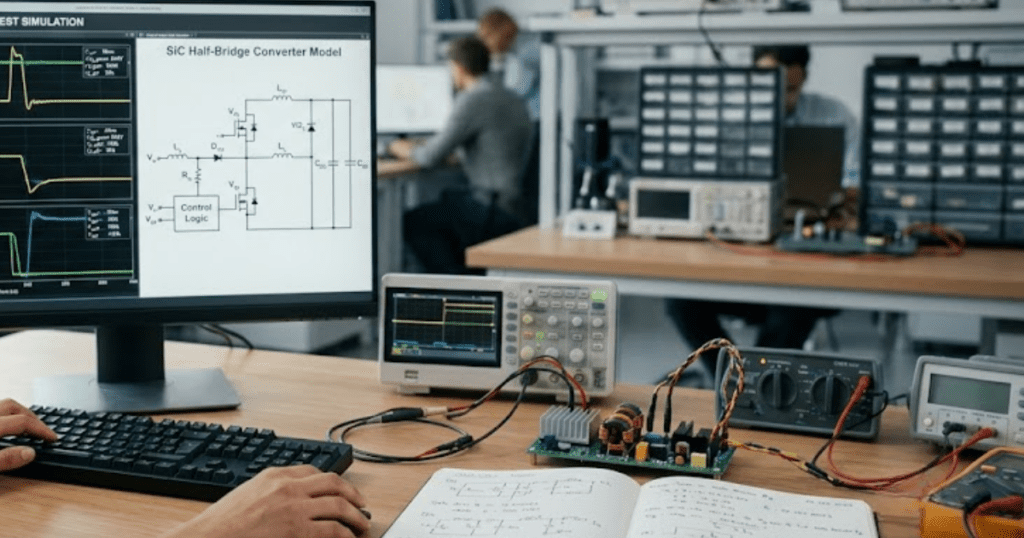
Initialization sets the starting electrical and control states, and that starting point will shape every transient that follows. You need software that can move from steady-state conditions into EMT states in a controlled way. If initialization is vague or poorly exposed, energization, fault, and reclosing results will be biased before the first switching event occurs.
Picture a feeder study with a transformer, shunt capacitor, and motor load. If controller integrators, machine flux states, or capacitor voltages start from inconsistent values, the first few cycles will include false offsets that look like physical stress. A transformer energization test can then report extra inrush or a misleading second harmonic content. You’re not studying the system anymore. You’re correcting startup errors.
Good software lets you inspect the transfer from load-flow style conditions into EMT states, including machine variables, control memories, and branch initial values. You should be able to tell where each initial condition came from and adjust it when the study calls for a different starting scenario. That kind of visibility matters in utility studies and classroom work alike because it teaches you which response belongs to the network and which response belongs to the setup.
|
Check |
What you should confirm before relying on results |
|---|---|
|
Solver visibility |
You can identify the numerical method, event handling, and tolerances that shape the waveform. |
|
Component openness |
You can inspect equations, limits, and internal states for the devices that matter in the study. |
|
Timestep control |
You can tighten the step and see stable peaks and event timing instead of large shifts. |
|
Initialization clarity |
You can trace every important starting value back to a known steady-state or user-defined condition. |
|
Data access |
You can probe internal states, export signals, and compare results without manual rework. |
|
Workflow fit |
You can keep model edits, parameter sweeps, and post-processing inside the same engineering process. |
Data access determines how engineers verify waveform anomalies
Data access decides how quickly you can explain a questionable waveform and correct the model behind it. You need more than plotted terminal voltages and currents. Useful power system analysis software for transients will expose internal states, switch commands, control outputs, and event times so you can trace cause and effect with confidence.
Take a relay pickup that appears 2 ms early. You need to compare the measured current, the filtered signal, the threshold logic, and the breaker command timing without exporting half the model into another tool. The same is true for a DC-link overvoltage, a crowbar trigger, or an arrester energy limit. When internal signals stay hidden, you spend hours recreating logic that the software already used.
Strong tools make verification easier through direct probing, consistent logging, and straightforward export into the analysis workflow you already use. You’ll also want units, sample timing, and signal names that remain clear after export, because ambiguous data is hard to audit later. Good access helps you catch sign errors, controller saturation, and unexpected state resets before they make it into reports. Poor access leaves you staring at a plot and guessing what happened between two visible points.
Workflow fit matters when studies move into MATLAB
Workflow fit matters because transient studies rarely end with one simulation run. You usually need parameter sweeps, controller edits, result comparison, and documented reruns. Software that fits your existing MATLAB process will save time and reduce transcription mistakes. Software that sits apart from that process turns every study into manual re-entry and weakens repeatability.
Consider a research team testing inverter fault response across a batch of cases. If model parameters, scripts, plots, and reports live in one place, the work stays traceable and easy to repeat. SPS SOFTWARE matters here because the models remain open and editable inside a MATLAB workflow instead of being sealed behind compiled blocks. That keeps the simulation step close to the code and data used for analysis.
The same fit helps in teaching labs and engineering groups. You can reuse scripts for batch runs, keep parameter sets under version control, and compare model revisions without copying values between disconnected tools. That doesn’t make the physics simpler, but it does remove avoidable friction. A transient tool earns a place in your stack when it helps you check assumptions, rerun cases cleanly, and keep results tied to the model that produced them.
A short benchmark model exposes weak transient tools
“A short benchmark model will tell you more about a transient tool than a long feature list will.”
You should test one compact case that includes switching, saturation, control action, and a measurable disturbance. If the software can explain that case clearly, it will usually scale to harder studies with fewer surprises. If it can’t, larger models will only hide the weakness.
- A source and line section that can show resonance and event timing clearly
- A transformer with visible saturation settings and controllable initial flux
- A switched capacitor or breaker event that produces a sharp transient
- A converter or controlled load with accessible internal states
- A small set of probes that track terminal quantities and hidden control signal
Run that model, tighten the timestep, adjust one component equation, and repeat the case from a different initial condition. You’ll see very quickly if the solver is stable, if the components are readable, and if the data access is good enough for serious work. That is the standard engineers should keep. SPS SOFTWARE fits that standard when you need transient studies built on open models you can inspect line by line inside MATLAB, because good EMT work depends on checking assumptions instead of trusting a closed result.