

Key Takeaways
- Black start studies have value only when the switching sequence is tested against weak island behaviour.
- Transformer inrush and motor pickup set the practical limits on early restoration steps.
- Operator playbooks should use transient pass criteria so field actions match studied system response.
Black start restoration works only when you test the transient steps as well as the steady path.
Restoration plans can look sound on a one-line diagram and still fail during the first few switching actions after a blackout. United States electricity customers were without power for an average of 5.5 hours in 2022 when major events were included, which shows why power system restoration has to be more than a checklist. A black start study has value only when it reflects how voltage, frequency, transformer flux, and motor pickup will behave on a weak island. You need a restoration path that remains stable when the first devices close and after the system settles.
Modern grids make that standard more important because restoration sources are often smaller relative to the network they must energize. Long lines, lightly loaded transformers, inverter controls, and cold load all press on the same limited voltage support margin. Safe sequencing comes from transient study work that checks each closure, each load block, and each control response in the order operators will actually use.
A black start study maps the restoration path after blackout
A black start study defines how generation, transmission, and load will be restored after a system collapse. It identifies the starting source, the order of switching, and the conditions that must be met before each step. You can treat it as an operating map that crews can follow during restoration.
A common case starts with a unit that can self-start, picks up its own auxiliaries, energizes a nearby bus, and then charges a transmission line toward the next source or substation. That sequence sounds simple until reactive charging raises voltage on the open end or a station service transformer pulls heavy inrush from a small island. The study has to show both the path and the electrical strength behind the path.
That detail matters because restoration crews don’t need a generic answer to what a black start study is. You need to know which source starts first, which line closes next, which load stays blocked, and what failure signs stop the sequence.
“Good studies answer those points in operating terms, so the plan will still hold when the system is weak and unsettled.”
Weak islands need strength checks before each energization
You energize a weak island safely only after checking source stiffness, reactive reserve, and control response at the next switching point. A bus that looks healthy at no load can collapse with one transformer or feeder closure. Each restoration step needs its own strength check.
Picture a single hydro unit holding a remote bus after a blackout. The voltage is acceptable with no load connected, yet the next action is a long line energization toward a substation with several unloaded transformers. That closure can push the island into overvoltage first and undervoltage seconds later when magnetizing current and control lag appear. Stable islands are judged by how much disturbance they can absorb while holding control through the event.
Source impedance, automatic voltage regulator limits, governor response, and local reactive devices all shape that margin. Short circuit level also matters because protection and control assumptions can break when fault current is low. A weak island isn’t unsafe because it is small. It becomes unsafe when the next energization is larger than the island’s ability to control voltage and frequency through the transient period.
Restoration sequencing should follow voltage support margins
Black start sequencing steps should be set by voltage support margin at each stage of restoration. The next action is the one the island can carry without losing control of voltage or frequency. Geographic order helps operations, but electrical margin must lead the sequence.
Consider a corridor with two substations and a pump load at the far end. Closing the far line first might restore more territory on paper, yet charging current can consume the margin needed to pick up the next transformer. A better sequence closes the shorter section, brings in local reactive support, and then moves outward once the island has a firmer voltage base. That approach often feels slower, but it prevents early rollback.
| Restoration checkpoint | What operators should confirm before the next step |
| Start with the black start source | The source can hold station service voltage and frequency without hunting or hitting reactive limits. |
| Charge the first transmission section | Line charging will not push the receiving bus beyond the acceptable voltage band. |
| Energize the first transformer | Magnetizing inrush will stay within the island strength and protection settings available at that moment. |
| Pick up the first load block | Motor starting current and cold load will not force a frequency dip that trips generation or protection. |
| Add the next source or tie point | Control modes, phase angle, and voltage targets are aligned before synchronizing the island. |
Power system restoration after blackout works best when the sequence reflects those checkpoints instead of a fixed route. Operators then know why a step is early, delayed, or blocked. That makes the plan usable under stress, because each action is tied to a measurable electrical condition rather than habit.
Transformer inrush defines early energization risk during restoration

Transformer inrush is one of the first large transient stresses in system restoration, and it will set the safe order of energization. The current spike depends on residual flux, source impedance, breaker timing, and transformer design. Weak islands feel that stress immediately through voltage dip and control interaction.
Take a substation transformer that sat de-energized through a prolonged outage. Residual core flux can add to the new applied flux and push the core deep into saturation on the first half cycle. The source then sees a current surge several times rated current while the bus voltage sags. Protection might restrain correctly, yet the generator voltage regulator and nearby motor controls can still react badly to the dip.
That is why modelling transformer inrush during restoration is more than a detail for specialists. If the study ignores residual flux and source weakness, the plan will overestimate how many transformers can be closed early. Practical sequencing often spaces transformer energizations, changes which side is energized first, or waits until a second source is online before closing a large bank.
Motor pickup shapes how quickly load can return
Motor pickup sets the pace of load restoration because starting current and torque recovery pull directly on island frequency and voltage. A feeder that looks modest in megawatts can still be a poor first choice if it contains many large motors. Load size alone won’t tell you that risk.
A water treatment plant is a good example. Several pumps can attempt near-simultaneous restart when the feeder returns, even if operators intend a staged process. The island then sees a steep current rise, a frequency dip, and slower motor acceleration that extends the stress. Voltage-sensitive contactors on smaller loads might drop out and reclose, which stretches the disturbance beyond the initial pickup.
You get a better answer when the study groups load by motor content, restart logic, and feeder location. Some blocks should return only after a second source is synchronized or after local capacitor banks are available. Cold load pickup matters too, but motor behaviour usually decides the first few restoration successes or failures because it hits both frequency and voltage at once.
System restoration simulation must capture each switching transient
System restoration simulation has to reproduce the switching events that operators will execute, step by step and in time order. Steady studies are useful for the broad path, yet they won’t show transformer saturation, control lag, or motor acceleration. Restoration risk lives in those transients.
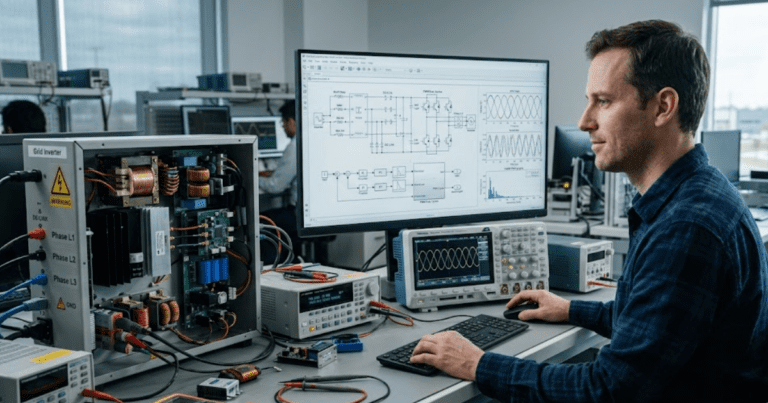
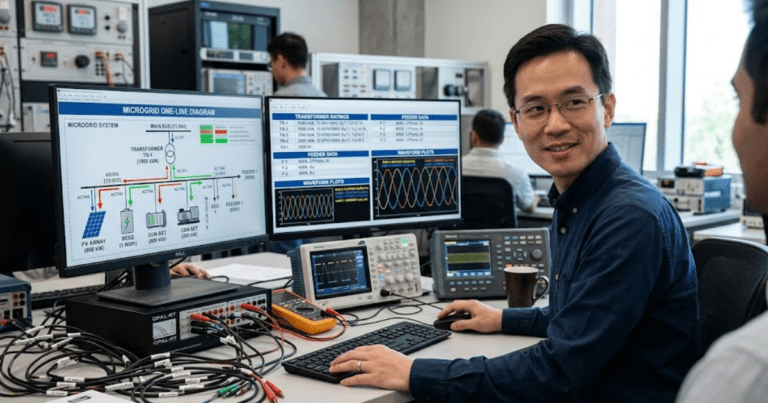
That means you need models for breaker actions, source controls, transformer magnetizing behaviour, feeder composition, and protection logic that can affect the sequence. A useful study closes one line, lets the waveforms settle, then closes the next device under the new conditions. When teams use SPS SOFTWARE for this work, the value comes from seeing how each physical model responds before the next action is approved.
That level of simulation also sharpens operator judgement. If a bus survives only when a tap changer is blocked, or when a motor block is delayed, the playbook can say so clearly. You aren’t asking the plan to guess the system state. You’re asking it to reproduce the sequence closely enough that the field steps match the studied electrical response.
Modern grids require restoration plans that include inverter controls
Modern restoration plans must account for inverter controls because many restored islands now include battery and renewable sources with current limits and different voltage control behaviour. Conventional assumptions about spinning machines won’t carry over cleanly. Control mode selection will shape which restoration steps are safe.
Renewables supplied about 30% of global electricity in 2023, which shows how often restoration studies will face inverter-based resources rather than only synchronous units. A battery unit set to support voltage can hold a bus well during light charging, then hit a current limit when a transformer closes and lose voltage control abruptly. Another unit following grid angle might perform well only after a stronger source has already established the island.
You need those control assumptions written into the restoration sequence, not left as generic resource labels. Grid-forming settings, reactive priority, protection thresholds, and recovery logic should all be tested against the exact switching order.
“Modern black start planning is no longer just about which source exists. It is about which control behaviour exists at each stage of the rebuild.”
Operator playbooks need pass criteria from transient studies
Operator playbooks should convert each studied restoration step into a clear go or hold test. Pass criteria make the sequence usable under pressure because crews can judge voltage, frequency, and control response against pre-set limits. Restoration works best when every major closure has an electrical acceptance check.
A useful playbook will state the few checks that matter most before the next action:
- Bus voltage remains inside the studied band after the previous step settles.
- Frequency recovers to the studied target without sustained oscillation.
- Reactive reserve remains available at the active source.
- Protection and control blocks required for the step are confirmed.
- The next transformer or load block matches the studied switching order.
Those criteria turn a restoration study into a disciplined operating tool. They also show why plans built on steady assumptions break once inrush and motor pickup strike a weak island. SPS SOFTWARE fits this stage well because the transient study results can be traced back to specific switching actions and model assumptions, which gives operators firmer ground for each closure and each hold point.