Analyzing ferroresonance in transformers and distribution networks explains switching triggers, overvoltage mechanisms, simulation setup, grounding effects, and prevention steps.



Analyzing ferroresonance in transformers and distribution networks explains switching triggers, overvoltage mechanisms, simulation setup, grounding effects, and prevention steps.

This piece explains how to model surge arrester behaviour, simulate lightning and switching transients, and verify protection coverage and energy duty across a substation.

This guide explains how to model an EV powertrain with clear system boundaries, suitable component fidelity, loss breakdown, regenerative braking limits, and software fit.

This guide explains how simulation engineers can choose model fidelity, set motor drive parameters, compare machine types, validate results, and judge software transparency for electric motor simulation.

A practical guide to battery management system modelling for lithium ion packs in electric vehicles and grid storage, with attention to plant models, estimators, protection timing, and thermal limits.

Accurate short circuit analysis keeps relay settings credible and equipment duties honest.
Protection work goes wrong when engineers treat fault analysis in power systems as a one-step calculation instead of a checked chain of assumptions. U.S. electricity customers were without power for an average of 5.5 hours in 2022, which shows how much system performance matters when a fault is cleared poorly or studied badly. You need a method that fits the duty under review, the network detail you trust, and the relay function you’re checking. Short circuit analysis in power systems works best when you start with the protection question, then pick the simplest method that still captures the fault behaviour that matters.

The right short-circuit method depends on what the study must prove. A breaker duty check needs maximum available current. A relay sensitivity check needs the weakest fault that still must trip. Scope comes first because one network can require different assumptions for each task.
A plant expansion shows the difference quickly. A new 15 kV motor bus can need one study for switchgear interrupting duty, another for feeder ground relay pickup, and a third for incident energy. You can’t use the same fault set for all three jobs and expect useful answers. The method is only right when its assumptions line up with the setting or rating you have to approve, so the first step in fault analysis is always defining the protection decision that rests on the result.
“Scope comes first because one network can require different assumptions for each task.”
Network reduction still has value because it gives you a fast truth check. A Thevenin equivalent at the fault point shows source strength. It also shows X/R ratio and likely fault level. You don’t need the full model to test first assumptions.
A feeder relay review often starts with the utility source, one transformer, one cable run, and the equivalent motor contribution behind the bus. That stripped network will tell you if expected fault current is closer to 2 kA or 20 kA, and that gap matters before you trust any detailed case file. A reduced model also shows when a result doesn’t make physical sense. Once the order of magnitude looks right, you can move to fuller models for protection coordination and equipment checks with much more confidence.
Three-phase faults matter because they usually produce the highest current. They set the largest mechanical stress on equipment. They also set the main thermal limit for interruption. That makes them the standard starting point for breaker duty and bus checks.
A 27.6 kV industrial substation makes the point clearly. A fault placed at the main bus can show the strongest symmetrical current the source and motors can supply, while a ground fault on a remote feeder will often be much lower. The larger case governs breaker interrupting rating and bus bracing. Symmetrical fault analysis is simple compared with asymmetrical studies, yet it answers the first hardware question protection engineers face: can the equipment interrupt the strongest fault the system will deliver?
| When you need this answer | Start with this method |
|---|---|
| A switchgear duty review needs the highest current a bus can see. | A balanced three phase bus fault gives the first current limit for interrupting checks. |
| A ground relay pickup review needs the weakest fault that still must trip. | A single line to ground study with sequence networks shows the zero sequence path that controls sensitivity. |
| A distance relay reach review needs apparent impedance along one protected line. | Fault cases placed at several points on that line show how source split alters the relay view. |
| A coordination review needs current over a practical range of source conditions. | RMS fault studies at minimum and maximum source strength show timing margins that survive operating changes. |
| A feeder with several converters needs current shape and control response. | An EMT model shows current limiting and first cycle effects that RMS tools smooth out. |
Sequence networks remain the clearest way to study unbalanced faults. They separate positive, negative, and zero sequence paths. That split shows why ground fault current rises or collapses for the case under study. Asymmetrical fault analysis becomes useful only when those paths are modelled correctly.
A grounded wye to delta transformer between a utility source and a plant feeder makes this visible. A single line to ground fault on the delta side won’t pass zero sequence current back to the source the same way a grounded wye to grounded wye bank will. Negative sequence current still matters for machine heating and phase unbalance, but zero sequence current will decide how ground elements behave. Engineers who skip sequence networks often end up with ground relays that look generous on paper and blind on the actual feeder.
Bad data will distort fault results more than the difference between sound methods. Wrong transformer impedance shifts calculated current. Missing motor contribution can change minimum fault values. Protection settings sit on small margins, so data quality has to come first.
Protection system misoperations were reported at a 6.5% rate on the bulk power system in 2023, which is a reminder that settings and models still fail under routine operation. A common plant study error comes from using transformer nameplate impedance on the wrong MVA base, which distorts both maximum and minimum fault levels. Another comes from leaving out local motor contribution after a site expansion. Those errors deserve attention before you refine relay curves.
RMS tools are best for steady fault levels and most coordination work. EMT tools are better when wave shape and control action matter. The time scale of the protection question should pick the method. That keeps the model focused and the result usable.
A feeder with several converters shows the split clearly. An RMS study can estimate current magnitude seen by time overcurrent elements across many contingencies, which keeps coordination work efficient. An EMT study becomes important when inverter current limiting, control delays, or current reversal can affect protection logic during the first cycle. SPS SOFTWARE is useful in that stage because transparent models let you inspect the assumptions behind source impedance, converter limits, and relay inputs instead of treating the result as a sealed output. You’ll get better answers when you reserve EMT detail for cases where transient behaviour actually changes the protection outcome.
Protection checks work best when fault cases follow protection zones. Each zone needs internal and external faults. Each zone also needs strong and weak source conditions. That structure ties short circuit analysis directly to what the relay has to judge.
A distance relay on a transmission line needs faults placed at several points on the protected line, with source strength varied at each end. A feeder overcurrent element needs near faults for speed and remote faults for sensitivity. Differential protection needs internal faults plus through faults that stress restraint and current transformer performance. When you organize cases by zone, gaps show up quickly, and you won’t mistake a complete bus fault report for a complete protection study.
“Matching study results to field evidence turns fault analysis into dependable protection practice.”

Settings become credible only when calculated faults agree with plant evidence over time. Relay event files should support the study. Commissioning tests should support it too. Matching study results to field evidence turns fault analysis into dependable protection practice.
A mismatch always means something needs attention. It’s often a grounding connection modelled incorrectly, a motor block omitted from the study, or a relay using different current transformer ratios than the file says. Engineers who keep closing that loop build settings that stay stable through outages, expansions, and audits. SPS SOFTWARE fits that discipline well because transparent models make it easier to trace a result back to the parameter or assumption that created it. Credible protection work comes from checked models, checked data, and checked results, repeated until the network and the relay tell the same story.
Pick your simulation tool by matching study goals to model fidelity, solver behaviour, and workflow fit.
“Tool selection goes wrong when you start with a feature checklist instead of the question you need answered, the time scales you must resolve, and the outputs you must trust.”
Teaching needs transparency so students can see why waveforms change, not just that they change. Engineering needs repeatable results that stay stable across parameter sweeps, model updates, and handoffs. A Nature survey reported 70% of researchers tried and failed to reproduce another scientist’s experiments, which is a reminder that repeatability is a technical requirement, not a nice-to-have.
A useful electrical simulation tools comparison treats accuracy, usability, and governance as a single package. You’re choosing assumptions, numerical methods, and model transparency, not just a user interface. You also need a plan for adoption in a teaching lab or an engineering team, since licensing, version control, and model review habits will shape results over time. The best power system simulation software is the one that makes your modelling assumptions visible and controllable, so you can explain results and defend them.
Your first evaluation step is writing down the study question, the events you must represent, and the outputs you will judge as correct. Fidelity is not “high” or “low”; it is a match between time scale and physics. If you cannot state what must be captured, you will overbuild models or miss key behaviours.
Start with three decisions you can document in a few lines: what phenomena matter, what you will ignore, and what error you can accept. Teaching and engineering differ most in what “good” means. A teaching lab often prioritizes clarity, inspectable component equations, and fast setup so students spend time learning, not wrestling with tool friction. Engineering work prioritizes traceability, model review, and stable runs across many cases, because a single unstable run can invalidate a whole set of conclusions.
A concrete way to lock this down is to define a “reference run” and a “stress run” before you install anything. A protection course might set a reference run as a 12.47 kV feeder fault with a grid-following inverter and a simple relay logic check, then use a stress run that tweaks fault resistance and inverter current limits to see if the results stay consistent. Once those two runs are written, every tool trial becomes measurable rather than impression-based.
The main difference between EMT and RMS simulation is what the solver treats as an electrical state versus an averaged approximation. EMT modelling resolves fast electromagnetic transients and switching effects with small time steps. RMS modelling focuses on slower electromechanical dynamics and phasor quantities, so it runs longer time horizons with less computational load.
EMT is the right lens when your question depends on waveform shape, fast controls, converter switching behaviour, protection interactions tied to instantaneous values, or harmonics. RMS is the right lens when your question depends on longer-duration voltage and frequency behaviour, stability margins, or operating-point changes where waveform detail does not change the answer. Neither approach is “better” in general, and both can produce misleading confidence if used outside their valid assumptions.
During tool evaluation, look past marketing terms and ask what the platform actually solves, how it initializes states, and what it assumes about network frequency and balance. A tool can offer both approaches, but you still need to check how models transition between time scales and what signals are available for verification. A practical selection habit is to decide EMT or RMS first, then shortlist tools that do that job cleanly, because forcing a tool into the wrong study type is a common source of wasted modelling time.

Library coverage matters when it reduces custom modelling effort without hiding physics behind locked blocks. You want component models that match your study goals, expose parameters that affect behaviour, and provide enough documentation to review equations and assumptions. Library breadth also matters only if the models are consistent and easy to audit.
Converter-heavy grids raise the stakes for this check. A global electricity review reported renewables produced 30% of global electricity in 2023, which means many studies now depend on inverter controls, limits, and protection coordination rather than only synchronous machine dynamics. If the library models hide current limiting, phase-locked loop behaviour, or control saturation, you will get clean-looking plots that do not match field behaviour.
For teaching, model transparency is part of the curriculum. Students learn faster when they can inspect a control loop, change a filter value, and connect that change to waveform effects without guessing what a block does. For engineering, transparency supports peer review and reduces handoff risk between teams. You should also check how protection and control logic is represented, since the tool’s modelling style will shape how you validate timing, thresholds, and state transitions.
“Solver quality shows up as stable runs, clear diagnostics, and repeatable results across small parameter changes.”
You should be able to control time step or tolerances, understand convergence limits, and reproduce a run from saved settings and model versions. If the platform cannot explain why a run failed, you will spend more time debugging than studying.
Numerical stability is not only a “solver problem”; it is a modelling discipline problem you need tool support for. Stiff networks, tight control loops, discontinuities, and ideal switches all push solvers into edge cases. Good platforms help you manage this with clear event handling, sensible defaults you can override, and warnings that point to the underlying cause. Reproducibility also includes governance basics: storing solver settings with the model, tracking library versions, and keeping run metadata so two engineers can confirm they ran the same case.
| What you test during a trial | What good behaviour looks like | What breaks if you skip it |
| You run the same case twice with identical settings. | The results match within a stated tolerance and the tool records key settings. | You cannot tell tool variance from system behaviour changes. |
| You vary time step or tolerances across a small range. | Trends stay consistent and any differences are explainable and bounded. | Plots look plausible but depend on numerical artefacts. |
| You test initialization from a steady operating point. | Start-up transients are controlled and initial conditions are inspectable. | Early transient behaviour contaminates protection and control results. |
| You force a hard event like a fault or breaker action. | The solver reports events clearly and recovers without silent instability. | Hidden discontinuities create non-physical oscillations or solver failure. |
| You inspect diagnostics after a failed or slow run. | Error messages point to elements, time ranges, or limits you can adjust. | Debug time grows and model trust drops across the team. |

Workflow fit is the difference between a tool that gets used and a tool that sits idle after procurement. You should check how the platform exchanges data with MATLAB and Simulink, how it supports parameter sweeps, and how it packages models for sharing. Lab deployment also needs predictable installs, licensing clarity, and version consistency across machines.
Integration checks should focus on what you will actually do day to day: import and export of parameters, scripted runs, and clean interfaces for controls work that lives outside the power network model. Collaboration checks should focus on model review and change tracking, since simulation credibility depends on being able to explain what changed and why results moved. Teaching labs add another constraint: students need to get running quickly with minimal configuration drift between workstations, or the course becomes an IT exercise.
SPS SOFTWARE is often evaluated in this step because teams want open, editable component models paired with a workflow that fits MATLAB and Simulink based control design. That practical combination matters when you need both transparency for learning and consistent execution for engineering studies. Tool trials should include a short “handoff test” where one person creates a case and another person reruns it from scratch using only the shared package, since that exposes hidden dependencies early.
A scoring rubric turns tool selection into a repeatable choice you can defend to a lab director or engineering manager. Start with a few non-negotiables tied to your study goals, then score the rest with weights that reflect how often you will use each capability. A good rubric also forces you to document tradeoffs instead of debating preferences.
Keep the rubric short enough that you will actually use it after the first meeting. These five categories cover most selection work without losing technical detail:
Judgment comes from how the scores behave under pressure, not from a perfect spreadsheet. If a tool wins only when you give it generous weights on minor features, it will fail you later when schedules tighten and you need dependable runs. When you apply this rubric consistently, SPS SOFTWARE tends to show its value where transparent modelling and reproducible execution matter most, which is the part of tool choice that determines long-term trust in results. The goal is not a tool with the longest feature list; it is a tool you can explain, rerun, and defend.
EMT simulation tells you what your system does between cycles.
A single cloud-to-ground lightning discharge can reach about 30,000 A, and that kind of impulse is measured in microseconds, not seconds. RMS studies can still be correct for many planning questions, but they will hide the stress that fast events place on insulation, breakers, converters, and protection logic. EMT gives you the instant-by-instant voltages and currents you need when “how high” and “how fast” matters.
The practical stance is simple: treat EMT as a precision instrument, not the default. You’ll get better outcomes when you pick EMT for questions that truly depend on waveform detail, and keep RMS modelling for questions that depend on slower phasor behaviour. That selection step is not academic, since model detail and simulation time rise quickly once you move into microsecond steps. Clear intent up front keeps EMT studies focused, credible, and easier to defend with technical leaders.
“Engineers reach for electromagnetic transient simulation when peaks, wave shape, and timing will set design limits.”
EMT simulation is a time-domain method that solves instantaneous voltages and currents in an electrical network at small time steps. It keeps the full waveform instead of compressing it into a single RMS magnitude and phase. That lets you represent switching, saturation, arcing, and control actions as they occur. You use it when those details control equipment stress or system response.
Outputs typically look like sampled waveforms for each phase and conductor, so you can see steep dv/dt, high di/dt, and the exact moment a device changes state. Nonlinear elements such as transformers, surge arresters, and power electronic switches can be modelled with their physical equations instead of simplified steady-state equivalents. EMT also lets you capture unbalanced and zero-sequence effects without leaning on assumptions about sinusoidal behaviour. The trade is that you must manage many more state variables and much smaller numerical steps.
EMT problems are usually defined by “fast” physics. Travelling waves on lines, capacitor and reactor switching, converter gating, and fault inception angle all produce behaviour that does not average out cleanly over a cycle. That matters because protection and insulation coordination are often set by peaks, not averages. A good EMT study starts from an acceptance criterion, such as maximum overvoltage at a terminal or maximum current through a device. Once you name the limit you care about, the needed model detail becomes easier to justify.
EMT is required when the decision you need to make depends on waveform shape, sub-cycle timing, or nonlinear switching behaviour. RMS modelling is enough when the question depends on slower electromechanical dynamics and balanced, near-sinusoidal assumptions hold. EMT also becomes the safer choice when protection logic depends on high-frequency content or DC offset. The goal is not to run EMT everywhere, but to use it where RMS will give you false confidence.
Power systems now include many more inverter-connected devices at the distribution and transmission edge, and those devices bring fast controls and switching artefacts into system studies. Solar accounted for 53% of new U.S. utility-scale generating capacity added in 2023, and a large share of that capacity connects through inverters that behave very differently from synchronous machines during transients. A disciplined workflow uses RMS studies to screen cases and narrow the study set, then uses EMT to verify the short list where waveform detail will change the engineering call. That sequencing also keeps compute and model QA effort in check.
The main difference between EMT and RMS modelling is what gets preserved from the waveform. RMS studies solve phasors that represent a sinusoid over a cycle, so fast changes are averaged out. EMT solves instantaneous values, so switching, harmonics, and nonlinearities appear directly in the results. That makes EMT better for transient stress questions, while RMS stays efficient for slower system-level dynamics.
| Study checkpoint | RMS phasor modelling | EMT time-domain modelling |
| What the state variables represent | Voltages and currents are represented as magnitudes and angles of sinusoids. | Voltages and currents are represented as instantaneous waveforms over time. |
| What time resolution means for results | Changes within a cycle are smoothed, so peaks and steep edges are lost. | Sub-cycle timing is explicit, so peaks and steep edges are visible. |
| How nonlinear device behaviour shows up | Nonlinearities are often linearized or represented with simplified equivalents. | Nonlinearities can be modelled directly, so saturation and clamping are captured. |
| How switching events are handled | Switching is often approximated as a change between steady states. | Switching is modelled at the instant it occurs, including transient ringing. |
| What questions the model answers best | Voltage stability, power flow sensitivity, and slower dynamics are answered efficiently. | Insulation stress, resonance risk, and protection response to fast events are answered directly. |
RMS modelling can still include fault currents, relay elements, and control blocks, but it will always assume a smooth sinusoidal backbone for the electrical quantities. EMT breaks that assumption and forces you to pay attention to stray RLC, line representation, and converter switching detail. That extra effort is justified only when the decision hinges on what happens within a few milliseconds or less. Teams get the best value when they treat RMS and EMT as complementary, not competing, study types. Matching the method to the question keeps your results defensible.
“Careful execution will always matter more than the most sophisticated network you can draw.”

EMT captures transients where the waveform is distorted, asymmetric, or rich in high-frequency content. That includes capacitor bank energization, transformer inrush, fault inception with DC offset, and resonance triggered by switching. It also covers the interaction between converter controls and network impedance at frequencies far above the fundamental. RMS studies will often show the right trend but miss the peak stress and timing that sets equipment limits.
Waveform detail matters because many limits are instantaneous. Surge arresters clamp based on voltage, not RMS, and insulation coordination is based on peak overvoltage and front time. Protection elements that depend on high-frequency components, such as travelling-wave concepts or fast directional logic, also depend on signals that RMS models do not preserve. Converter current limiters and phase-locked loops respond to sub-cycle distortion, which can shift the system response even when RMS voltage looks acceptable. EMT gives you those signals directly, which removes guesswork when you’re validating a protection or equipment limit.
Scope control is still important. Not every harmonic or oscillation matters, and not every part of the network must be modelled at full detail to answer a focused question. The practical approach is to tie each transient type to one measurable outcome, such as arrester energy, breaker TRV stress, or relay pickup time. That keeps interpretation anchored in engineering criteria, not pretty waveforms. When the outcome is clear, you can trim the network to what materially shapes that outcome. EMT then becomes a tool for engineering judgement, not an exercise in complexity.
Time step selection in EMT must be tied to the fastest phenomenon you need to resolve, not the nominal system frequency. Network detail must also match the transient type, since line modelling and stray capacitance can dominate high-frequency behaviour. Solver settings then become a stability and accuracy choice, especially when stiff nonlinearities are present. You will get credible results only when these three choices are consistent with each other.
Time steps that are too large will damp peaks and can shift the frequency of resonances, which looks like “better” behaviour while being numerically wrong. Excessively small time steps can also be a problem, since they can amplify noise and make parameter errors harder to spot. Line representation is a common inflection point: lumped models can be fine for some low-frequency events, while distributed or frequency-dependent models are needed when travelling waves or steep fronts matter. A practical check is to run a short sensitivity sweep on time step and key parasitics and confirm the result converges toward a stable waveform shape.
Model transparency helps when you’re tuning these choices. SPS SOFTWARE is often used in teaching and engineering teams because component equations and parameters are open to inspection, which makes it easier to see what each modelling assumption is doing to your results. That matters when a result changes after you refine a line model or adjust a switch representation, since you can trace the change back to model physics instead of treating it as a tool quirk. Solver choices still require judgement, especially for power electronics with discontinuous switching. Consistency checks, convergence testing, and parameter audits will do more for credibility than any single “recommended” setting.
A typical EMT workflow starts with a single question tied to a limit, then builds only the model detail needed to answer it. You’ll define the switching or fault event, set initial conditions, and choose monitoring points that map to the limit. Then you’ll run a baseline, refine time step and network detail until results converge, and only then run variations. The workflow is repeatable when every run is linked to a named acceptance criterion.
A common transient study starts when a utility needs to energize a long distribution feeder with a large capacitor bank and an inverter-based plant connected near the end of the line. The EMT model is set up to close a breaker at controlled points on the voltage wave, then record the peak phase-to-ground voltage at the plant terminals and the current through the capacitor switch. A small set of runs varies breaker closing angle and source strength, since those two inputs drive the worst peaks. Results are accepted only when overvoltage stays under the equipment’s specified withstand and the switch current stays under its rating.
Post-processing is where the study becomes usable. Peaks should be captured with adequate sampling, and plots should be paired with numeric extraction so that teams can compare cases quickly. Initial-condition handling deserves special care, since pre-charge on capacitors or remanent flux in transformers can shift peaks more than a small parameter tweak. Model version control also matters, because the hardest EMT questions usually require iterative refinement across weeks, not a single run. A workflow that records assumptions will save you time when stakeholders ask why a specific case was selected.

Most EMT errors come from mismatched intent, detail, and validation. Models fail when key parasitics are missing, when nonlinear device limits are oversimplified, or when initial conditions are not physically consistent. Time step and solver choices can also create numerical damping that hides the very stress you’re trying to measure. Credible findings come from a small set of disciplined checks, repeated every time the model changes.
Start with a sanity pass on steady-state values before applying any transient event, since an incorrect operating point can poison everything downstream. Confirm that energy storage elements have realistic values, and check that their initial voltages and currents match the pre-event conditions you intended. Run a convergence check on time step, and verify that peak values and ringing frequency do not shift materially as you refine resolution. Then challenge the result by removing one modelling refinement at a time and confirming you understand why the waveform changes.
Good EMT practice also includes a clear stopping rule. When the answer you need is “peak overvoltage at this terminal,” additional model detail that does not move that peak is extra complexity with little value. Teams that build that discipline end up with EMT models that stay usable across multiple studies, because the model is structured around limits and checks, not around maximum detail. SPS SOFTWARE fits well into that mindset because its open modelling style supports inspection and peer review, which is what keeps transient studies defensible over time. Careful execution will always matter more than the most sophisticated network you can draw.
Students learn faster when they must predict, test, and explain results, not just watch a lecture or copy a schematic. A large meta-analysis of 225 STEM studies found active learning raised exam scores by about 6% and cut failure rates by 55%. Simulation fits that pattern when you use it as a structured lab, with checks, limits, and clear reporting. Used as a black box, it does the opposite and trains students to trust plots they cannot defend.
The most effective simulation teaching uses disciplined, physics-based models plus validation habits that students repeat until they become automatic. You’re not trying to replace hardware labs or textbook math. You’re building the missing bridge between them, so learners can reason from assumptions to waveforms, and from waveforms back to engineering choices with confidence.
“Simulation models help students link equations to power system behaviour they can test safely.”
Simulation models teach cause and effect across an electrical network, not just component equations in isolation. Students learn how voltage, current, and power move through a system after a change such as a fault, a switching event, or a control action. The lesson is always conditional on assumptions, so modelling becomes a way to think clearly about limits.
Start by naming the learning target in plain language, then map it to what students must observe. If the target is “fault current depends on network impedance,” the observation is a current waveform and an impedance path, not a completed diagram. If the target is “protection needs selectivity,” the observation is timing and coordination, not a pass or fail result. That framing keeps simulation from becoming a button-click exercise.
Simulation also teaches students what not to assume. Ideal sources, perfect measurements, and lossless components produce clean plots that look correct but teach the wrong instincts. Good course design forces students to track parameter choices, initial conditions, and solver settings, then explain how those choices shape behaviour. That habit pays off later when they face messy field data and conflicting requirements.
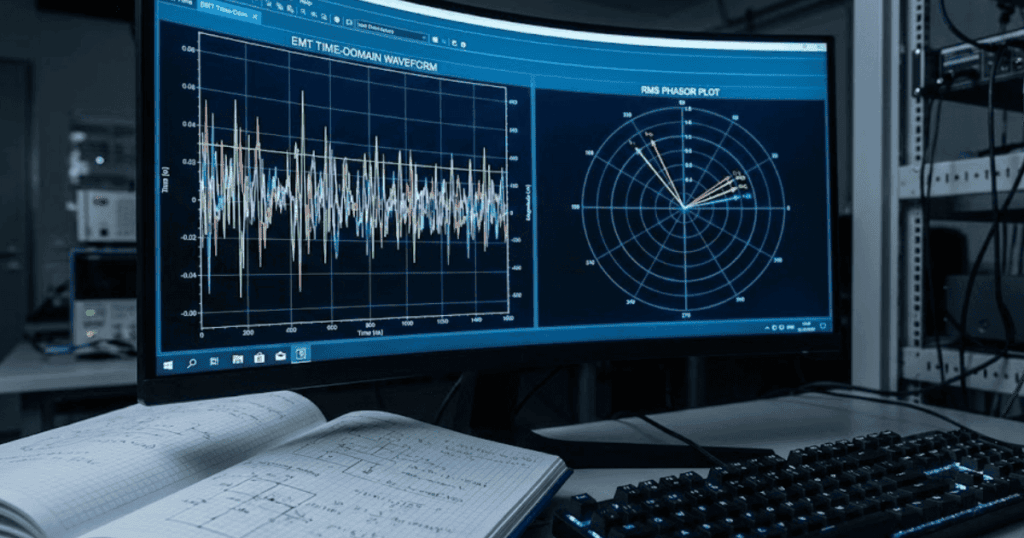
The main difference between EMT and RMS simulation is the time detail each one keeps, and that detail decides what you can teach. EMT resolves fast electromagnetic transients and switching effects, so it suits converters, harmonics, and protection waveforms. RMS smooths fast dynamics into phasors, so it suits load flow, voltage control, and stability studies across longer time windows.
Use RMS when the lesson is system-level relationships and you need fast runs for many cases, such as parameter sweeps or contingency studies. Use EMT when the lesson depends on waveform shape, switching instants, or control interactions that vanish in a phasor model. Power systems curricula now must treat power electronics as normal grid equipment, not a special topic, since wind and solar produced 13% of global electricity in 2023. That share shows up in control behaviour and fault response, which pushes many teaching labs toward EMT at least some of the time.
Match fidelity to the question you’re asking, then make that match visible to students. When learners can say “RMS hides switching ripple, so I should not interpret this as a harmonic result,” they’ve learned something that transfers. When they cannot, they will misread a plot with total confidence, which is the failure mode to design against.
| What you want students to understand | Model detail that usually fits the task |
| How voltage setpoints and reactive power targets affect a feeder | RMS studies with steady-state or slow control dynamics keep runs fast |
| Why a converter trips during a disturbance despite “normal” power flow | EMT waveform detail captures current limits, control saturation, and switching effects |
| How protection coordination depends on timing and measurement filtering | EMT supports relay inputs and transient behaviour that phasors can hide |
| How operating points shift across many contingencies | RMS lets you run many cases and compare patterns without long runtimes |
| What modelling assumptions change the answer the most | Either approach works if students must justify assumptions and validate outputs |
Simulation labs work best when each lab adds one new modelling skill while keeping the rest familiar. Students need repetition in setup, checking, and reporting, then a controlled increase in complexity. That pacing reduces copy-and-paste work and makes it clear what concept is being tested. The goal is steady competence, not a single impressive capstone run.
Structure each lab around the same workflow so students build habits, then swap the technical content. A simple template keeps attention on the engineering rather than on interface details. A staged plan also makes grading more consistent because artefacts look similar across groups. Use a single lab handout format that always asks for the same five deliverables.
Staging also protects learning time. Early labs should run quickly and fail predictably when something is wrong, so students can debug with logic rather than guesswork. Later labs can add larger networks, more controls, and more edge cases once students can explain why the earlier models behaved the way they did.
“The most important judgement is simple: simulation is a teaching lab only when students can explain why the model behaves as it does, and when they can show basic evidence that it is not lying.”
Students learn modelling when they can see what a component assumes, and they can change parameters without breaking the system. Physics-based components, with transparent equations and clear parameter meaning, turn a simulation into a teachable object. The model becomes a set of claims that students can test, not a sealed artefact that produces plots.
Start with parameter sets that map directly to course concepts, such as R, L, C values, transformer percent impedance, or controller gains with units. Keep names consistent across labs, and require students to state where each value came from, even if it is provided. Ask learners to identify one parameter that affects magnitude, one that affects timing, and one that affects stability, then confirm each with a sensitivity run. That keeps attention on physical meaning instead of on interface clicks.
SPS SOFTWARE supports this style of teaching through open, editable component models and workflows that can align with MATLAB/Simulink model-based design. That matters most when you want students to inspect internals, change assumptions, and defend results line by line. Tool choice still matters less than transparency and discipline, so insist on models your students can read and reason about.
Fault and switching studies teach system behaviour because they expose network limits quickly and visibly. Students see how impedance paths set current, how voltage sags propagate, and how protection and controls interact. These studies also force attention to initial conditions and timing, which are the first places where modelling errors show up. Done well, they convert “rules of thumb” into observable cause and effect.
A concrete lab can use a simple medium-voltage feeder with a source, a transformer, a line, a load, and one breaker. Set an initial steady operating point, apply a single line-to-ground fault at the far end, then clear it with a breaker trip after a set delay. Students compare bus voltages, fault current peak, and energy in inductive elements before and after clearing, then repeat with a different fault resistance and a different trip delay. That single scenario teaches network impedance, protection timing, and transient recovery in one controlled setup.
Keep the teaching focus on interpretation, not on the drama of the waveform. Require students to identify which elements carried the fault current and which ones limited it, using the network diagram and parameter values. Require a short explanation of what would change if the network were weaker or if the load were more inductive, without adding new cases. That approach teaches reasoning, and it keeps the lab within a manageable scope.

Assessment should reward correct reasoning and validation, not just a working simulation file. A strong rubric checks if students can confirm units, sanity-check magnitudes, and explain discrepancies between expected and simulated results. That pushes learners to treat simulation outputs as hypotheses that need testing. It also reduces grading noise, since you can score the logic even when minor setup differences exist.
Validation is easiest to teach as a small set of repeatable checks. Require one check before running dynamics, such as confirming power balance at the operating point or matching a hand-calculated short-circuit estimate within a defined tolerance. Require one check after the run, such as verifying that the breaker operation produces the expected current interruption pattern and that the model returns to a plausible steady state. Make students write each check as a statement they could apply again, not as a one-off calculation.
Reporting rubrics should also enforce traceability. Students should record solver settings, timestep choices, and key model assumptions in plain language. Marks should go to clear plots with labelled axes, a short explanation of why the plot answers the original system question, and a note about one limitation of the model. That combination builds engineers who can defend results under review, not students who can only reproduce a screenshot.
Misleading simulation results usually come from hidden assumptions, weak validation, and overconfident interpretation. Students will trust a clean waveform even when the model is wrong, so teaching must put friction on that impulse. The fix is procedural: force explicit assumptions, demand basic checks, and grade explanations as hard as plots. Over time, that discipline becomes part of how students think.
Watch for a few predictable failure modes. Ideal sources and missing losses can produce unrealistically stiff behaviour, so require students to justify source impedance and load models. Poor initial conditions can fake a transient that looks like a fault response, so require an operating point check before any event. Solver settings can hide oscillations or create false ones, so require students to state timestep and tolerance choices and to rerun one case with tighter settings as a confidence check.
The most important judgement is simple: simulation is a teaching lab only when students can explain why the model behaves as it does, and when they can show basic evidence that it is not lying. SPS SOFTWARE fits that mindset when you use its transparent models to keep assumptions visible and debuggable, but the habit matters more than the platform. Keep simulation disciplined, and you’ll graduate engineers who trust results for the right reasons.